Session 1
Obadiah — The Shortest Voice, The Loudest Warning
Opening Prayer
LEADER: Let us begin by asking the Holy Spirit to be with us tonight.
ALL: Come, Holy Spirit, fill the hearts of your faithful and kindle in us the fire of your love. Send forth your Spirit and we shall be created, and you shall renew the face of the earth. O God, who by the light of the Holy Spirit did instruct the hearts of the faithful, grant that by the same Holy Spirit we may be truly wise and ever rejoice in His consolation, through Christ our Lord. Amen.
LEADER: We open with a verse from the only book in the Bible that never once appears in the Catholic Mass — a short, fierce word from a prophet whose name means "servant of the Lord."
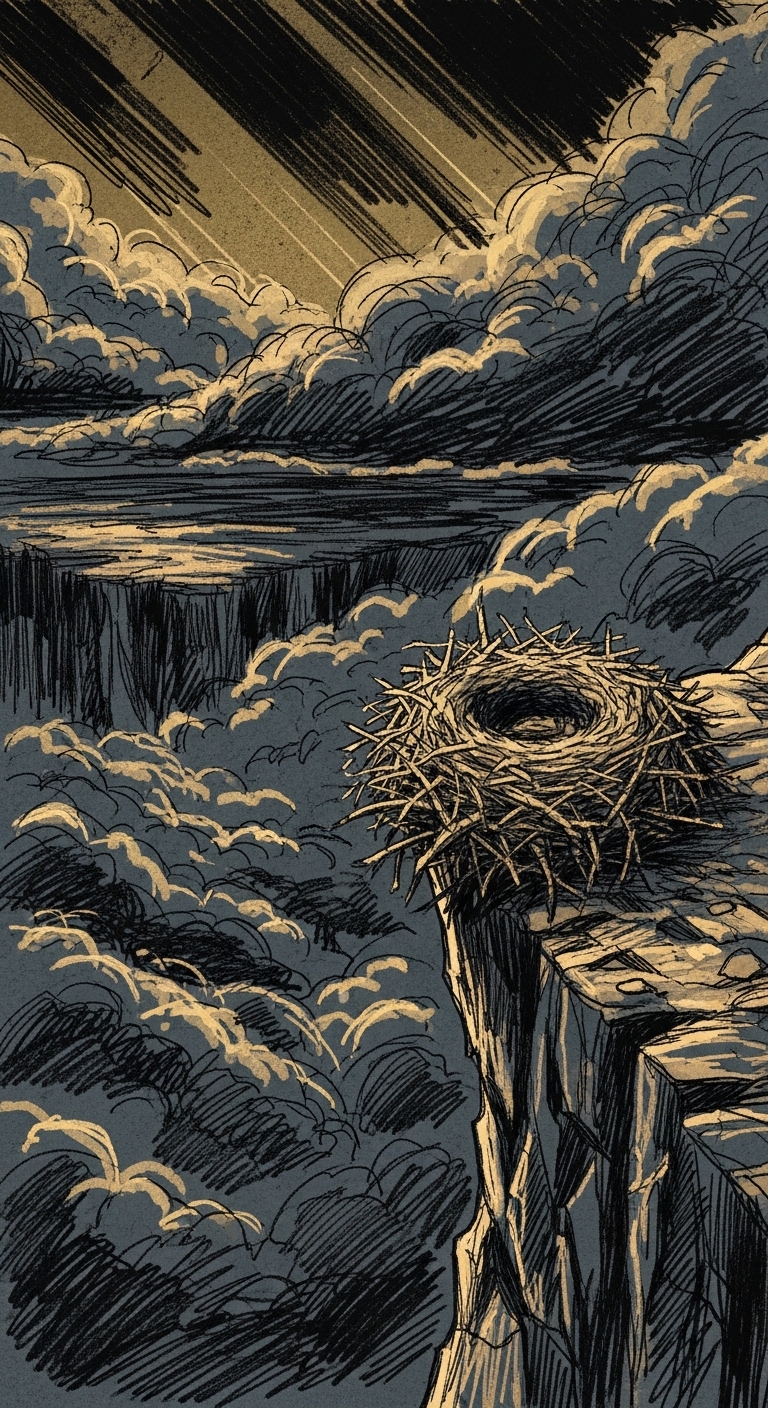
ALL: "The pride of your heart has deceived you, you who live in the clefts of the rock, whose dwelling is high, who say in your heart, 'Who will bring me down to the ground?' Though you soar aloft like the eagle, though your nest is set among the stars, from there I will bring you down, declares the Lord." — Obadiah 1:3–4
Scripture Assignments
Before beginning, assign each passage to a man in the group. When the teaching reaches that passage, he reads it aloud.
- Passage 1: Obadiah 1:1–4
- Passage 2: Obadiah 1:10–14
- Passage 3: Proverbs 16:18
- Passage 4: Luke 10:25–37
The Book Nobody Reads
Here is a fact worth sitting with before we begin: Obadiah is the only book in the entire 73-book Catholic Bible that has no reading — not one verse — in the daily Mass lectionary or the Liturgy of the Hours. It is not skipped over for a more important week. It is not condensed. It simply isn't there. In two thousand years of praying the liturgy of the Church, Obadiah has never been assigned.
That makes it either the least important book in Scripture, or one that is waiting for us.
It is 21 verses long. You can read the whole thing in four minutes. Most Catholics have never read it once.
So let's read it together. And let's ask why God preserved it.
Teaching Block 1 — Who Are the Edomites, and Why Should We Care?
To understand Obadiah, you have to go back to a moment from Genesis — a moment of betrayal between brothers that shaped the history of an entire people.
Jacob and Esau were twins. They fought in the womb. Esau was the elder, the firstborn, the one who should have received the blessing and the birthright. Instead, Esau sold his birthright for a bowl of stew. Later, Jacob tricked their dying father into giving him the blessing that belonged to Esau. The two brothers parted ways, and their descendants became two nations: Israel (from Jacob) and Edom (from Esau).
For centuries, they lived as neighbors. They shared a border, a history, a bloodline. They knew each other.
And that is exactly what makes what Edom did so devastating.
The vision of Obadiah. Thus says the Lord God to Edom: We have heard a report from the Lord, and he has sent an envoy to the nations: "Arise, and let us together rise up in battle against him." Behold, I have made you little among the nations. You are greatly contemptible. The arrogance of your heart has lifted you up, living in the clefts of the rocks, exalting your throne. You say in your heart, "Who will pull me down to the ground?" Though you have been lifted high like an eagle, and though you have placed your nest among the stars, from there I will pull you down, says the Lord.
Obadiah 1:1-4 — CPDV
The Edomites had built their nation in the cliffs of the rock — literally. Their capital, Petra, was carved into the sandstone mountains of what is now southern Jordan. They were geographically protected, economically powerful, and strategically positioned. They looked down on their neighbors — figuratively and literally — from the heights. Their pride had become their identity.
And then Babylon came for Jerusalem.
In 587 BC, the Babylonian army broke through the walls, burned the Temple, and drove the people of Israel into exile. It was one of the darkest moments in the entire history of God's people.
And Edom watched. And did worse than watch.
Because of the execution, and because of the iniquity against your brother Jacob, confusion will cover you, and you will pass away into eternity. In the day when you stood against him, when strangers seized his army, and foreigners entered into his gates, and they cast lots over Jerusalem: you also were just like one of them. But you shall not show disdain for the day of your brother in the day of his sojourn. And you shall not rejoice over the sons of Judah in the day of their perdition. And you shall not magnify your mouth in the day of anguish. And neither shall you enter into the gate of my people in the day of their ruin. And neither shall you also show disdain for his troubles in the day of his desolation. And you shall not send out against his army in the day of his desolation. Neither shall you stand at the exits to execute those who will flee. And you shall not enclose their remnant in the day of tribulation.
Obadiah 1:10-14 — CPDV
Read those verses slowly. "You should not have gloated." "You should not have entered the gate of my people." "You should not have stood at the crossroads to cut off his fugitives." Seven times in five verses, the prophet says you should not have. There is a specificity here that is not poetry. Obadiah is listing what Edom actually did, one offense at a time, against their own brothers.
They watched. They cheered. They looted. They handed over survivors.
Against their brothers.
Discussion Question 1: Edom's sin was not that they attacked Israel — it was that they stood by, and then made things worse, when their brothers were suffering. Have you ever been on the wrong side of that moment — when someone needed you and you stayed out of it, or worse, benefited from their fall? What kept you from acting?
Teaching Block 2 — The Sin God Names Last
There is a specific kind of sin that gets very little attention in men's circles, in homilies, in Catholic culture. It's not sexual sin. It's not violence. It's not theft. It is the sin of pride that expresses itself as contempt for those who are suffering.
Arrogance precedes destruction. And the spirit is exalted before a fall.
Proverbs 16:18 — CPDV
"Pride goes before destruction, and a haughty spirit before a fall." We've heard that so many times it doesn't sting anymore. But Obadiah makes it concrete. Edom's pride was not the boastful kind — it was the settled, structural kind. The kind that says I have built my house in the high places and no one can touch me. The kind that watches someone else's world collapse and feels, somewhere underneath, a quiet satisfaction. At least it isn't me. I must have done something right.
This is not a sin that announces itself. It comes dressed as common sense. Why would I get involved? What could I have done? It's not my fight. Edom didn't think of itself as cruel. It thought of itself as smart.
God does not agree.
Notice that Obadiah doesn't call Edom's sin cruelty. He calls it pride. The pride came first — the settled belief that Edom was above the suffering, above the loss, above the obligation of brotherhood. The cruelty followed naturally. Once you believe you are elevated above someone, their suffering becomes something that confirms your position rather than something that demands your response.
Obadiah is a four-minute book. And this is what it is about: what pride does to brotherhood.
Discussion Question 2: Edom's sin started with pride that they were safe and elevated — and ended with them handing over survivors to the enemy. That's a long road, but each step probably seemed reasonable. Where does that road start in your own life — the small decisions to stay elevated, to stay uninvolved, to protect your position?
Teaching Block 3 — The Neighbor You Passed By
The last question Obadiah raises is one that Jesus will return to centuries later — and it is the question that makes this tiny, neglected book land with permanent weight.
And behold, a certain expert in the law rose up, testing him and saying, "Teacher, what must I do to possess eternal life?" But he said to him: "What is written in the law? How do you read it?" In response, he said: "You shall love the Lord your God from your whole heart, and from your whole soul, and from all your strength, and from all your mind, and your neighbor as yourself." And he said to him: "You have answered correctly. Do this, and you will live." But since he wanted to justify himself, he said to Jesus, "And who is my neighbor?" Then Jesus, taking this up, said: "A certain man descended from Jerusalem to Jericho, and he happened upon robbers, who now also plundered him. And inflicting him with wounds, they went away, leaving him behind, half-alive. And it happened that a certain priest was descending along the same way. And seeing him, he passed by. And similarly a Levite, when he was near the place, also saw him, and he passed by. But a certain Samaritan, being on a journey, came near him. And seeing him, he was moved by mercy. And approaching him, he bound up his wounds, pouring oil and wine on them. And setting him on his pack animal, he brought him to an inn, and he took care of him. And the next day, he took out two denarii, and he gave them to the proprietor, and he said: 'Take care of him. And whatever extra you will have spent, I will repay to you at my return.' Which of these three, does it seem to you, was a neighbor to him who fell among the robbers?" Then he said, "The one who acted with mercy toward him." And Jesus said to him, "Go, and act similarly."
Luke 10:25-37 — CPDV
You know the parable. A man is beaten, left for dead on the road to Jericho. A priest passes by. A Levite passes by. And then the Samaritan — the outsider, the one with no obligation, the one with every social and religious reason to keep walking — stops. Binds the wounds. Pays for the care. Comes back.
The shocking part of that parable is not the Samaritan's generosity. It is who the priest and Levite were. They were the ones who should have stopped. They had the bloodline, the history, the covenant obligation. They were the ones who called themselves brothers. And they crossed to the other side of the road.
Edom crossed to the other side of the road.
And they did more than that — they handed over the man in the ditch.
Jesus tells His parable without ever naming Obadiah. But the shape of the sin is identical. The question is the same: Who is your neighbor, and what do you owe him when his world is falling apart? And underneath that question, the same diagnosis: the reason the priest and Levite kept walking was not busyness. It was the same thing that moved in Edom — a heart that had quietly decided that self-preservation was more important than brotherhood.
Obadiah's word to Edom is not complicated. It is: You knew what you owed. You chose otherwise. And God saw every step of it.
That is the warning this tiny book has been holding for two and a half thousand years, waiting for someone to open it.
Discussion Question 3: Jesus ends the parable with a command, not a principle: "Go and do likewise." Not "think about what brotherhood means" — go. Is there someone in your life right now — a brother, a friend, a man from this group — who is in the ditch and you've been crossing to the other side? What would it look like to stop this week?
This Week
Read Obadiah out loud, all 21 verses, in one sitting. It will take four minutes. Then sit with one question: Where in my life am I currently standing at the crossroads — watching someone lose something — and calling it none of my business?
Don't answer it tonight. Sit with it until Sunday.
Closing Prayer
Take prayer requests and close out.