Session 10
Baruch — Exile, Repentance, and the Long Way Home
Opening Prayer
LEADER: Let us begin by asking the Holy Spirit to be with us tonight.
ALL: Come, Holy Spirit, fill the hearts of your faithful and kindle in us the fire of your love. Send forth your Spirit and we shall be created, and you shall renew the face of the earth. O God, who by the light of the Holy Spirit did instruct the hearts of the faithful, grant that by the same Holy Spirit we may be truly wise and ever rejoice in His consolation, through Christ our Lord. Amen.
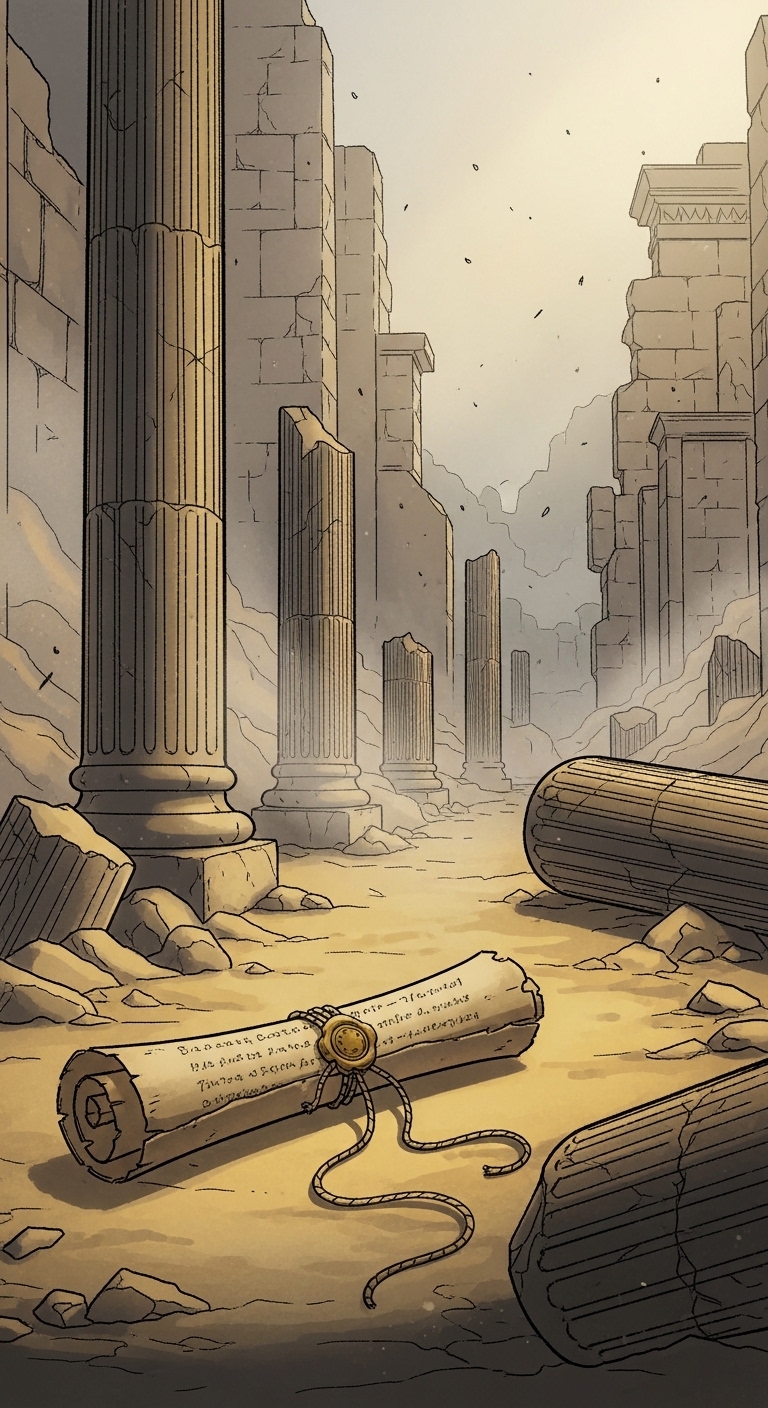
LEADER: Baruch is Jeremiah's secretary — the man who wrote down the prophet's words. Tonight he speaks in his own voice, from exile, on behalf of a people who are beginning to understand why they are where they are.
ALL: "The Lord our God is in the right, but there is open shame on us today, on the men of Judah, on the inhabitants of Jerusalem, and on our kings and our officials and our priests and our prophets and our fathers, because we have sinned against the Lord." — Baruch 1:15–17
Scripture Assignments
Before beginning, assign each passage to a man in the group. When the teaching reaches that passage, he reads it aloud.
- Passage 1: Baruch 1:15–22
- Passage 2: Baruch 3:9–15, 32–37
- Passage 3: Baruch 4:1–4
- Passage 4: Baruch 4:36–5:2
The Secretary Who Spoke
Baruch ben Neriah appears in the book of Jeremiah as Jeremiah's scribe — the man who sat beside the prophet and wrote down the words, who read the scroll aloud in the Temple, who preserved the record during the darkest period in Israel's history. He watched everything. He wrote everything down.
And then he is taken into exile in Babylon. Not as a prophet. As a secretary. As the man who carried someone else's words.
The book of Baruch is his own voice — a prayer of confession, a meditation on wisdom, and a poem of consolation to the exiles. It is the work of a man who has spent his career in someone else's shadow, writing someone else's words, and who now, in the middle of the worst catastrophe his people have ever experienced, finds he has something of his own to say.
Teaching Block 1 — The Confession That Takes Responsibility
And you will say, 'To the Lord our God is justice, but to us is confusion of our face, just as it is this day for all of Judah and the inhabitants of Jerusalem, even for our kings, and our leaders, and our priests, and our prophets, and our fathers. We have sinned before the Lord our God and we have not believed, lacking confidence in him. And we have not been submissive to him, and we have not listened to the voice of the Lord our God, so as to walk in his commandments, which he has given to us. From the day that he led our fathers out of the land of Egypt, even to this day, we were unfaithful to the Lord our God, and, having been scattered, we fell away. We did not listen to his voice. And we joined ourselves to many evils and to the curses which the Lord established through Moses, his servant, who led our fathers out of the land of Egypt, to give us a land flowing with milk and honey, just as it is in the present day. And we have not listened to the voice of the Lord our God, according to all the words of the prophets whom he sent to us. And we have gone astray, each one after the inclinations of his own malignant heart, serving strange gods and doing evil before the eyes of the Lord our God.
Baruch 1:15-22 — CPDV
Baruch's prayer of confession is one of the most complete acts of corporate repentance in the Bible. He does not say: the leaders sinned. He does not say: the false prophets led us astray. He does not exempt anyone, including himself.
The righteousness belongs to God. The shame belongs to us. The kings, the officials, the priests, the prophets, the fathers. We did not listen. We did not walk in the ways of the commandments. We served other gods. We did the very things God warned us against.
This is not self-flagellation. It is precision. Baruch is diagnosing the situation accurately so that the healing can be real. You cannot repent from a sin you have not named. And Baruch names it with a completeness that becomes the foundation for everything that follows.
There is a specific kind of maturity in this confession — the maturity that can look at a catastrophe and say: we did this. Not: circumstances did this. Not: other people did this. Not: God abandoned us first. We walked away. The exile is not a punishment that came from nowhere. It is the consequence of choices made over generations, clearly named, finally owned.
Discussion Question 1: Baruch's confession includes everyone — kings, priests, prophets, fathers. No one is exempt, and he includes himself in the "we" even though he was the righteous man's secretary. How do you handle responsibility for communal sins — the failures of your family, your parish, your culture — that you may not have personally committed but have benefited from or participated in by silence? What does honest confession of those things look like?
Teaching Block 2 — Where Is Wisdom?
Listen, O Israel, to the commandments of life! Pay attention, so that you may learn prudence! How is it, O Israel, that you are in the land of your enemies, that you have grown old in a foreign land, that you are defiled with the dead, that you are regarded as among those who are descending into hell? You have forsaken the fountain of wisdom. For if you had walked in the way of God, you would certainly have lived in everlasting peace. Learn where prudence is, where virtue is, where understanding is, so that you may know at the same time where long life and prosperity are, where the light of the eyes and peace are. Who has discovered its place? And who has entered its treasure chamber? Yet he who knows the universe is familiar with her, and in his foresight he invented her, he who prepared the earth for time without end, and filled it with cattle and four-footed beasts, who sends out the light, and it goes, and who summoned it, and it obeyed him in fear. Yet the stars have given light from their posts, and they rejoiced. They were called, and so they said, "Here we are," and they shined with cheerfulness to him who made them. This is our God, and no other can compare to him. He invented the way of all instruction, and delivered it to Jacob his child, and to Israel his beloved.
Baruch 3:9-15,32-37 — CPDV
After the confession, Baruch asks a question that the exiles are implicitly asking: how did we get here? We thought we were wise. We thought we knew. And we are sitting by rivers in a foreign country, having lost everything. What happened to our wisdom?
His answer echoes Job and Proverbs: wisdom is not a human achievement. It is not accumulated through education, experience, or sophistication. It is given by God, and it begins with the fear of the Lord. The nations around Israel had their wisdom — Egypt, Canaan, the merchants of Midian — but they did not find the path of wisdom. They did not understand the ways of God.
And then one of the most startling verses in all of Scripture: He found the whole way to knowledge, and gave her to Jacob His servant, and to Israel whom He loved. Afterward she appeared on earth and lived among men.
The early Church fathers read this and heard something unmistakable. Wisdom appearing on earth and living among men. The Word made flesh. Baruch, writing in exile in Babylon, is gesturing toward an Incarnation he cannot yet name.
" 'This is the book of the commandments of God and of the law, which exists in eternity. All those who keep it will attain to life, but those who have forsaken it, to death. Convert, O Jacob, and embrace it, walk in the way of its splendor, facing its light. Do not surrender your glory to another, nor your value to a foreign people. We have been happy, O Israel, because the things that are pleasing to God have been made clear to us.
Baruch 4:1-4 — CPDV
She is the book of the commandments of God, the law that endures forever. Those who hold her fast will live, and those who forsake her will die. Happy are we, O Israel, for we know what is pleasing to God.
Discussion Question 2: Baruch says the exile happened because Israel forsook wisdom — not because they stopped performing religious duties, but because they stopped walking in the way of understanding. Is there a difference in your own life between going through the motions of faith and actually walking in wisdom? What does walking in wisdom look like in the ordinary decisions of your week?
Teaching Block 3 — Jerusalem Speaks to Her Children
Look around, Jerusalem, towards the east, and see the happiness that comes to you from God. For behold, your sons approach, whom you sent away scattered. They approach, gathering together, from the east all the way to the west, at the word of the Holy One, rejoicing in the honor of God. " 'Take off, O Jerusalem, the garment of your sorrow and troubles, and put on your beauty and the honor of that eternal glory, which you have from God. God will surround you with a double garment of justice, and he will set a crown on your head of everlasting honor.
Baruch 4:36-37; Baruch 5:1-2 — CPDV
The book ends with a poem in which Jerusalem — personified as a mother — speaks to her exiled children. It is one of the most tender passages in all of the deuterocanonical books.
"Look toward the east, O Jerusalem, and see the joy that is coming to you from God. Behold, your sons are coming, whom you sent away; they are coming, gathered from east and west, at the word of the Holy One, rejoicing in the glory of God."
And then: "Take off the garment of your sorrow and affliction, O Jerusalem, and put on forever the beauty of the glory from God. Put on the robe of righteousness from God; put on your head the diadem of the glory of the Everlasting."
The exile is not permanent. The shame is real, the confession is necessary, the consequences are being endured — but the story does not end in Babylon. God is gathering. God is calling. The children who were sent away in disgrace are coming home in glory.
This passage from Baruch is quoted in St. Luke's Gospel — in the introduction to St. John the Baptist, the one who prepares the way. The long way home that Baruch promises is the same road that St. John will make straight in the desert.
The exile ends. It always ends. Because the God who exiled in justice also restores in mercy. That is who He is.
Discussion Question 3: Baruch's poem ends with Jerusalem being told to take off the garment of sorrow and put on the robe of righteousness. There is a moment in every exile — spiritual, relational, vocational — where you are offered the chance to stop identifying primarily with the sorrow and start identifying with the one who is gathering you home. Have you been given that invitation? Have you taken it?
This Week
Read Baruch 4:36–5:9 this week — the full poem of homecoming. Then ask yourself honestly: what exile am I still sitting in that God has already begun to end? Where am I still wearing the garment of sorrow when the robe of righteousness is being offered?
Closing Prayer
Take prayer requests and close out.