Session 13
1 Maccabees — When Faithfulness Costs Everything
Opening Prayer
LEADER: Let us begin by asking the Holy Spirit to be with us tonight.
ALL: Come, Holy Spirit, fill the hearts of your faithful and kindle in us the fire of your love. Send forth your Spirit and we shall be created, and you shall renew the face of the earth. O God, who by the light of the Holy Spirit did instruct the hearts of the faithful, grant that by the same Holy Spirit we may be truly wise and ever rejoice in His consolation, through Christ our Lord. Amen.
LEADER: Maccabees is the story of a family that refused to bend when an empire demanded it — and what that cost them. It is the origin of Hanukkah. And it is a manual for men living in a world that is increasingly hostile to what they believe.
ALL: "We will not obey the king's words by turning aside from our religion to the right hand or to the left." — 1 Maccabees 2:22
Scripture Assignments
Before beginning, assign each passage to a man in the group. When the teaching reaches that passage, he reads it aloud.
- Passage 1: 1 Maccabees 1:41–50
- Passage 2: 1 Maccabees 2:15–28
- Passage 3: 1 Maccabees 2:49–64
- Passage 4: Hebrews 11:32–38
The World That Wanted Them to Fit In
Around 175 BC, Antiochus IV Epiphanes became king of the Seleucid Empire, which controlled Judea. He had a project: the Hellenization of his entire kingdom. Greek language, Greek culture, Greek religion — a unified civilization under one cultural banner. Most of his subjects found this reasonable or even appealing. Many Jews did too.
The program of assimilation was initially voluntary. Greek gymnasiums were built in Jerusalem. Jewish priests began wearing Greek clothes and learning Greek customs. The social pressure to fit in was enormous — to be sophisticated, to be modern, to stop insisting on the strange particularity of Jewish practice.
And then the pressure became compulsion.
Teaching Block 1 — The Edict
Her sanctuary was desolate, like a place of solitude, her feast days were turned into mourning, her sabbaths into disgrace, her honors into nothing. Her shame was multiplied according to her glory, and her loftiness was turned into lamentation. And king Antiochus wrote to all his kingdom, that all the people must be one, and that each one should relinquish his own law. And all Gentiles consented, according to the word of king Antiochus. And many out of Israel consented to his servitude, and they sacrificed to idols, and they polluted the Sabbath. And the king sent letters, by the hand of messengers, to Jerusalem and to all the cities of Judah: that they should follow the law of the Nations of the earth, and that they should prohibit holocausts and sacrifices and atonements to be made in the temple of God, and that they should prohibit the celebration of the Sabbath and the solemn days. And he ordered the holy places to be defiled, along with the holy people of Israel. And he ordered altars to be built, and temples, and idols, and he ordered the immolation of the flesh of swine and of unclean cattle,
1 Maccabees 1:41-50 — CPDV
Antiochus issued a decree. One religion for the whole kingdom. One law. One people. Circumcision forbidden. Sabbath forbidden. Feast days forbidden. The Torah scrolls to be torn and burned. The Temple to be desecrated with sacrifice to Zeus. Pigs to be offered on the altar of the Lord. Anyone who refused to comply was to be executed.
This is not a metaphor. It is historical. It happened.
And here is the detail that the text records with devastating understatement: Many of the people of Israel, everyone who forsook the law, joined them, and they did evil in the land. Many of the people went along. They found a way to keep some Jewish identity while complying with the edict. They told themselves it was survival. That they could honor God privately while publicly conforming. That the outer things didn't matter as much as the inner life.
And then there were the ones who didn't.
Discussion Question 1: The majority of Jews under Antiochus found a way to accommodate. They weren't apostates — they still thought of themselves as Jewish. They just made peace with the demands of the dominant culture. Does that pattern describe anything in contemporary Catholic life? Where is the pressure to keep the faith private while conforming publicly? And how do you know when you've crossed from prudent accommodation into something that costs the faith its substance?
Teaching Block 2 — The Spark
And those who had been sent from king Antiochus came to that place, to compel those who fled into the city of Modin to immolate, and to burn frankincense, and to depart from the law of God. And many of the people of Israel consented and came to them. But Mattathias and his sons stood firm. And those who had been sent from Antiochus, responding, said to Mattathias: "You are a ruler, and very splendid and great in this city, and you are adorned with sons and brothers. Therefore, approach first, and carryout the order of the king, as all the nations have done, and the men of Judah, and those who remained in Jerusalem. And you and your sons will be among the friends of the king, and enriched with gold and silver and many gifts." And Mattathias responded, and he said with a loud voice: "Even if all nations obey king Antiochus, so that each one departs from the service of the law of his fathers and consents to his commandments, I and my sons and my brothers will obey the law of our fathers. May God be forgiving to us. It is not useful for us to abandon the law and the justices of God. We will not listen to the words of king Antiochus, nor will we sacrifice, transgressing the commandments of our law, so as to set out on another way." And, as he ceased speaking these words, a certain Jew approached in the sight of all to sacrifice to the idols upon the altar in the city of Modin, according to the order of the king. And Mattathias saw, and he grieved, and his temperament trembled, and his fury was enkindled according to the judgment of the law, and leaping up, he slaughtered him on the altar. Moreover, the man whom king Antiochus had sent, who compelled them to immolate, he killed at the same time, and he destroyed the altar, and he was zealous for the law, just as Phinehas did to Zimri, the son of Salomi. And Mattathias exclaimed with a loud voice in the city, saying, "All who hold zeal for the law, maintaining the covenant, let them follow me." And he and his sons fled to the mountains, and they left behind whatever they had in the city.
1 Maccabees 2:15-28 — CPDV
Mattathias is an old priest in a small town. The king's officers come to enforce the edict. They offer Mattathias the first sacrifice — as a leader, his compliance would model compliance for the whole town. They offer him silver, gold, the king's friendship, honor.
He refuses. Simply. Directly. "We will not obey the king's words by turning aside from our religion to the right hand or to the left."
And then something happens that Mattathias did not plan. Another Jew from the town steps forward to make the sacrifice. And Mattathias kills him. And kills the king's officer. And tears down the altar. And flees to the hills.
This is not tidy heroism. It is messy, violent, consequential. Mattathias has just started a war. His family will pay for this. Many of his people will pay for this. He knows it. He goes anyway.
His cry as he flees is one of the great rallying calls of the Old Testament: "Let everyone who is zealous for the law and supports the covenant come out with me."
Then the days drew near when Mattathias would die, and he said to his sons: "Now arrogance and chastisement have been strengthened, and it is a time of overturning and of the wrath of indignation. Now therefore, O sons, be imitators of the law, and give your lives for the sake of the covenant of your fathers. And call to mind the works of the fathers, which they have done in their generations. And you will receive great glory and an eternal name. Was not Abraham found to be faithful in temptation, and so it was accounted to him as justice? Joseph, in the time of his anguish, kept the commandment, and he was made ruler of Egypt. Phinehas our father, being zealous in the zeal of God, received the covenant of an eternal priesthood. Jesus, since he fulfilled the word, was made a commander in Israel. Caleb, since he testified in the assembly, received an inheritance. David, in his mercy, obtained the throne of a kingdom for all generations. Elijah, since he was zealous with a zeal for the law, was received into heaven. Hananiah and Azariah and Mishael, by believing, were delivered from the flame. Daniel, in his simplicity, was delivered from the mouth of the lions. And so, consider that, through generation after generation of all those who trusted in him, none have failed in strength. And fear not the words of a sinful man, for his glory is dung and worms. Today he is extolled, and tomorrow he will not be found, because he has returned into his earth and his thinking has perished. Therefore, you sons, be strengthened and act manfully in the law. For by it, you shall become glorious.
1 Maccabees 2:49-64 — CPDV
Mattathias is dying. He gathers his sons and gives them his final words — a speech that reads like a compressed summary of all of Israelite history, calling each of the fathers as witnesses. Abraham was tested and found faithful. Joseph kept the commandments in a time of distress. Phinehas, by being zealous, received the covenant of an everlasting priesthood. Joshua fulfilled his calling. Caleb witnessed and received his inheritance. David in his mercy inherited the throne of a kingdom forever. Elijah was zealous and was taken up into heaven.
And then: "My children, be courageous and grow strong in the law, for by it you will gain honor."
He is not promising them survival. He is promising them honor. The difference matters.
Discussion Question 2: Mattathias's call was simple: everyone who is zealous for the covenant, come out with me. It was a call to visible, costly commitment — not private faithfulness but public identification. Is there a place in your life where you are being asked to come out and identify yourself, and you are calculating the cost? What is keeping you from stepping forward?
Teaching Block 3 — The Cost
And what should I say next? For time is not sufficient for me to give an account of Gideon, Barak, Samson, Jephthah, David, Samuel, and the Prophets: those who, by faith, conquered kingdoms, accomplished justice, obtained promises, closed the mouths of lions, extinguished the violence of fire, escaped the edge of the sword, recovered from infirmities, showed strength in battle, turned back the armies of foreigners. Women received their dead by means of resurrection. But others suffered severe punishment, not yet receiving redemption, so that they would find a better resurrection. Truly, others were tested by mocking and lashes, and moreover by chains and imprisonment. They were stoned; they were cut; they were tempted. With the slaughter of the sword, they were killed. They wandered about in sheepskin and in goatskin, in dire need, in anguish afflicted. Of them, the world was not worthy, wandering in solitude on mountains, in the caves and caverns of the earth.
Hebrews 11:32-38 — CPDV
The author of Hebrews lists the heroes of faith and arrives at the Maccabees — without naming them, because he doesn't need to. His audience knew. "Others were tortured, refusing to accept release, so that they might rise again to a better life. Others suffered mocking and flogging, and even chains and imprisonment. They were stoned, they were sawn in two, they were killed with the sword. They went about in skins of sheep and goats, destitute, afflicted, mistreated — of whom the world was not worthy — wandering about in deserts and mountains, and in dens and caves of the earth."
Of whom the world was not worthy.
That is the verdict Hebrews renders on the men and women who refused to bend under Antiochus. The world was not worthy of them. Not: they were too naive to survive. Not: they should have been more pragmatic. The world was not worthy of what they were.
1 Maccabees is not a comfortable book for comfortable men. It is a book written to men who are about to find out what they are made of, and who need to know — before the moment comes — what faithfulness looks like when it costs something real.
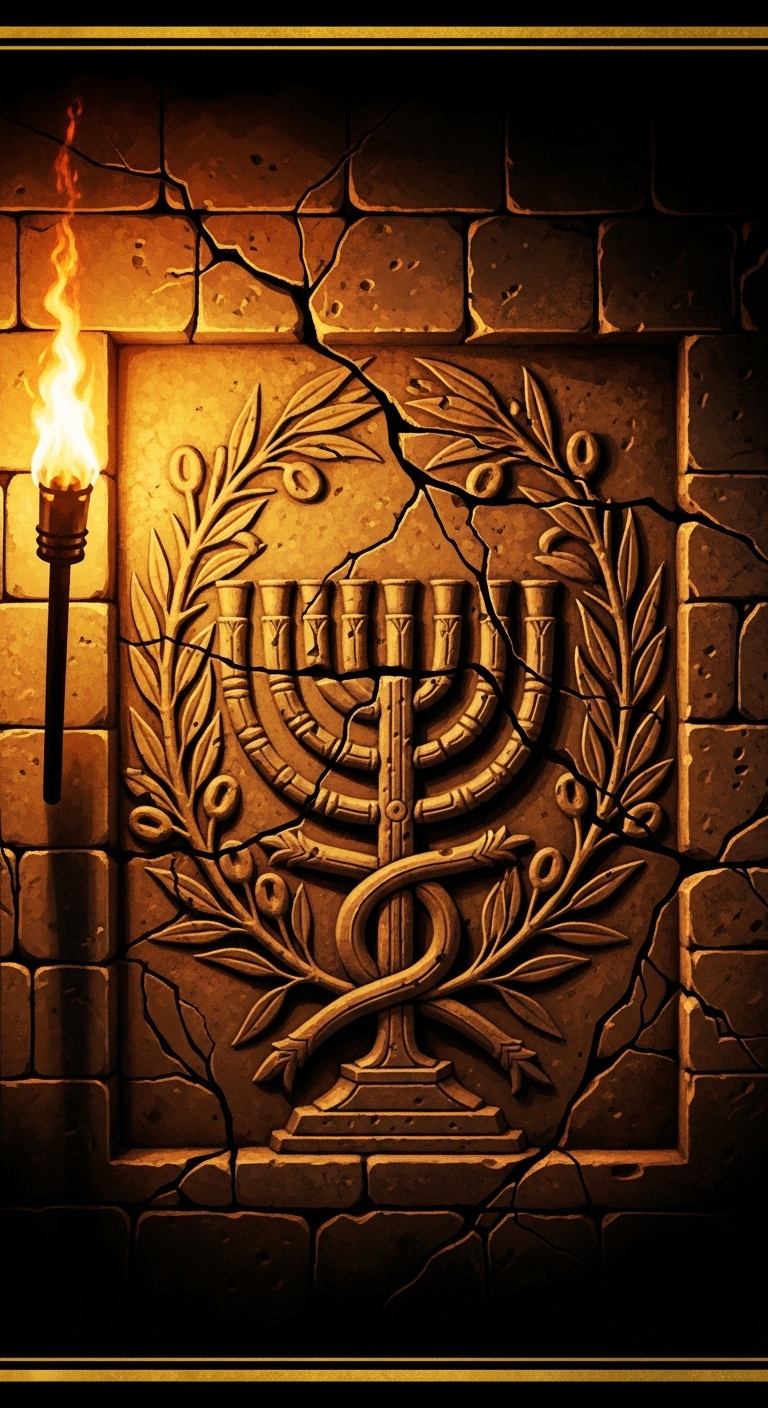
The Maccabean revolt succeeded militarily — the Temple was rededicated, the menorah was relit, the feast of Hanukkah was born. But the victory came through the deaths of men who did not live to see it. They were faithful before the outcome was certain. They refused to bend before they knew how the story would end.
That is what faithfulness actually looks like.
Discussion Question 3: "Of whom the world was not worthy." That is the verdict on people who suffered rather than compromise. Most of us will not face the choice Mattathias faced. But we face smaller versions of it regularly. What is a place in your life right now where fidelity to what you believe is in tension with what the culture around you expects? And what would it mean to say — quietly, firmly, in that specific place — I will not turn to the right hand or to the left?
This Week
Read 1 Maccabees 2 in full — Mattathias's refusal, his act, his death, and his final words to his sons. Then ask yourself: what am I willing to pass on to the next generation by the way I live now? Not by what I say — by what I do when the officers come to town and the offer is on the table.
Closing Prayer
Take prayer requests and close out.