Session 2
Nahum — The Comfort of God's Justice
Opening Prayer
LEADER: Let us begin by asking the Holy Spirit to be with us tonight.
ALL: Come, Holy Spirit, fill the hearts of your faithful and kindle in us the fire of your love. Send forth your Spirit and we shall be created, and you shall renew the face of the earth. O God, who by the light of the Holy Spirit did instruct the hearts of the faithful, grant that by the same Holy Spirit we may be truly wise and ever rejoice in His consolation, through Christ our Lord. Amen.
LEADER: The name Nahum means "comfort." Tonight we read a book that offers comfort through the most difficult of truths — that God's justice is real, and it is coming.
ALL: "The Lord is slow to anger and great in power, and the Lord will by no means clear the guilty. His way is in whirlwind and storm, and the clouds are the dust of his feet." — Nahum 1:3
Scripture Assignments
Before beginning, assign each passage to a man in the group. When the teaching reaches that passage, he reads it aloud.
- Passage 1: Nahum 1:1–8
- Passage 2: Nahum 3:1–7
- Passage 3: Romans 12:17–19
- Passage 4: Revelation 19:1–2
The Book That Celebrates a City's Destruction
Nahum makes modern readers uncomfortable in a way that most of the Bible does not. It is not a book of lament. It is not a call to repentance. It is a book of judgment — and it reads at times like a war cry. A nation will fall. Its people will suffer. And the prophet is not sorry.
To understand why God preserved this book, you have to understand who Nineveh was.
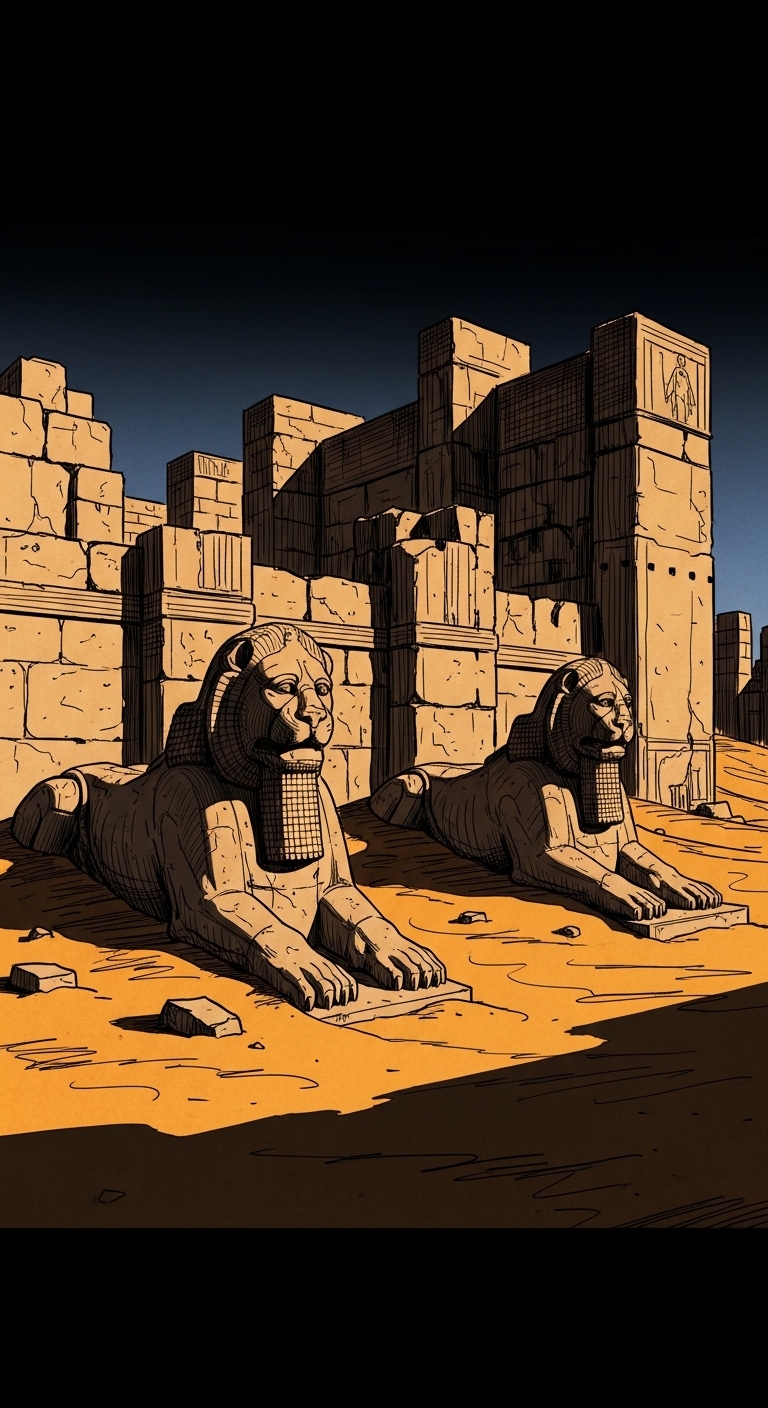
Nineveh was the capital of Assyria — the most powerful, most brutal empire the ancient world had yet produced. The Assyrians invented the systematic use of terror as military policy. They impaled captives on stakes outside city walls. They skinned enemy leaders alive. They deported entire populations, deliberately breaking the cultural identity of conquered peoples. They were not just cruel in the way all ancient armies were cruel. They made cruelty into a strategy.
And they had already destroyed the northern kingdom of Israel. They had already scattered ten of the twelve tribes, never to return. When Nahum wrote this book, every man in his audience had lost cousins, villages, history — to Nineveh.
Nahum is not a call to vengeance. It is a declaration that the God of Israel has not forgotten what Nineveh did, and that the accounting is coming.
Teaching Block 1 — The God Who Is Slow to Anger (And Still Comes)
The burden of Nineveh. The book of the vision of Nahum the Elkoshite. God is a rival, and the Lord is avenging. The Lord is avenging, and one who applies wrath. The Lord is avenging with his enemies, and he becomes angry with his adversaries. The Lord is patient and great in strength, and those who are not clean, he makes innocent. The Lord is in a tempest, and his way is a whirlwind, and the clouds are dust at his feet. He is the one who rebukes the sea, and who dries it up, and who leads all the rivers to the desert. Basan has been weakened, and also Carmel, and the flower of Lebanon has languished. The mountains have trembled before him, and the hills have become desolate, and the earth has quaked before his face, both the world and all that dwells in it. Who can stand firm before the face of his indignation? And who can continue against the fury of his wrath? His indignation has broken out like a fire, and the rocks have been dissolved before him. The Lord is good, and a comforter in the day of tribulation, and he knows those who hope in him. And in the flood that passes over, he brings to consummation the end of his place. And darkness shall pursue his adversaries.
Nahum 1:1-8 — CPDV
The opening of Nahum is one of the most powerful descriptions of God's character in all of Scripture — and it is one that almost nobody knows. God is jealous. God avenges. God is slow to anger. God is great in power. God will by no means clear the guilty.
Read that list carefully, because it does not feel like a contradiction to Nahum. We have trained ourselves to separate "the God of wrath" from "the God of love" — usually by relegating the first to the Old Testament and claiming the second for the New. But Nahum does not separate them. He puts them in the same sentence. God is slow to anger and He will not clear the guilty. These are not two different Gods. They are two facets of the same holiness.
The word "jealous" in the Old Testament is not the petty jealousy of an insecure person. It is the jealousy of a husband whose wife has been assaulted. It is a word that carries righteous ownership, fierce protectiveness, and the absolute refusal to pretend that what happened did not happen.
Nineveh had not just broken a political alliance. It had attacked the people that God had called His own. And God had watched. And God had been patient — slow to anger, just as He said. But the patience of God is not the indifference of God. The clouds are the dust of His feet. He is already moving.
Discussion Question 1: We often hear that God is patient and slow to anger, and we use it to comfort ourselves. But Nahum pairs that patience with the certainty that the guilty will not go free. Does that pairing change how you understand God's patience in your own life — including patience with you?
Teaching Block 2 — What Happens to Empires Built on Violence
Woe to the city of blood, filled with all manner of lies and violence. Crime shall not depart from you: the voice of the whip, and the voice of the turning wheels, and of the neighing horse, and the burning chariot, and the horsemen who ride, and of the flashing sword and the shining spear, and of a multitude executed and a grievous ruination. Neither is there an end to the dead bodies, and they will fall down upon their dead bodies. Because of the multitude of fornications of the kept woman, beautiful and pleasing and practicing evil deeds, who sold nations by her fornications, and families by her evil doing: behold, I will come to you, says the Lord of hosts, and I will reveal your shame to your face, and I will show your nakedness to the Gentiles, and your disgrace to kingdoms. And I will cast abominations over you, and I will afflict you with abuse, and I will make an example of you. And this shall be: everyone who sees you, will recoil from you, and he will say: "Nineveh has been devastated." Who will shake his head over you? Where might I seek consolation for you?
Nahum 3:1-7 — CPDV
This is the part that makes people put the book down. Nahum describes the fall of Nineveh in vivid, unsparing detail — the cracking whips, the piles of bodies, the city stripped bare, exposed to the nations that had once feared it. And he uses language that is deliberately humiliating.
But sit with it for a moment before you look away.
Nahum is not being cruel for the sake of cruelty. He is doing something specific: he is describing what Nineveh did to others, coming back on Nineveh. The city that impaled and stripped and exposed its enemies is itself impaled, stripped, exposed. There is a moral logic here that is as old as Genesis — whatever measure you use will be measured back to you. Nahum is not inventing this. He is announcing that the God who set that principle in motion has not forgotten it.
The nations around Nineveh had spent a century living in dread of this city. They had watched it devour everything it touched. And when it finally fell — in 612 BC, to the Babylonians and Medes, almost exactly as Nahum prophesied — no one came to help. No one mourned. The text says: "All who hear the news about you clap their hands over you."
That detail is important. It tells you something about what sustained terror does to human community. Nineveh had built its security on making the world afraid. And when it fell, the world felt nothing but relief.
Render to no one harm for harm. Provide good things, not only in the sight of God, but also in the sight of all men. If it is possible, in so far as you are able, be at peace with all men. Do not defend yourselves, dearest ones. Instead, step aside from wrath. For it is written: "Vengeance is mine. I shall give retribution, says the Lord."
Romans 12:17-19 — CPDV
"Vengeance is mine, says the Lord." St. Paul quotes that principle to tell the Romans not to avenge themselves. But notice what the principle assumes: the vengeance is real. God is not telling His people to let it go because injustice doesn't matter. He is telling them to let Him handle it because He will — and He does it better than they can.
Nahum is the proof of concept.
Discussion Question 2: The fall of Nineveh was a moment when people who had suffered under an empire finally saw justice. Most of us have experienced some version of injustice — something done to us, or to someone we love, that was never made right. How do you hold that against a God who says "vengeance is mine"? Do you trust it, or does it feel like a way of saying nothing will ever happen?
Teaching Block 3 — Why This Is Good News
There is a word hidden in Nahum's name that we need to recover. His name means comfort. Not consolation in the sense of gentle reassurance. Comfort in the ancient sense — the kind a warrior gives his people when he tells them the enemy has been defeated. The comfort of it is finished.
After these things, I heard something like the voice of many multitudes in heaven, saying: "Alleluia! Praise and glory and power is for our God. For true and just are his judgments, he who has judged the great harlot that corrupted the earth by her prostitution. And he has vindicated the blood of his servants from her hands."
Revelation 19:1-2 — CPDV
"Hallelujah! Salvation and glory and power belong to our God, for His judgments are true and just." The book of Revelation uses almost the same language Nahum uses — and uses it as the prelude to worship. The fall of the great oppressor is greeted with hallelujah. Not because suffering is beautiful, but because justice is.
We live in a culture that has lost the ability to celebrate justice. We have been trained to feel guilty about any satisfaction when the wicked suffer consequences. But Nahum — and Revelation — push back on that instinct. There is something morally right about the relief felt when an Auschwitz falls, when a trafficking network is dismantled, when an abuser finally faces what he did. That relief is not hatred. It is the recognition that the moral order of the universe has been upheld.
Nahum wrote to people who had watched their brothers and sisters marched into slavery by the Assyrian army. He told them: God has seen it. God will not clear the guilty. And God is coming.
That is not a threat to the righteous. It is the most comforting thing anyone has ever said.
Discussion Question 3: Revelation uses the language of judgment as worship — as a reason to sing. Do you have a framework for that? Can you hold God's justice as something to be grateful for, not just something to fear? What would it change in how you pray if you actually believed that every injustice you know about is on God's accounting ledger?
This Week
Find one situation in your life — a relationship, a circumstance, a wound that was never addressed — where you have been waiting for justice and growing bitter waiting. Bring it before God this week not as a complaint but as a trust: I am putting this on Your ledger. I believe You are slow to anger and will not clear the guilty. I am letting go of the accounting.
Closing Prayer
Take prayer requests and close out.