Session 3
Habakkuk — When God's Silence Feels Like Absence
Opening Prayer
LEADER: Let us begin by asking the Holy Spirit to be with us tonight.
ALL: Come, Holy Spirit, fill the hearts of your faithful and kindle in us the fire of your love. Send forth your Spirit and we shall be created, and you shall renew the face of the earth. O God, who by the light of the Holy Spirit did instruct the hearts of the faithful, grant that by the same Holy Spirit we may be truly wise and ever rejoice in His consolation, through Christ our Lord. Amen.
LEADER: Habakkuk is one of the few prophets who speaks not to the people on God's behalf — but to God on the people's behalf. Tonight we read a man who complained to God and received an answer he did not expect.
ALL: "O Lord, how long shall I cry for help, and you will not hear? Or cry to you 'Violence!' and you will not save?" — Habakkuk 1:2
Scripture Assignments
Before beginning, assign each passage to a man in the group. When the teaching reaches that passage, he reads it aloud.
- Passage 1: Habakkuk 1:1–4
- Passage 2: Habakkuk 1:12–2:1
- Passage 3: Habakkuk 2:2–4
- Passage 4: Habakkuk 3:17–19
The Prophet Who Argued With God
Most of the prophets stand before the people and say: This is what God told me to tell you. Habakkuk does something different. He stands before God and says: I have a complaint. And I intend to wait here until You answer it.
This is not a man who has lost his faith. This is a man who takes his faith seriously enough to bring it into direct confrontation with what he is seeing. The violence around him is real. The injustice is real. The silence of God is real. And Habakkuk refuses to pretend otherwise.
The book of Habakkuk is structured as a dialogue — a series of complaints from the prophet, followed by God's responses, followed by more questions. It reads less like a prophecy and more like a transcript of prayer that most men have prayed at some point and never spoken aloud.
Teaching Block 1 — The Question Every Man Has Asked
The burden that Habakkuk the prophet saw. How long, O Lord, shall I cry out, and you will not heed? Shall I shout to you while suffering violence, and you will not save? Why have you revealed to me iniquity and hardship, to see plunder and injustice opposite me? And there has been judgment, but the opposition is more powerful. Because of this, the law has been torn apart, and judgment does not persevere to its conclusion. For the impious prevail against the just. Because of this, a perverse judgment is issued.
Habakkuk 1:1-4 — CPDV
Habakkuk is watching Judah fall apart around him. Violence. Injustice. The law paralyzed. The wicked surrounding the righteous. And God, apparently, doing nothing. His complaint is specific: I have cried out. You have not answered. How long?
This is not the prayer of a weak man. This is the prayer of a man who has been praying long enough to feel the weight of unanswered prayer. There is a particular exhaustion that comes from crying out to God consistently, faithfully — and watching the situation get worse, not better. Habakkuk names it without apology.
The temptation for most men is to resolve the tension before God does. Either we stop praying because it doesn't seem to work, or we construct a theological explanation for why what we see isn't really what we see. Habakkuk does neither. He stays at his post and keeps asking.
God's first answer to Habakkuk is not what he expected: I am doing something. You would not believe it if I told you. I am raising up the Babylonians.
The thing Habakkuk feared most — Babylonian conquest — is God's instrument.
Discussion Question 1: Have you ever received an answer to prayer that was worse than the problem you were praying about — at least at first? What did you do with that? Did it deepen your faith or did it make you want to stop asking?
Teaching Block 2 — Standing on the Watchtower
Have you not existed from the beginning, Lord my God, my holy one, and so we shall not die? Lord, you have stationed him for judgment, and you have establish that his strength will be swept away. Your eyes are pure, you do not behold evil, and you cannot look towards iniquity. Why do you look upon the agents of iniquity, and remain silent, while the impious is devouring one who is more just than himself? And you will make men like the fish of the sea and like the creeping things that have no ruler. He lifted up everything with his hook. He drew them in with his dragnet, and gathered them into his netting. Over this, he will rejoice and exult. For this reason, he will offer victims to his dragnet, and he will sacrifice to his netting. For through them, his portion has been made fat, and his meals elite. Because of this, therefore, he expands his dragnet and will not be lenient in continually putting to death the peoples. I will stand firm during my watch, and fix my position over the fortification. And I will observe carefully, to see what might be said to me and what I might respond to my opponent.
Habakkuk 1:12-17; Habakkuk 2:1 — CPDV
God's answer does not satisfy Habakkuk. He has a second complaint, more personal and more urgent than the first: You are too pure to look on evil — so why are You watching while the wicked devour the righteous? Why are You silent while they swallow those more just than themselves?
This is the hardest version of the question: not just "why is there suffering" but "why does the suffering seem to fall on the people who least deserve it?" Habakkuk is not asking in the abstract. He knows specific people who are being crushed. And God, in His silence, seems complicit.
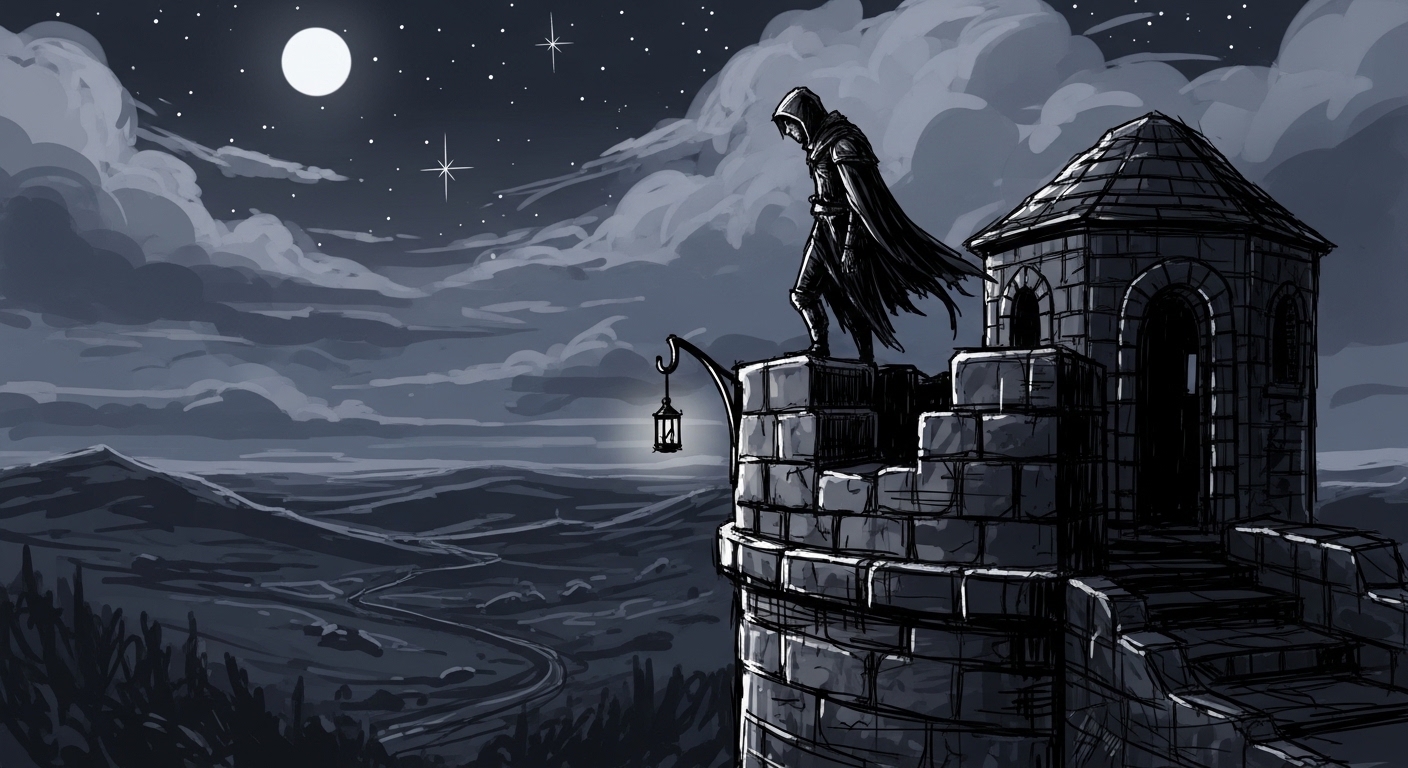
And then Habakkuk does something that we should take seriously as men who pray. He does not spiral. He does not catastrophize. He does not leave. He says: I will take my stand at my watchpost and station myself on the tower and look out to see what He will say to me, and what I will answer concerning my complaint.
He builds a watchtower out of his complaint and stands in it. He is not walking away. He is waiting — with deliberate, military patience — for an answer.
And the Lord responded to me and said: Write the vision and explain it on tablets, so that he who reads it may run through it. For as yet the vision is far off, and it will appear in the end, and it will not lie. If it expresses any delay, wait for it. For it is arriving and it will arrive, and it will not be hindered. Behold, he who is unbelieving, his soul will not be right within himself; but he who is just shall live in his faith.
Habakkuk 2:2-4 — CPDV
God's answer comes. Write the vision. Make it plain. It awaits its appointed time. If it seems slow, wait for it — it will surely come, it will not delay.
And then the sentence that will echo through the rest of Scripture, through St. Paul, through the entire New Testament theology of faith: "The righteous shall live by his faith."
Five words. St. Paul quotes them three times. The entire letter to the Hebrews is built around them. And they come from this tiny, neglected book — from a man standing on a watchtower, waiting for an answer from a God who seemed to be ignoring him.
Discussion Question 2: "The righteous shall live by his faith." In Habakkuk's context, this is not a feel-good statement — it is what God says to a man who just complained that the righteous are being devoured. Faith here is not certainty. It is the decision to stay at the watchtower. What is your watchtower right now — the thing you are still standing in, still waiting on, still choosing to trust despite the silence?
Teaching Block 3 — The Most Honest Ending in the Bible
For the fig tree will not flower, and there will be no bud on the vines. The labor of the olive tree will be misleading, and the farmland will produce no food. The sheep will be cut off from the sheepfold, and there will be no herd at the manger. But I will rejoice in the Lord; and I will exult in God my Jesus. The Lord God is my strength. And he will set my feet like those of the stag. And he, the victor, will lead me beyond my high places while singing psalms.
Habakkuk 3:17-19 — CPDV
Read this slowly, because these may be the most honest verses in the entire Old Testament.
Though the fig tree should not blossom, nor fruit be on the vines, the produce of the olive fail and the fields yield no food, the flock be cut off from the fold and there be no herd in the stalls — yet I will rejoice in the Lord; I will take joy in the God of my salvation.
Habakkuk is not describing a hypothetical disaster. For a man in ancient Israel, this list is total economic collapse. No figs, no grapes, no olives, no grain, no livestock. Nothing. The complete, catastrophic failure of everything that makes life sustainable.
And his conclusion is not: then surely God will provide. His conclusion is: yet I will rejoice. Not because things are fine. Not because he expects them to turn around. But because God remains God regardless of the harvest. The joy is not contingent on the outcome.
This is the hardest thing in the Christian life. Not the big moments of suffering where we find reserves we didn't know we had — but the long seasons of failure and silence where we are called to worship anyway. To say: the fig tree has not blossomed. I have not gotten what I prayed for. The situation has not resolved. And yet.
That yet is the whole of faith. Habakkuk earned it by standing on his watchtower. He didn't arrive there by bypassing the complaint. He arrived there because he brought the complaint fully, waited honestly, and let God answer in God's own time.
Discussion Question 3: "Yet I will rejoice" is not denial — it's the hardest-won sentence in this book. Is there a "yet" in your life right now — something you are choosing to trust or to worship through, despite circumstances that argue against it? What would it mean to say it out loud tonight?
This Week
Write down one complaint you have been carrying to God — or avoiding bringing to God. Be specific. Don't clean it up. Then write underneath it: I will stand at my watchtower. Put it somewhere you'll see it before you pray this week.
Closing Prayer
Take prayer requests and close out.