Session 5
Haggai — Building What Actually Matters
Opening Prayer
LEADER: Let us begin by asking the Holy Spirit to be with us tonight.
ALL: Come, Holy Spirit, fill the hearts of your faithful and kindle in us the fire of your love. Send forth your Spirit and we shall be created, and you shall renew the face of the earth. O God, who by the light of the Holy Spirit did instruct the hearts of the faithful, grant that by the same Holy Spirit we may be truly wise and ever rejoice in His consolation, through Christ our Lord. Amen.
LEADER: Haggai is the most practical of the minor prophets. His message is not about nations or empires or the end of days. It is about a group of men who stopped building something important because their own houses needed work first.
ALL: "Is it a time for you yourselves to dwell in your paneled houses, while this house lies in ruins?" — Haggai 1:4
Scripture Assignments
Before beginning, assign each passage to a man in the group. When the teaching reaches that passage, he reads it aloud.
- Passage 1: Haggai 1:1–11
- Passage 2: Haggai 1:12–15
- Passage 3: Haggai 2:3–9
- Passage 4: Matthew 6:31–33
The Men Who Came Home and Stopped
In 538 BC, the Persian king Cyrus issued a decree that allowed the exiled Jews to return to Jerusalem and rebuild the Temple. After fifty years of captivity in Babylon, they were free to go home.
They went home. They started rebuilding.
And then they stopped.
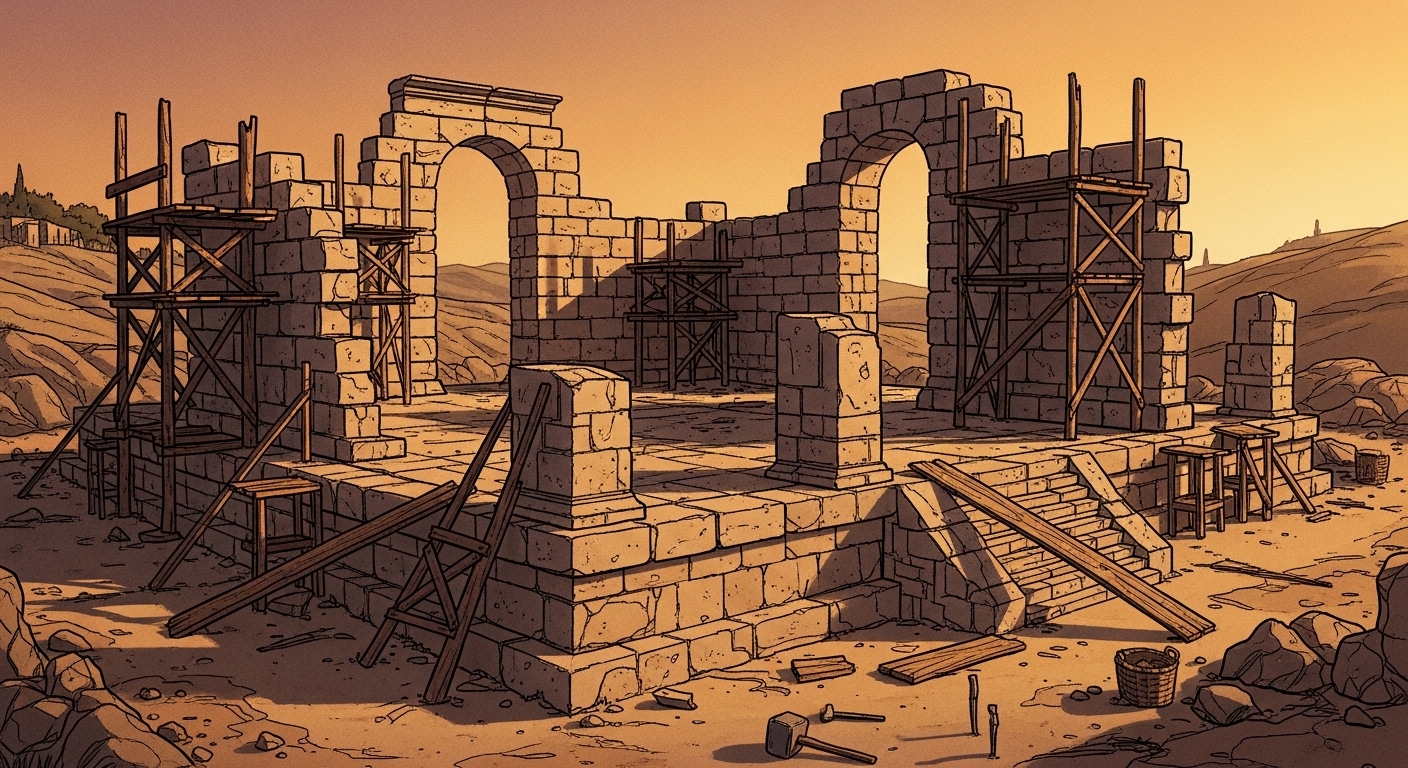
Sixteen years passed. The foundation of the Temple had been laid, but the walls were not built. The altar stood, but the house of God remained in ruins. The people had wood and stone and labor — they had built their own houses, comfortable houses with paneled ceilings — but the work of God sat unfinished.
Haggai is sent to ask them one question: Why?
Teaching Block 1 — You Have Sown Much and Harvested Little
In the second year of king Darius, in the sixth month, on the first day of the month, the word of the Lord came, by the hand of Haggai the prophet, to Zerubbabel the son of Shealtiel, governor of Judah, and to Jesus the son of Jehozadak, the high priest, saying: Thus says the Lord of hosts, saying: This people claims that the time has not yet arrived for building the house of the Lord. But the word of the Lord came by the hand of Haggai the prophet, saying: Is it time for you to dwell in paneled houses, while this house is deserted? And now, thus says the Lord of hosts: Set your hearts upon your ways. You sowed much and have brought in little. You consumed and have not been satisfied. You drank and have not been inebriated. You covered yourselves and have not been warmed. And whoever gathered wages, has put them in a bag with holes. Thus says the Lord of hosts: Set your hearts upon your ways. Ascend to the mountain, bring wood and build the house, and it shall be acceptable to me, and I shall be glorified, says the Lord. You have looked for more, and behold, it became less, and you brought it home, and I blew it away. What is the cause of this, says the Lord of hosts? It is because my house is desolate, yet you have hurried, each one to his own house. Because of this, the heavens over you have been prohibited from giving dew, and the earth has been prohibited from giving her sprouts. And I called a drought over the land, and over the mountains, and over the wheat, and over the wine, and over the oil, and whatever the soil would bring forth, and over men, and over beasts of burden, and over all the labor of hands.
Haggai 1:1-11 — CPDV
Haggai's diagnosis of the people's situation is startling in its precision. They say the time has not come to rebuild the Lord's house — it's not the right season, the economy isn't right, the conditions aren't ideal. And God responds with a description of their actual circumstances: you eat but are never satisfied. You drink but never have your fill. You clothe yourselves but are never warm. You earn wages and put them into a bag with holes.
This is not punishment. This is physics. When you build your own kingdom while the Kingdom of God sits unattended, the foundations of your own kingdom are unstable. Not because God is withholding in anger, but because the order of things is what it is. We are not designed to be at the center of our own story. The farther we move from what we were built for, the less anything satisfies.
The people's houses were paneled. Their ceilings were finished. Their personal comfort was attended to. And they were empty inside. They had optimized for the wrong thing, and all their optimization was giving them diminishing returns.
And Zerubbabel the son of Shealtiel, and Jesus the son of Jehozadak, the high priest, and all the remnant of the people heeded the voice of the Lord their God, and the words of Haggai the prophet, just as the Lord their God sent him to them. And the people were fearful before the face of the Lord. And Haggai, a messenger of the Lord among messengers of the Lord, spoke to the people, saying: the Lord says, "I am with you." And the Lord stirred the spirit of Zerubbabel the son of Shealtiel, governor of Judah, and the spirit of Jesus the son of Jehozadak, the high priest, and the spirit of the remainder of all the people. And they entered and performed work in the house of the Lord of hosts their God,
Haggai 1:12-15 — CPDV
And here is what makes Haggai remarkable: when Haggai delivers this word, the people obey. Immediately. Within twenty-three days of Haggai's message, the governor, the high priest, and the remnant of the people come and begin work on the house of the Lord their God. No arguing. No committees. No prolonged discernment process. The Word lands, they hear it, they move.
Haggai notes something else: the Lord stirred up their spirit. The obedience was theirs — but the movement was God's. He calls, then He equips the response. The two are not in competition.
Discussion Question 1: The people stopped building the Temple not out of hostility but out of distraction — their own lives kept needing attention first. What is the "Temple project" in your life that you have put on hold because your own house keeps needing work? Is that a legitimate season, or has it become a habit?
Teaching Block 2 — Be Strong and Work
Speak to Zerubbabel the son of Shealtiel, the governor of Judah, and to Jesus the son of Jehozadak, the high priest, and to the remainder of the people, saying: Who is left among you, who saw this house in its first glory? And how do you see it now? Is it not, in comparison to that, as nothing in your eyes? And now be strengthened, Zerubbabel, says the Lord. And be strengthened, Jesus the son of Jehozadak, the high priest. And be strengthened, all people of the land, says the Lord of hosts. For I am with you, says the Lord of hosts. And act according to the word that I planted with you when you departed from the land of Egypt. And my Spirit will be in your midst. Do not be afraid. For thus says the Lord of hosts: There is yet one brief time, and I will move heaven and earth, and the sea and the dry land. And I will move all nations. And the Desired of all nations will arrive. And I will fill this house with glory, says the Lord of hosts. Mine is the silver, and mine is the gold, says the Lord of hosts.
Haggai 2:3-9 — CPDV
The people start building. And immediately the discouragement sets in. The older men — the ones who remembered Solomon's Temple before its destruction — look at what they are building and weep. It is nothing. It is small. It is a shadow of what was. Who could be inspired by this?
God's response to their discouragement is one of the great rallying cries of the Old Testament: Be strong. Work. For I am with you. He does not tell them the building is actually impressive. He does not tell them their feelings are wrong. He tells them that His presence is not contingent on the scale of their effort. The Spirit that was with them at the Exodus — the same Spirit — is with them now. In this small work. In this inadequate beginning.
And then the promise: The latter glory of this house shall be greater than the former. The Temple they are building, the one that looks nothing, will one day hold a glory greater than Solomon's. Jesus will walk in its courts. He will teach in its porticoes. He will turn over its tables.
They don't know this. They are just men stacking stones. But the promise is made over their labor regardless.
Therefore, do not choose to be anxious, saying: 'What shall we eat, and what shall we drink, and with what shall we be clothed?' For the Gentiles seek all these things. Yet your Father knows that you need all these things. Therefore, seek first the kingdom of God and his justice, and all these things shall be added to you as well.
Matthew 6:31-33 — CPDV
"Seek first the Kingdom of God and His righteousness, and all these things will be added to you." Jesus is not quoting Haggai directly, but He is saying the same thing. The people who put the house of God first found that their own needs were provided for. The people who attended to their own houses first found that their wages went into a bag with holes.
The order matters. Not as a transactional formula — not as a way of getting God to fund your personal goals — but as a description of how reality actually works when you are aligned with the God who built it.
Discussion Question 2: The older men wept at the smallness of what they were building compared to Solomon's Temple. God's response was essentially: be strong and work, because I am with you regardless of the scale. Where in your life are you paralyzed by the gap between what you are building and what it "should" look like? What would it mean to be strong and work anyway?
Teaching Block 3 — The Signet Ring
Haggai ends with a personal word to Zerubbabel, the governor — a man who had led the people back from exile, who was doing the unglamorous work of civil administration in a ruined city. God calls him His signet ring. In the ancient world, a signet ring was what a king used to seal official documents — it carried the king's authority, the king's identity, the mark of the king's presence.
God is saying to Zerubbabel: You. The governor. The man doing the administrative work. You are the seal of my authority in this place.
Most men in this room are not prophets or high priests. They are men doing ordinary work — work that often feels beneath what they thought their life would look like. Haggai speaks to those men. The governor who kept the books, oversaw the labor, handled the disputes, showed up every day to a ruined city and tried to make something function — that man is the signet ring.
God seals His purposes through the ordinary faithfulness of ordinary men who do not stop building.
Discussion Question 3: Zerubbabel was honored not for a dramatic act of heroism but for showing up, leading, and building through discouragement. Who in your life is doing that kind of unglamorous, faithful work — building something for God without recognition? And is that description also, honestly, of you?
This Week
Identify one concrete act of building — something that serves the Kingdom, your family, your parish, or this group — that you have been putting off because your own house keeps needing attention. Do that one thing this week. Just begin. Twenty-three days after Haggai spoke, they had already started. You have seven days.
Closing Prayer
Take prayer requests and close out.