Session 6
Joel — The Prophet of Pentecost
Opening Prayer
LEADER: Let us begin by asking the Holy Spirit to be with us tonight.
ALL: Come, Holy Spirit, fill the hearts of your faithful and kindle in us the fire of your love. Send forth your Spirit and we shall be created, and you shall renew the face of the earth. O God, who by the light of the Holy Spirit did instruct the hearts of the faithful, grant that by the same Holy Spirit we may be truly wise and ever rejoice in His consolation, through Christ our Lord. Amen.
LEADER: On the day the Church was born, St. Peter stood up and explained what the crowd was witnessing by quoting a prophet almost no one knew. Tonight we meet that prophet.
ALL: "And it shall come to pass afterward, that I will pour out my Spirit on all flesh; your sons and your daughters shall prophesy, your old men shall dream dreams, and your young men shall see visions." — Joel 2:28
Scripture Assignments
Before beginning, assign each passage to a man in the group. When the teaching reaches that passage, he reads it aloud.
- Passage 1: Joel 1:1–7
- Passage 2: Joel 2:12–14
- Passage 3: Joel 2:28–32
- Passage 4: Acts 2:1–4, 14–18
The Locusts That Changed History
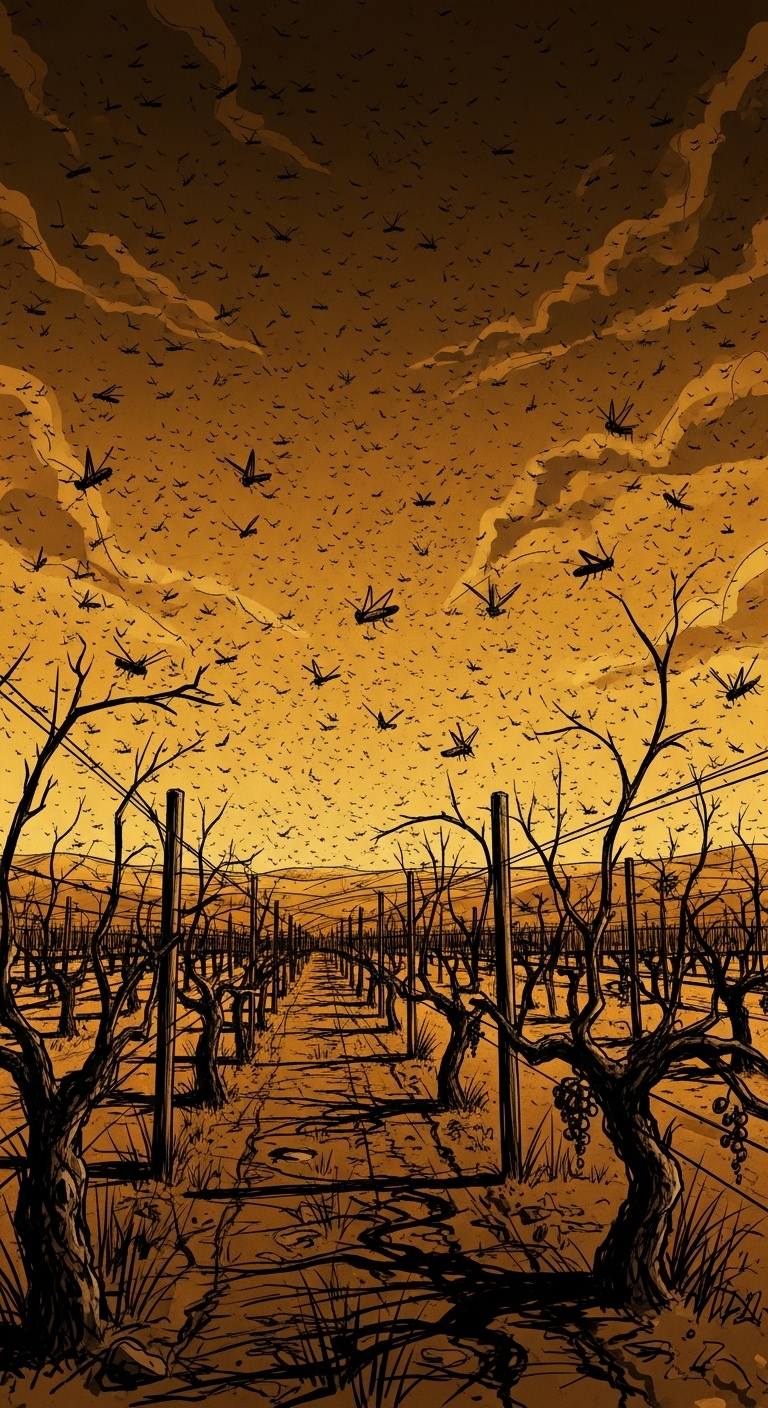
Joel begins with a disaster. A plague of locusts — four waves of them, each named with a different Hebrew word, each describing a different stage of devastation — has stripped the land bare. The vines are ruined. The fig trees are stripped. The grain is destroyed. The priests have no offering to bring. The joy of the people has withered.
This is not a metaphor. The locusts are real. The famine is real. And Joel opens the book not with a theological explanation but with a command: Tell your children about this. Let your children tell their children. Let their children tell the next generation.
The disaster itself is the beginning of a revelation. Something is being opened up through the catastrophe. Joel's task is to help his people see what.
Teaching Block 1 — Rend Your Hearts, Not Your Garments
The word of the Lord that came to Joel, the son of Pethuel. Listen to this, elders, and pay close attention, all inhabitants of the land. Did this ever happen in your days or in the days of your fathers? Talk this over with your sons, and your sons with their sons, and their sons with another generation. The locust has eaten what the caterpillar has left, and the beetle has eaten what the locust has left, and the mildew has eaten what the beetle has left. Rouse yourselves, you drunkards, and weep and wail, all you who delight in drinking wine; for it has been cut off from your mouth. For a nation has ascended over my land: strong and without number. His teeth are like the teeth of a lion, and his molars are like that of a lion's young. He has put my vineyard into desolation, and he has pulled off the bark of my fig tree. He has stripped it bare and cast it away; its branches have become white.
Joel 1:1-7 — CPDV
Joel's description of the locust plague is one of the most vivid pieces of writing in the Old Testament. The locusts are like lions. Their teeth are like those of a lioness. They have laid waste, stripped bare, cut down, thrown down. The land mourns.
But here is what Joel does with the disaster that most of his contemporaries would not: he does not look for someone to blame. He does not argue about whether the locusts were natural or supernatural. He asks: what does this moment require of us?
The answer, in Joel chapter 2, is repentance. But Joel is careful about what kind of repentance he is calling for.
Now, therefore, the Lord says: "Be converted to me with your whole heart, in fasting and weeping and mourning." And rend your hearts, and not your garments, and convert to the Lord your God. For he is gracious and merciful, patient and full of compassion, and steadfast despite ill will. Who knows if he might convert and forgive, and bequeath a blessing after him, a sacrifice and a libation to the Lord your God?
Joel 2:12-14 — CPDV
"Return to me with all your heart, with fasting, with weeping, and with mourning; and rend your hearts and not your garments." In the ancient world, tearing your garment was the outward sign of grief and repentance. Joel tells his people to do the inner thing, not just the outer thing. God is not interested in the performance of repentance. He is interested in the actual turning of the heart.
Who knows whether He will turn and relent? Again — like Zephaniah's perhaps — there is no guarantee. Repentance is not a transaction. It is the appropriate response to who God is. We return because He is the Lord, because He is gracious and merciful, slow to anger, abounding in steadfast love. Not because we will definitely get something in return.
Discussion Question 1: Joel makes a distinction between rending your garments — the performance of repentance — and rending your heart — the real thing. What does fake repentance look like in your life? The kind that checks the box but doesn't actually change the direction? What would the real version of the same repentance look like?
Teaching Block 2 — Your Sons and Daughters Shall Prophesy
And after this, it will happen that I will pour out my spirit upon all flesh, and your sons and your daughters will prophesy; your elders will dream dreams, and your youths will see visions. Moreover, in those days I will pour out my spirit upon my servants and handmaids. And I will grant wonders in the sky and on earth: blood and fire and the vapor of smoke. The sun will be turned into darkness, and the moon into blood, before the great and terrible day of the Lord shall arrive. And it will happen that everyone who will call upon the name of the Lord will be saved. For on Mount Zion, and in Jerusalem, and in the remnant whom the Lord will call, there will be salvation, just as the Lord has said.
Joel 2:28-32 — CPDV
After the call to repentance and the promise of restoration, Joel pivots to something no one expected: a vision of the Spirit being poured out on everyone.
In the Old Testament, the Spirit of God came upon specific people for specific tasks — a judge, a king, a prophet. It was selective. It was rare. The recipients were set apart for it. The average Israelite farmer did not expect the Spirit of God to descend on him.
Joel says that is about to change. Not on some people — on all flesh. Sons and daughters. Old men and young men. Even the servants, male and female. The Spirit will be poured out without distinction. Everyone will prophesy. Everyone will dream. Everyone will see visions.
This is a revolutionary statement. And for five hundred years it sat in Joel's book, quoted occasionally, not fully understood.
And when the days of Pentecost were completed, they were all together in the same place. And suddenly, there came a sound from heaven, like that of a wind approaching violently, and it filled the entire house where they were sitting. And there appeared to them separate tongues, as if of fire, which settled upon each one of them. And they were all filled with the Holy Spirit. And they began to speak in various languages, just as the Holy Spirit bestowed eloquence to them. But Peter, standing up with the eleven, lifted up his voice, and he spoke to them: "Men of Judea, and all those who are staying in Jerusalem, let this be known to you, and incline your ears to my words. For these men are not inebriated, as you suppose, for it is the third hour of the day. But this is what was spoken of by the prophet Joel: 'And this shall be: in the last days, says the Lord, I will pour out, from my Spirit, upon all flesh. And your sons and your daughters shall prophesy. And your youths shall see visions, and your elders shall dream dreams. And certainly, upon my men and women servants in those days, I will pour out from my Spirit, and they shall prophesy.
Acts 2:1-4,14-18 — CPDV
And then Pentecost.
Tongues of fire. The rush of wind. A room full of men who were fishermen and tax collectors suddenly speaking languages they had never learned. And a crowd gathered outside, baffled, some of them mocking: They are filled with new wine.
St. Peter stands up. And the first thing he does — the very first thing — is open the book of Joel. This is what was uttered through the prophet Joel. Not: this is sort of like what Joel said. Not: Joel had a foreshadowing of this. This is that. What you are seeing right now, in this crowd, in these streets, in the languages of every nation under heaven — this is the moment Joel was pointing at.
The Church was born in the fulfillment of a book that most Christians have never read.
Discussion Question 2: St. Peter's first move at Pentecost was to connect what was happening to Scripture — specifically to Joel. The crowd needed a framework to understand what God was doing. Where in your life are you experiencing something from God that you haven't yet connected to Scripture — something that feels real but you don't have language for? What would it mean to go looking for the Joel passage that names it?
Teaching Block 3 — Everyone Who Calls on the Name of the Lord
The most quoted verse from Joel is also its most universally applicable: "Everyone who calls on the name of the Lord shall be saved." St. Paul quotes it in Romans. St. Peter quotes it at Pentecost. It has become so embedded in Christian vocabulary that we forget it is a promise from a man standing in a field surrounded by locusts, watching the harvest fail, calling his people to rend their hearts.
The promise comes in the middle of catastrophe. It is not a promise made to people who have their lives together. It is a promise made to people who have lost their harvest, their security, their reason to celebrate. In that condition — with nothing left to offer but the calling out of the name — salvation comes.
Joel's book moves from devastation to repentance to the outpouring of the Spirit to the Day of the Lord to the promise of restoration. It is the entire arc of salvation history compressed into three chapters. The locusts in chapter one are not a detour from the story. They are the beginning of it. The disaster is what drives the people back to God, and the return is what positions them to receive what God was always planning to pour out.
Sometimes God uses the locusts.
Discussion Question 3: "Everyone who calls on the name of the Lord shall be saved." Joel wrote this to people who had lost everything. St. Paul wrote it to Gentiles who had never been part of the covenant. St. Peter proclaimed it to a crowd that had just watched the disciples speak in fire. What does it mean to you, tonight, in the specific condition you are in? Are you calling on the name, or are you managing from a distance?
This Week
Call on the name. Not a structured prayer, not a rosary, not morning offering — though all of those are good. Just the name, out loud, in your car or your kitchen or your yard at some point this week. Say it the way Joel's people said it standing in a ruined field: Lord. Save me. Let that be enough.
Closing Prayer
Take prayer requests and close out.