Session 7
Lamentations — The Prayer the Church Forgot How to Pray
Opening Prayer
LEADER: Let us begin by asking the Holy Spirit to be with us tonight.
ALL: Come, Holy Spirit, fill the hearts of your faithful and kindle in us the fire of your love. Send forth your Spirit and we shall be created, and you shall renew the face of the earth. O God, who by the light of the Holy Spirit did instruct the hearts of the faithful, grant that by the same Holy Spirit we may be truly wise and ever rejoice in His consolation, through Christ our Lord. Amen.
LEADER: Lamentations is the book the Church prays on Good Friday. It is the prayer of a man who watched everything he loved be destroyed — and kept praying anyway.
ALL: "Is it nothing to you, all you who pass by? Look and see if there is any sorrow like my sorrow, which was brought upon me, which the Lord inflicted on the day of his fierce anger." — Lamentations 1:12
Scripture Assignments
Before beginning, assign each passage to a man in the group. When the teaching reaches that passage, he reads it aloud.
- Passage 1: Lamentations 1:1–5
- Passage 2: Lamentations 2:11–13
- Passage 3: Lamentations 3:19–26
- Passage 4: Lamentations 5:19–22
The Book Written in the Ruins
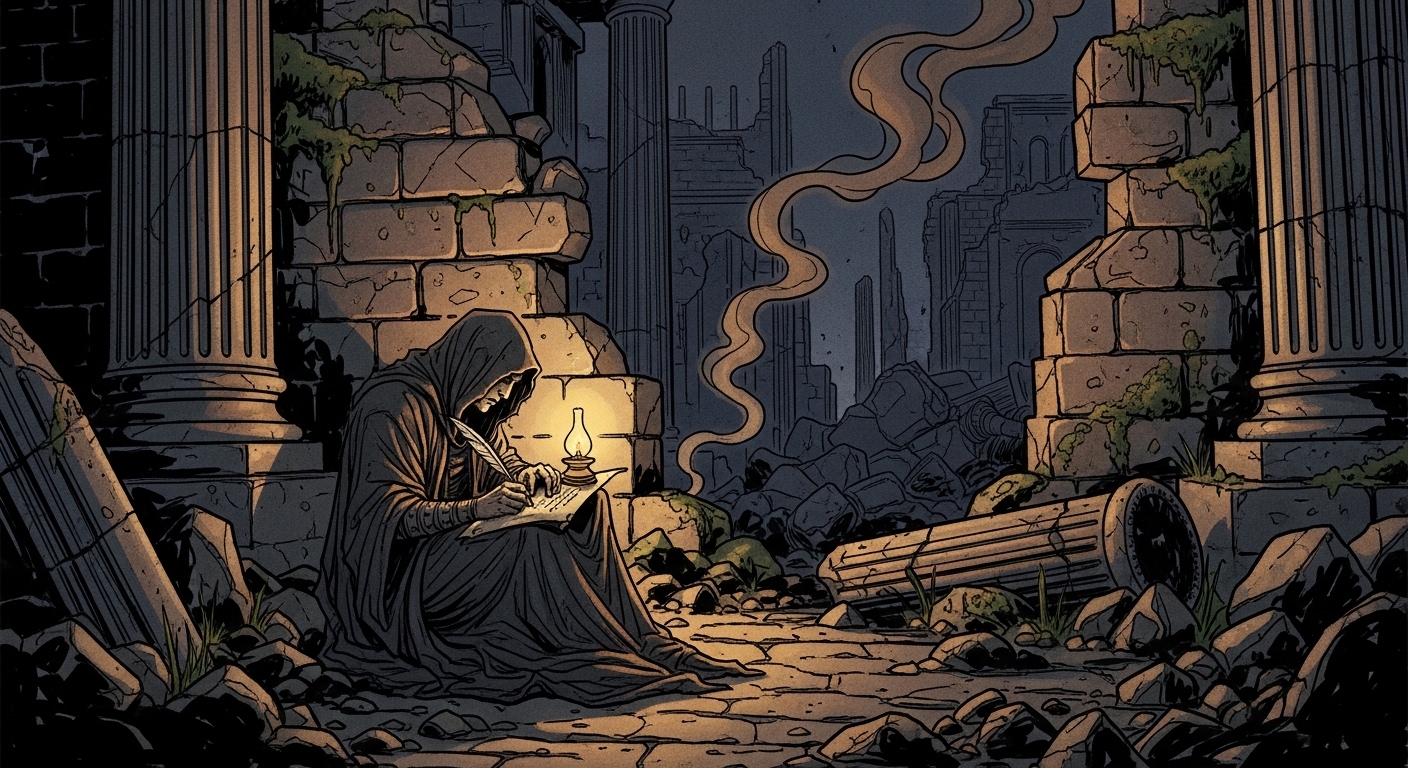
Jerusalem has fallen. The Temple is ash. The king has been blinded and chained, forced to watch his sons killed before the sword took his sight. The people are in exile. The streets that were full of people are empty. The city that was great among nations has become a widow.
The man writing Lamentations — likely Jeremiah, though the book does not name its author — did not leave. He stayed in the ruins. And sitting in the ruins, he wrote five poems. Not theological treatises. Not explanations. Not defenses of God's justice. Five poems of grief, structured with painful artistry — four of them written as acrostics, each verse beginning with the next letter of the Hebrew alphabet. Twenty-two letters. Twenty-two verses. The entire alphabet of grief.
The form is deliberate. You do not construct an acrostic in a moment of uncontrolled anguish. You write an acrostic when you are determined to say everything — to go through the whole alphabet of what you are feeling and not leave anything out.
Lamentations is not a book about losing faith. It is a book about how to grieve without losing faith.
Teaching Block 1 — The Permission to Grieve
ALEPH. O how a city once filled with people now sits alone! The Governess of the Gentiles has become like a widow. The Prince of the provinces has been placed under tribute. BETH. Weeping, she has wept through the night, and her tears are on her cheeks. There is no one to be a comfort to her and to all her beloved. All her friends have spurned her, and they have become her enemies. GHIMEL. Judah has migrated because of affliction and great servitude. She has lived among the nations and not found rest. All of her persecutors have apprehended her, amid torments. DALETH. The pathways of Zion mourn, because there are none who approach for the solemnity. All her gates are destroyed. Her priests groan. Her virgins are filthy. And she is overwhelmed with bitterness. HE. Her enemies have been made her leaders; her adversaries have been enriched. For the Lord has spoken against her, because of the multitude of her iniquities. Her little ones have been led into captivity before the face of the tribulator.
Lamentations 1:1-5 — CPDV
"How lonely sits the city that was full of people." The opening word in Hebrew is eikah — "how." It is a word of disbelief. Not why, which is a theological question. How — which is the utterance of someone who cannot reconcile what they see with what they expected. It is the word a man says standing in the ruins of his marriage, his health, his career, his family. How did we get here?
The Church has allowed men to ask why in the abstract — why does God permit suffering? — because that question can be answered with philosophy. But she has not always given men permission to ask how — the personal, specific, disoriented grief of a man looking at the rubble of something real. Lamentations gives that permission. It puts the howl of grief into the mouth of the people of God and preserves it in Scripture.
CAPH. My eyes have exhausted their tears. My internal organs have become disturbed. My liver has been poured out on the earth, over the grief of the daughter of my people, when the little ones and the infants passed away in the streets of the town. LAMED. They said to their mothers, "Where is the wheat and the wine?" when they fell like the wounded in the streets of the city, when they breathed out their lives into the bosoms of their mothers. MEM. To what shall I compare you, or to what shall I liken you, O daughter of Jerusalem? To what shall I equate you, so as to console you, O virgin daughter of Zion? For your destruction is as great as the sea. Who will cure you?
Lamentations 2:11-13 — CPDV
"My eyes are spent with weeping; my stomach churns; my bile is poured out to the ground." Jeremiah is not being poetic. He is describing what grief does to a body. His insides are spilling out. He is physically sick with sorrow. And his question — What can I say to you, to what compare you, O daughter of Jerusalem? What can I liken to you, that I may comfort you? — is not a rhetorical flourish. It is the honest admission that some grief is beyond comfort. You cannot fix it. You can only sit with it.
Most men have been trained to fix suffering, not to sit with it. Lamentations trains us for something harder.
Discussion Question 1: The Church preserved Lamentations precisely because grief is a legitimate form of prayer. What are you grieving right now that you haven't given yourself permission to bring to God as grief — not as a problem to be solved, but as a wound to be held? What would it mean to pray your eikah?
Teaching Block 2 — The Most Famous Verse in a Book Nobody Reads
ZAIN. Remember my poverty and my transgression, the wormwood and the gall. ZAIN. I will call to mind the past, and my soul shall languish within me. ZAIN. These recollections are in my heart; therefore, I shall hope. HETH. By the mercies of the Lord, we are not consumed. For his compassion has not passed away. HETH. I know it at first light; great is your faithfulness. HETH. "The Lord is my portion," said my soul. Because of this, I will wait for him. TETH. The Lord is good to those who hope in him, to the soul that seeks him. TETH. It is good to stand ready in silence for the salvation of God.
Lamentations 3:19-26 — CPDV
Here, in the exact center of the book, in the middle of the great lament, comes the pivot — and it is one of the most famous passages in all of Scripture.
"The steadfast love of the Lord never ceases; His mercies never come to an end; they are new every morning; great is Your faithfulness."
Those words live on coffee mugs and wall prints and Instagram captions. Almost no one knows they come from Lamentations — from a man sitting in the smoking ruins of Jerusalem, whose eyes are spent with weeping, whose stomach has churned out its bile onto the ground. The comfort of those words is only possible because of the desolation that surrounds them. Remove the ruins and the verses become sentiment. Keep the ruins and they become testimony.
The steadfast love of the Lord never ceases. Jeremiah does not say this because he feels it in the moment. He says it because he has decided to believe it in the face of everything that seems to contradict it. "The Lord is my portion," says my soul, "therefore I will hope in Him." It is a decision, not a feeling. He waits for the Lord. He hopes in silence. Because the Lord is good to those who wait for Him.
Discussion Question 2: "Great is Thy faithfulness" is one of the most beloved songs in Christianity. Most people who sing it don't know it comes from a man in ruins. Does knowing the context change how the words land for you? What would it mean to sing those words from inside your ruins, rather than from a place of comfort?
Teaching Block 3 — The Prayer That Doesn't Resolve
But you, O Lord, shall remain for eternity, your throne from generation to generation. Why would you forget us forever? Why would you forsake us for a long time? Convert us, O Lord, to you, and we shall be converted. Renew our days, as from the beginning. But you have utterly rejected us; you are vehemently angry against us.
Lamentations 5:19-22 — CPDV
Lamentations does not end with resolution. This is the part that most Christians find uncomfortable.
The final chapter ends with a prayer: "But you, O Lord, reign forever; your throne endures to all generations. Why do you forget us forever, why do you forsake us for so many days? Restore us to yourself, O Lord, that we may be restored! Renew our days as of old — unless you have utterly rejected us, and you remain exceedingly angry with us."
And then — silence. The book ends. No answer comes. No heavenly voice says I have not forgotten you. No angel descends. The prayer sits there, unanswered, on the last page. The final word of Lamentations, in the Hebrew, is the word for fierce anger.
The Church has preserved this ending for a reason. Not every prayer resolves in this life. Not every grief is lifted before the grave. The man of faith is not the man who never says how — he is the man who keeps praying even when the book ends without an answer. Even when the last word is still anger. Because the next chapter, the one Lamentations doesn't contain, is written by the resurrection.
Good Friday ends in silence too. And then comes Sunday.
Discussion Question 3: Lamentations ends without resolution. Is there a prayer in your life that feels like it ended on that last word — anger, or silence, or absence? What does it mean to keep praying into that silence? And what does the resurrection say about prayers that seem to have no ending?
This Week
Read Lamentations 3:19–26 slowly, out loud, once each morning this week. Before the coffee kicks in. Before the phone. Before anything else. Let the man in the ruins teach you what faithfulness looks like when the ruins are still there.
Closing Prayer
Take prayer requests and close out.