Session 10
"The Living Light" — Hildegard and the Theology of Beauty
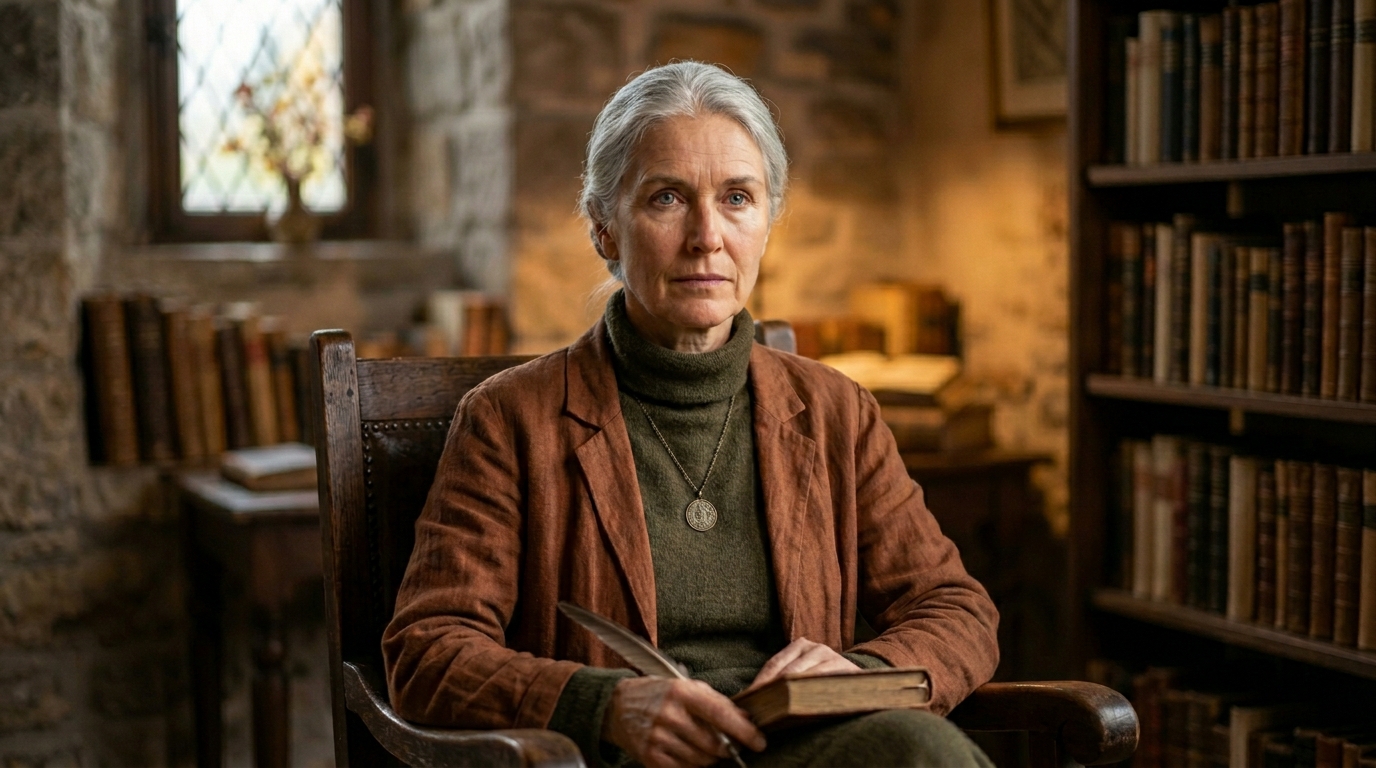
Session 10 — St. Hildegard of Bingen
"The Living Light" — Hildegard and the Theology of Beauty
Opening Prayer
LEADER: Let us begin by asking the Holy Spirit to be with us tonight.
ALL: Come, Holy Spirit, fill the hearts of your faithful and kindle in us the fire of your love.
LEADER: Send forth your Spirit and we shall be created.
ALL: And you shall renew the face of the earth.
LEADER: O God, who by the light of the Holy Spirit did instruct the hearts of the faithful,
ALL: Grant that by the same Holy Spirit we may be truly wise and ever rejoice in His consolation, through Christ our Lord. Amen.
LEADER: Tonight we sit with a woman who saw God in colors that have no names — a twelfth-century German nun whose visions of the Living Light reshaped what the Church understood about creation, beauty, and the soul's life with God. Lord, give us eyes to see Your light in the world You made.
ALL: St. Hildegard of Bingen, pray for us. Amen.
Scripture Assignments
Assign each passage to a woman in the group before beginning.
- Passage 1: Genesis 1:26-31
- Passage 2: Wisdom 7:24-27
- Passage 3: Psalm 19:1-4
- Passage 4: Colossians 1:15-20
Who Was This Woman?
Her name was Hildegard, and she was born in 1098 in the Rhineland of what is today western Germany — a small village called Bermersheim, in the diocese of Mainz. She was the tenth child of a noble family. At the age of eight, by the custom of the time, her parents offered her as a tithe of their children to the Church, and she was given into the care of a young noblewoman named Jutta, who lived as an anchoress — a consecrated woman walled into a small dwelling attached to the Benedictine monastery of Disibodenberg.
For the next thirty years, St. Hildegard lived inside that walled-in cell, then in the small community of women that grew up around it. When Jutta died in 1136, the sisters elected St. Hildegard as their leader. She was thirty-eight years old. And she had a secret.
Since she was three, she had been seeing visions. Not dreams, not pious imaginings, but what she called the Living Light — a luminous presence she perceived directly, with her waking eyes, in which images, voices, and theological truths were communicated to her. She had told almost no one. For most of her life, she had assumed everyone saw the world this way and had simply learned, through experience, that they did not. She kept the visions to herself.
Then, in 1141, when she was forty-three, she received what she described as a command from God to write down what you see and hear. She resisted. She was terrified. She was a woman, with no formal theological education, in an era when even male theologians were beginning to lose authority to the new university scholastics. To write — to publish — would be audacious beyond words. She fell into a serious illness from her refusal. Eventually her spiritual director, a Benedictine monk named Volmar, helped her begin to write. The result was a vast theological work called Scivias — short for Sci vias Domini, Know the Ways of the Lord — describing twenty-six of her visions, with theological commentary.
The book reached the Synod of Trier in 1147, where Pope St. Eugenius III himself reviewed selected passages, was deeply moved, and gave her his formal apostolic blessing to continue writing and publishing. With the Pope's endorsement, she became, almost overnight, one of the most consequential theological voices in the Latin Church. She wrote two more major works of visionary theology, Liber Vitae Meritorum (Book of the Rewards of Life) and Liber Divinorum Operum (Book of Divine Works). She wrote a treatise on natural medicine called Physica and a medical handbook called Causae et Curae. She composed sacred music — over seventy compositions, more surviving works than any other composer of her century, male or female. She wrote a morality play with music called Ordo Virtutum, the earliest known of its genre. She founded her own monastery at Rupertsberg, near the town of Bingen, from which she takes her name. She advised popes, emperors, abbots, and bishops by letter. She preached publicly — publicly — in the cathedrals of Cologne, Trier, Liège, and elsewhere, at a time when no other woman in Latin Christendom was doing such a thing.
She died in 1179, at eighty-one years old. Her cause for canonization was opened almost immediately. It took 833 years to complete. In 2012, Pope Benedict XVI formally canonized her and, in the same year, named her a Doctor of the Church — the fourth woman Doctor in the Church's history. Doctor of the Church is one of the highest titles the Church can give. It means her writings are recognized as authoritative for the universal Church, in every age, for the formation of Christian life and theology. There are presently thirty-seven Doctors. Four of them are women. St. Hildegard is one.
That is the woman we are sitting with tonight. The visionary, the abbess, the composer, the preacher, the theologian — and one of only four women in two thousand years of Church history to be given the title Doctor.
Teaching Block 1 — The Living Light
St. Hildegard's central image, the one that shapes everything else in her theology, is the Living Light. Lux vivens. It is the name she gave to the way God appeared to her — not as a person she could see in the way she saw the sisters in her monastery, but as a luminous presence that filled her vision and through which she perceived deeper realities.
She is careful, in her own writings, to distinguish this from any kind of self-generated mystical experience. I see these things not with the outer eyes of the body or with the thoughts of my heart, she writes, but in my soul, with my eyes open, with the inner eye, without ecstasy and without losing my senses, day and night. She was not in a trance. She was awake. She was working. She was running a monastery, advising popes, composing music. And, throughout all of it, she was perceiving the Living Light.
This is not as strange as it sounds, and it is not as foreign to Catholic spirituality as you might think.
And he said: "Let us make Man to our image and likeness. And let him rule over the fish of the sea, and the flying creatures of the air, and the wild beasts, and the entire earth, and every animal that moves on the earth." And God created man to his own image; to the image of God he created him; male and female, he created them. And God blessed them, and he said, "Increase and multiply, and fill the earth, and subdue it, and have dominion over the fish of the sea, and the flying creatures of the air, and over every living thing that moves upon the earth." And God said: "Behold, I have given you every seed-bearing plant upon the earth, and all the trees that have in themselves the ability to sow their own kind, to be food for you, and for all the animals of the land, and for all the flying things of the air, and for everything that moves upon the earth and in which there is a living soul, so that they may have these on which to feed." And so it became. And God saw everything that he had made. And they were very good. And it became evening and morning, the sixth day.
Genesis 1:26-31 — CPDV
Genesis tells us that God spoke creation into being and saw that it was good — and tells us seven times that He saw it was good. Six times for the days of creation, and a seventh — the summary — that what He had made was very good. The Catholic tradition has always read this seriously. The created world is not neutral. The created world is not raw material on which God's truth is somehow superimposed. The created world is itself a revelation — what theologians call the book of nature, alongside the book of Scripture, the first place where God speaks to us about who He is.
St. Hildegard's visions were not a denial of this; they were an intensification of it. She saw the world as it actually is — a place radiant with divine presence, in which every creature, every plant, every stone, every river bears the signature of the Creator. She had a word for this radiance, a word she coined: viriditas. It is Latin for greenness, but in St. Hildegard's usage it means much more than that. It is the life-giving freshness of God flowing through all of creation — the green vigor that makes plants grow, that makes wounds heal, that makes a soul that has been near death come back to life. Viriditas is, for St. Hildegard, the visible evidence of God's invisible Spirit, working in everything that grows.
She saw it in plants. She saw it in animals. She saw it in human bodies. She saw it in the rhythms of the liturgical year. She saw it in herself when she prayed and in her sisters when they sang. She saw it, most of all, in Christ — the greenness of the Father, as she called Him in one place, the source of all viriditas in creation. The Catholic faith, for St. Hildegard, was not a set of doctrines layered over a dead world. It was the explanation of why the world is so unbearably alive.
This is the great gift St. Hildegard offers Catholic women who have begun to feel that their faith has become abstract or grey. The world you live in is full of viriditas, full of the Living Light, full of God's signature in every leaf and every body and every honest moment of love. The faith is not somewhere else. The faith is here — in the kitchen, in the garden, in the body that has carried you this far, in the small bright life of every creature you meet. The Catholic tradition has been telling Catholic women this for nine hundred years. Some of them have only just started to hear it.
Discussion Question 1: St. Hildegard saw the world as full of viriditas — the green, life-giving radiance of God flowing through all of creation. Most modern Catholics have a much greyer experience of the world; the faith feels separated from the rest of life, and creation feels neutral or even hostile. Where in your life do you most easily perceive the viriditas of God — the freshness of divine life — and where has it gone dim? What might it look like to recover the practice of seeing God in the ordinary creation around you?
Teaching Block 2 — Beauty as Theological Category
Most modern Christians do not think of beauty as a serious theological category. We treat beauty as a matter of taste, of aesthetics, of personal preference — interesting, perhaps, but not on the level of truth or goodness. The Catholic tradition has never agreed.
The Catholic theological tradition speaks of three transcendentals — three names of God that radiate through creation and that the human soul recognizes as ultimate: the True, the Good, and the Beautiful. These are not three categories of human valuation; they are three ways in which God's own nature is reflected in everything He has made. Truth is the radiance of His mind. Goodness is the radiance of His will. Beauty is the radiance of His glory. To encounter beauty in the world is to encounter, in a particular way, the splendor of God Himself.
St. Hildegard knew this. She did not just think about beauty — she composed it. Over seventy of her musical compositions survive, and they are unlike anything else from her century. They soar. Where most twelfth-century plainchant moves within a narrow range of notes, St. Hildegard's melodies leap across octaves. Where most twelfth-century chant follows established conventions, St. Hildegard's chant breaks them, reaching for sounds the conventions could not contain. She was, by every measure, a serious composer doing serious work — and she did it because, for her, music was not decoration. Music was theology made audible.
There is a moment late in her life that captures this perfectly. In 1178, when she was eighty years old, she and her community gave Christian burial in their monastery cemetery to a young man who had been under ecclesiastical interdict — meaning the local Church authorities had withdrawn the sacraments from him. St. Hildegard had received private testimony that he had reconciled with the Church before death, and on that authority she buried him in consecrated ground. The diocesan authorities disagreed and placed her entire monastery under interdict — which meant, among other things, that the sisters were forbidden to sing the Divine Office. Forbidden to sing.
St. Hildegard wrote a famous letter of protest. When we consider — she wrote — that the body is the garment of the soul, and that the soul, with the body, gives voice to the praises of God, we should not be deprived of this voice... For the sound of praise itself is from God, before all sin, and through the praising voice the human soul comes back to the harmony of paradise. The letter went all the way to the archbishop. The interdict was lifted. The sisters began to sing again.
This is a Catholic woman in the twelfth century telling an archbishop that forbidding women to sing is forbidding the work of God. She did it on theological grounds. She did it from her own authority. And she won.
Read what Scripture says about how beauty teaches us.
For wisdom is more active than all active things, yet she reaches everywhere because of her purity. For she is a breath of the virtue of God and a genuine emanation from the purity of the almighty God, and therefore nothing unclean can invade her. Indeed, she is the brightness of eternal light, and the unspotted mirror of the majesty of God, and the image of his goodness. And though she is one, she can do all things; and, unchanging in herself, she renews all things, and throughout the nations she conveys herself to holy souls, establishing them as friends and prophets of God.
Wisdom 7:24-27 — CPDV
The book of Wisdom describes the Wisdom of God as a breath of the power of God, and a pure emanation of the glory of the Almighty... she is a reflection of eternal light, a spotless mirror of the working of God, and an image of His goodness. This is the same theology St. Hildegard worked in — the conviction that beauty is not a luxury of the spiritual life. Beauty is a door. Beauty is the way the soul, weighed down by the ordinary friction of the world, is lifted into the presence of God.
Unto the end. A Psalm of David. May the Lord hear you in the day of tribulation. May the name of the God of Jacob protect you. May he send you help from the sanctuary and watch over you from Zion. May he be mindful of all your sacrifices, and may your burnt-offerings be fat.
Psalm 19:1-4 — CPDV
The heavens are telling the glory of God; and the firmament proclaims His handiwork. Day to day pours forth speech, and night to night declares knowledge. The Psalms have always known what St. Hildegard knew. The created world is, itself, speech — a voice telling us about God. There is no place on earth where this speech is not being uttered. There is no corner of creation that is not, every moment, declaring the glory of its Maker.
Catholic women who have been formed by a flat, utilitarian culture often need to be told this directly: beauty is not a luxury. Beauty is a witness. The beauty of the Catholic liturgy is not decoration. The beauty of sacred art and music is not optional. The beauty of a well-kept home, a well-prepared meal, a careful word, a kindness in passing — these are not aesthetic indulgences. They are theological acts. They participate in the work of God who saw that it was good and made it so.
Discussion Question 2: St. Hildegard treated beauty as a serious theological category — beauty is not decoration, but a witness to God. Most of us have areas of our lives where we have stopped attending to beauty because it feels frivolous or impractical. Where in your life could you recover beauty as a real Catholic practice — in your home, in your prayer, in the way you eat or dress or speak — not as vanity, but as worship?
Teaching Block 3 — Christ the Source of All Beauty
We have to end where St. Hildegard's whole theology ends, and where the Catholic tradition has always ended its theology of beauty — at Christ.
He is the image of the invisible God, the first-born of every creature. For in him was created everything in heaven and on earth, visible and invisible, whether thrones, or dominations, or principalities, or powers. All things were created through him and in him. And he is before all, and in him all things continue. And he is the head of his body, the Church. He is the beginning, the first-born from the dead, so that in all things he may hold primacy. For the Father is well-pleased that all fullness reside in him, and that, through him, all things be reconciled to himself, making peace through the blood of his cross, for the things that are on earth, as well as the things that are in heaven.
Colossians 1:15-20 — CPDV
Read this passage slowly. It is, in some ways, the most concentrated theological claim in all of St. Paul's letters. He is the image of the invisible God, the firstborn of all creation; for in Him all things were created, in heaven and on earth, visible and invisible... all things were created through Him and for Him. Then, three verses later: In Him all things hold together.
Every beautiful thing in creation — every sunrise, every face, every chord of music that has ever moved you to tears — is being held together, right now, by Christ. He is not just the One through whom these things were originally made. He is the One in whom they are sustained, moment by moment, in being. The beauty of the created world is not a residue of His past act of creation. It is the present radiance of His ongoing presence in everything that is.
St. Hildegard understood this with extraordinary clarity. In one of her visions, she sees Christ as the brightness of the living God, who shines in the works of His glory — and the whole vision becomes a kind of musical and visual liturgy in which all of creation is participating, knowingly or unknowingly, in the worship of the One who holds it in being. Her music, her medicine, her writings, her sermons — all of it is one project. She is bearing witness to the Christ who is at the center of everything beautiful in the world.
And this is where the Catholic theology of beauty becomes pastoral, not just doctrinal. Because if Christ is the source of all beauty, then every time you perceive something beautiful, you are perceiving Him. Not as fully as the saints in glory perceive Him. But really. The beauty of a child's laughter, the beauty of an evening sky, the beauty of a great hymn, the beauty of a kindness done in secret — every one of these is a particular, partial, real glimpse of the Christ who holds the world. The world has been so full of His beauty, every moment of every day of every life you have ever lived, that the wonder is not that you have sometimes seen Him in it. The wonder is that you ever fail to.
The Catholic mystical tradition has a phrase for the soul's gradual training in this perception. They call it seeing God in all things. Not as a slogan. As a discipline. As something a Catholic woman learns, slowly, across a lifetime of attention, until her experience of the ordinary world becomes saturated with the awareness of the One who is, every moment, holding it. St. Hildegard had this discipline at a level few have ever had. She is not asking us to match her. She is telling us the door is open.
And there is one more thing to see, and it is the hope that finishes everything St. Hildegard ever wrote about beauty. The Christ who is the source of all beauty in the present world is the same Christ who will be the source of all beauty in the world to come. The new creation — the one we were studying with St. Macrina last week — will not be a different world without beauty. It will be this world, transformed, with its beauty intensified beyond measure, every creature singing in its full voice, every color seen in its full brightness, every face shining with the glory of the Christ who is finally, fully present in everything. The beauty you perceive in the present world is the promise of the beauty that awaits. Behold, I make all things new.
This is the conviction Catholic women have lived in for nine hundred years since St. Hildegard, and for two thousand years since the apostles. The world is beautiful because Christ is beautiful. The world will be more beautiful because Christ will be more fully present. And the woman who learns to see beauty as His signature in the present world is being prepared, by that very seeing, for the day when she sees Him face to face.
Discussion Question 3: St. Paul says of Christ that in Him all things hold together — and St. Hildegard saw the entire created world as radiant with His presence. What would change in your daily life if you took seriously that every beautiful thing you encounter — every sunset, every kind face, every piece of music that has ever moved you — is a real, partial glimpse of Christ Himself? How might that change the way you walk through your week?
This Week
Choose one beautiful thing in your daily life — something you usually rush past — and stop, this week, for thirty seconds in front of it. A flower in your yard. A stained-glass window at your parish. The face of your child or your husband as he sleeps. A piece of music you love. Stand in front of it. Look at it as though Christ were holding it in being for you, in that moment, on purpose. Say, simply: Thank You for this.
Do this once a day for the next seven days. Notice what happens to your soul.
If you do not own any sacred music, find a recording of St. Hildegard's O Virtus Sapientiae or O Viridissima Virga and listen to it once this week, with attention. You will be hearing the music of a saint who composed it as a window into the Living Light. Let it be a window.
Closing Prayer
Gather prayer requests and close out.