Session 12
"The Bride and the Blood" — Catherine and Bridal Mysticism
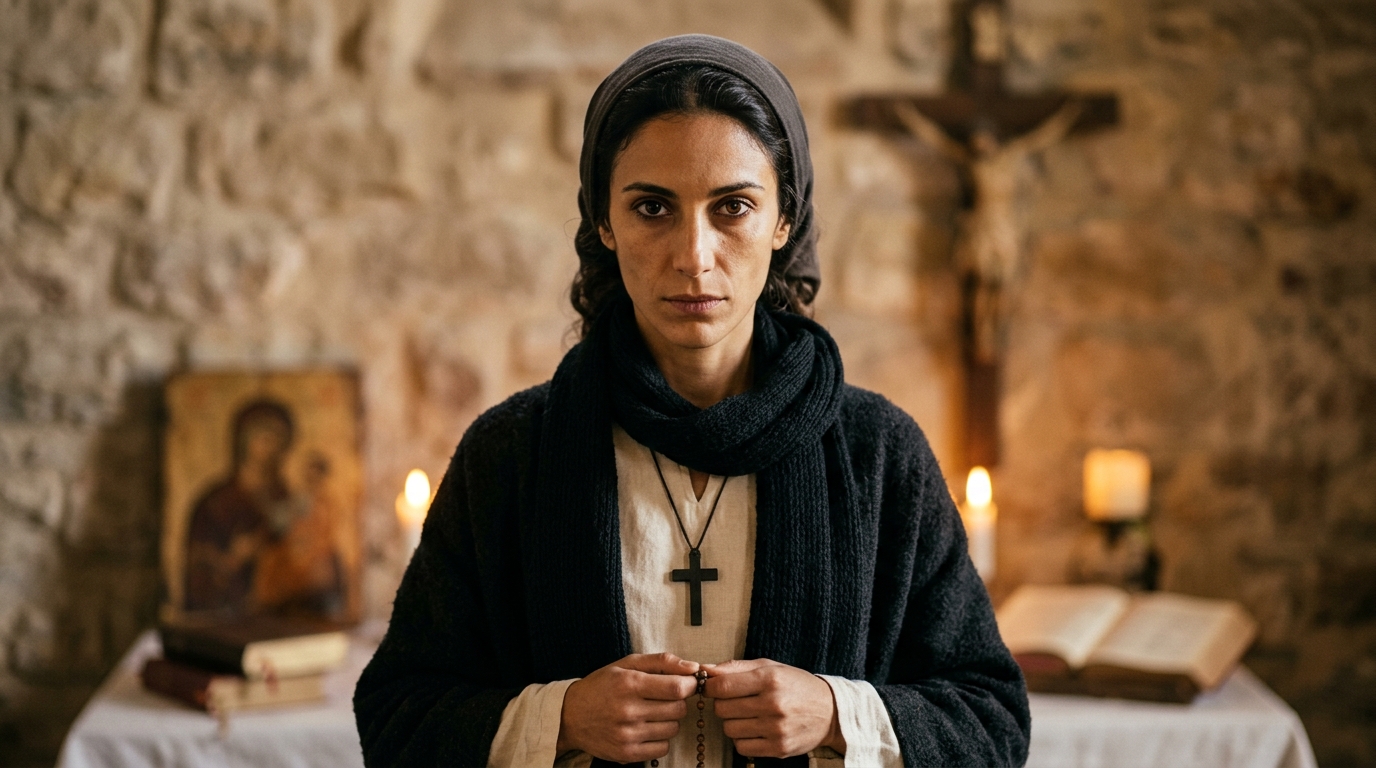
Session 12 — St. Catherine of Siena
"The Bride and the Blood" — Catherine and Bridal Mysticism
Opening Prayer
LEADER: Let us begin by asking the Holy Spirit to be with us tonight.
ALL: Come, Holy Spirit, fill the hearts of your faithful and kindle in us the fire of your love.
LEADER: Send forth your Spirit and we shall be created.
ALL: And you shall renew the face of the earth.
LEADER: O God, who by the light of the Holy Spirit did instruct the hearts of the faithful,
ALL: Grant that by the same Holy Spirit we may be truly wise and ever rejoice in His consolation, through Christ our Lord. Amen.
LEADER: Tonight we sit with a woman who saw the Blood of Christ on every page of her life, and whose union with Him was so deep the Church has called it a mystical marriage. Lord, make us bold enough to receive love at that depth.
ALL: St. Catherine of Siena, pray for us. Amen.
Scripture Assignments
Assign each passage to a woman in the group before beginning.
- Passage 1: Song of Solomon 2:10-13
- Passage 2: Hosea 2:14-20
- Passage 3: Ephesians 5:25-32
- Passage 4: Revelation 19:6-9
Who Was This Woman?
Her name was Caterina Benincasa, born in 1347 in the Italian city of Siena. She was the twenty-fifth child of her parents Giacomo and Lapa — a wool dyer and his wife, ordinary working-class Sienese — and a twin. Her twin sister Giovanna died in infancy. St. Catherine survived, was raised in the busy household above her father's dye shop in the contrada of Fontebranda, and from her earliest years showed signs of being not quite like other children.
She had her first vision when she was six. She was walking home with her brother from visiting a married sister, and she saw, suspended above the church of San Domenico across the valley, Christ in glory, seated on a throne, dressed in pontifical robes, with St. Peter and St. Paul and St. John the Evangelist beside Him. He looked at her and smiled and gave her His blessing. She stopped on the road. Her brother had to drag her along. From that day forward, the world around her had a different center.
By the time she was seven she had vowed her virginity to Christ in private — a vow her family did not learn of for years. At twelve, her parents tried to arrange her marriage. She refused. They pressed harder. She cut off her hair. She fasted. She made her body unattractive to suitors on purpose. Her family, finally, gave up — and her mother, exasperated, assigned her the work of a household servant in their own home, expecting that the indignity would break her. It did not. St. Catherine performed the work with extraordinary peace, treating every household task as a service rendered directly to Christ. At sixteen, her father, watching her, finally relented. She joined the Dominican Mantellate — a third order of laywomen who wore the Dominican habit but lived in their own homes, dedicated to prayer and service to the poor and sick.
For three years, from sixteen to nineteen, she lived in a small room in her parents' house in almost total silence, leaving it only to attend Mass and to receive the sacraments. She slept on a board with a stone for a pillow. She ate almost nothing. She spent her days in prayer. And during those three years, the events of her interior life were so intense that they remade her into the figure the Church would later canonize.
The center of those three years came at the end of them, on Shrove Tuesday of 1366, when she was nineteen. She had a vision in which Christ Himself appeared to her, accompanied by His mother Mary, by King David, by St. John the Evangelist, St. Paul, and St. Dominic. Our Lady took St. Catherine's right hand and offered it to her Son. He took it, and placed on her finger a wedding ring set with four pearls and a brilliant diamond, and said to her: I espouse you to Me in faith, to Me your Creator and Savior. Keep this faith unstained until you arrive at the perfect wedding feast in heaven. The Catholic tradition has called this the Mystical Marriage of St. Catherine. She wore the ring, visibly only to herself, for the rest of her life.
After that vision, she came out of her cell. She began working with the sick and dying in the hospitals of Siena. She nursed plague victims at the height of the Black Death — which had returned to Siena multiple times in her lifetime — and embraced the work as a daily encounter with the wounds of Christ. A circle of followers gathered around her, men and women both, who called her Mamma — Mother — and depended on her counsel. Among them was the Dominican friar Raymond of Capua, who became her confessor and later wrote her biography. She began to write letters — eventually nearly four hundred of them survive — to popes, cardinals, kings, queens, prisoners, prostitutes, soldiers, abbesses, and ordinary people of every station.
By her late twenties she had become the most influential lay Catholic in Europe. She persuaded Pope Gregory XI to end the seventy-year exile of the papacy in Avignon and return the papal seat to Rome — one of the most consequential acts of her century. She mediated between warring Italian city-states. She advised popes, urged reforms, called bishops to holiness. Her major theological work, dictated in a kind of sustained ecstasy across several months in 1377–78, became known as the Dialogue of Divine Providence — a book-length conversation between her soul and God the Father, in which she received some of the most concentrated mystical theology in the Catholic tradition.
She died in 1380. She was thirty-three years old. The same age, she would have been the first to note, as her Bridegroom on the day He died.
She was canonized in 1461. She was named co-patroness of Italy in 1939. She was named a Doctor of the Church in 1970 — one of the first two women ever given that title, along with St. Teresa of Ávila, and the second woman in the chronology of formal recognition. In 1999, Pope St. John Paul II named her co-patroness of Europe.
That is the woman we are sitting with tonight. The wool dyer's daughter who became the Bride of Christ and the conscience of fourteenth-century Europe. The mystic whose theological work is read today, six hundred years after her death, in Catholic seminaries and convents and Bible studies like this one. The woman who proved, in case anyone doubted, that mystical union with Christ is not an escape from the world; it is the only thing that makes work in the world possible at the depth Christ Himself worked at.
Teaching Block 1 — The Soul as Bride
The Catholic mystical tradition has used many images for the relationship between God and the soul — friendship, sonship, discipleship, servant and master. But the image the tradition has used most consistently, from the Old Testament prophets through the New Testament parables through every century of Christian mysticism, is the image of marriage. The soul as bride. Christ as Bridegroom. The relationship between God and His people as a covenant of love so deep that no other human relationship can quite contain its meaning.
This needs to be said carefully, because in modern culture bridal mysticism is sometimes misread as sentimental, romantic, or therapeutic. The Catholic tradition has never meant any of those things by it. What the Catholic tradition has meant is that the deepest and most accurate analogy for God's love for the human soul is the covenant of marriage — a love that is exclusive, total, fruitful, lifelong, and consummated in union. The Old Testament prophets are direct about this.
"Because of this, behold, I will attract her, and I will lead her into the wilderness, and I will speak to her heart. And I will give to her, from the same place, her vinedressers, and the valley of Achor as a passage of hope. And she will sing there as in the days of her youth, and as in the days of her ascension from the land of Egypt. And it will be in that day," says the Lord, "that she will call me, 'My Husband,' and she will no longer call me, 'My Baal.' And I will remove the names of the Baals from her mouth, and she will no longer remember their name. And in that day, I will strike a deal with them, with the beasts of the field, and with the birds of the sky, and with the creatures of the earth. And I will crush the bow and the sword, and I will wipe away war from the earth. And I will let them sleep securely. And I will betroth you to me forever, and I will betroth you to me in justice and judgment, and in mercy and compassion. And I will wed you to me in faith, and you will know that I am the Lord.
Hosea 2:14-20 — CPDV
Hosea is told by God to marry an unfaithful woman as a prophetic sign — a living parable of God's love for Israel, who has been unfaithful to Him repeatedly and yet whom He continues to pursue. Therefore, behold, I will allure her, and bring her into the wilderness, and speak tenderly to her... And in that day, says the Lord, you will call Me, "My husband"... And I will betroth you to Me forever; I will betroth you to Me in righteousness and in justice, in steadfast love and in mercy. I will betroth you to Me in faithfulness; and you shall know the Lord.
Read those last lines again. I will betroth you to Me forever. God speaks of His love for His people in the language of marriage, not as a metaphor we add on top, but as the primary register in which He describes the relationship. The covenant at Sinai is a marriage covenant. The faithlessness of Israel is adultery. The reconciliation God offers is a renewal of vows. The whole structure of salvation history is a love story between the God who is Husband and the people who are His Bride.
The Song of Solomon takes this same language and turns it into poetry.
Lo, he stands beyond our wall, gazing through the windows, watching through the lattices. Lo, my beloved speaks to me: Groom to Bride: Rise up, quickly, my love, my dove, my shapely one, and advance. For winter has now past; the rain has decreased and gone away.
Song of Songs 2:10-13 — CPDV
My beloved speaks and says to me: Arise, my love, my fair one, and come away. The Song of Solomon is the longest sustained love poem in the Bible, and the Catholic tradition has, from the earliest centuries, read it as the great Scriptural witness to the love of God for the soul. St. Bernard of Clairvaux preached eighty-six sermons on its first two chapters alone. St. Gregory of Nyssa wrote a commentary on it that is one of the great works of patristic mystical theology. St. John of the Cross's spiritual classics borrow their imagery from it. Every major mystical theologian in the Catholic tradition has, at some point, returned to the Song to find the language they needed.
And St. Catherine of Siena lived inside it. The love language of the Song was not metaphorical for her. It was descriptive. She had been espoused to Christ in a vision when she was nineteen. She wore the ring. She lived for the next fourteen years inside the daily reality of being His — and not in a way that floated above the ordinary world, but in a way that made the ordinary world more vivid, more demanding, more real than it had ever been before.
This is the Catholic conviction about bridal mysticism that gets misunderstood the most: mystical union with Christ is not an escape from reality. It is the deepest form of engagement with reality. Because the soul that has been espoused to Christ now sees the world as His — every person in it as one He died for, every situation in it as a place where He is at work, every duty in it as something to be done for Him personally. St. Catherine did not retire from the world after her mystical marriage. She came out of her cell and into the plague wards. She nursed lepers. She wrote to popes. She walked into political situations most clerics would not touch. She did all of this because of the mystical marriage, not despite it.
Discussion Question 1: The Catholic tradition has used the language of marriage — exclusive, total, lifelong, fruitful — as the deepest analogy for God's love for the human soul. Most modern Catholic women have never thought of their relationship with Christ in these terms; we have been formed with images of friendship or discipleship but rarely with the image of the Bride. What would change in your prayer life and your daily walk with Christ if you took seriously that you are, in a real theological sense, His Bride?
Teaching Block 2 — The Blood
There is one image more central to St. Catherine's spirituality than even the bridal image, and it is the one that gives this session its second word. The Blood.
St. Catherine saw the Blood of Christ everywhere. In her letters, she signs herself again and again with the phrase I, Catherine, servant and slave of the servants of Jesus Christ, write to you in His precious Blood. She speaks of bathing herself in the Blood, of drinking the Blood, of the cell of the knowledge of self where you discover the Blood. For St. Catherine, the Blood of Christ is the central reality of the Christian life — the place where the love of God for the soul becomes visible, the medicine for every sin, the bond of every union with Him.
This is not idiosyncratic to her. This is straight Catholic theology, made vivid.
Husbands, love your wives, just as Christ also loved the Church and handed himself over for her, so that he might sanctify her, washing her clean by water and the Word of life, so that he might offer her to himself as a glorious Church, not having any spot or wrinkle or any such thing, so that she would be holy and immaculate. So, too, husbands should love their wives as their own bodies. He who loves his wife loves himself. For no man has ever hated his own flesh, but instead he nourishes and cherishes it, as Christ also does to the Church. For we are a part of his body, of his flesh and of his bones. "For this reason, a man shall leave behind his father and mother, and he shall cling to his wife; and the two shall be as one flesh." This is a great Sacrament. And I am speaking in Christ and in the Church.
Ephesians 5:25-32 — CPDV
St. Paul is teaching the Ephesians about marriage, and he says something that has shaped Catholic theology of marriage ever since: Husbands, love your wives, as Christ loved the Church and gave Himself up for her, that He might sanctify her, having cleansed her by the washing of water with the word. The marriage of Christ and the Church is consummated in the blood of the Cross. The Bride is presented to her Husband not on the day she meets Him, but on the day He dies for her. The love that the Bridegroom has for her is measured by what He was willing to pour out for her sake.
And then St. Paul ends with the verse Catholic theology has read for two thousand years as the central image of Christ and the Church: This mystery is a profound one, and I am saying that it refers to Christ and the Church. Human marriage, St. Paul says, is not the primary reality — it is the image of a deeper reality. The deeper reality is the marriage of Christ and His Church, sealed on the Cross, in His Blood.
St. Catherine understood this completely. For her, the Blood was not just a devotional image. It was the literal substance — sacramentally received in the Eucharist, spiritually contemplated in prayer, mystically present in every act of charity — through which the Bride is joined to her Bridegroom. Without Blood, there is no marriage. Christ does not love the Church abstractly. He loves her to the last drop of His Blood. And the Bride who receives Him in the Eucharist receives the Blood by which she is His.
This is why, for St. Catherine, mystical union with Christ was inseparable from the Cross. She did not have a soft, comforting spirituality. She had a bloody one — in the sense that she understood the love of Christ as costing Him everything, and as costing her, in different ways, the same. She fasted to a degree the medical profession of our own time would call dangerous. She nursed plague victims at risk of her own death. She put herself between warring factions in Italian city-states and risked being murdered for it. She wore herself out in her thirties, dictating the Dialogue and writing letters and traveling and praying, until her body literally could not continue. She gave her Bridegroom what He had given her.
This is the deepest Catholic teaching about the soul united to Christ. Union with Him is not painless. The bride who has been espoused to the Crucified does not get to keep her old life. She gives Him what He gave her — not because He demands it, but because love, at the depth He has loved her, asks for everything in return.
Discussion Question 2: St. Catherine's spirituality was inseparable from the Blood of Christ — the literal cost of His love, received in the Eucharist, contemplated in prayer, returned to Him in a life poured out. Most Catholic women have a more comfortable spirituality than this. Where in your life has Christ been asking you to pour something out for Him — your time, your comfort, your reputation, your strength — and where have you been holding back?
Teaching Block 3 — The Wedding Feast
We end where every Catholic theology of bridal mysticism ends, which is where the book of Revelation ends, which is where every Mass on earth points us — at the wedding feast of the Lamb.
And I heard something like the voice of a great multitude, and like the voice of many waters, and like the voice of great thunders, saying: "Alleluia! For the Lord our God, the Almighty, has reigned. Let us be glad and exult. And let us give glory to him. For the marriage feast of the Lamb has arrived, and his wife has prepared herself." And it was granted to her that she should cover herself with fine linen, splendid and white. For the fine linen is the justifications of the Saints. And he said to me: "Write: Blessed are those who have been called to the wedding feast of the Lamb." And he said to me, "These words of God are true."
Revelation 19:6-9 — CPDV
Hallelujah! For the Lord our God the Almighty reigns. Let us rejoice and exult and give Him the glory, for the marriage of the Lamb has come, and His Bride has made herself ready... And the angel said to me, "Write this: Blessed are those who are invited to the marriage supper of the Lamb."
This is the final image of the Bible, and it is the image the entire Catholic theology of the spiritual life moves toward. The end of salvation history is not the soul's lonely arrival in heaven. The end of salvation history is a wedding — the visible, celebrated, communal consummation of the love between Christ and His Church, in a feast that all the redeemed attend together. Every saint in heaven is at that wedding. Every Mass on earth is a foretaste of it. The marriage you may or may not have had on earth was always, in the Catholic understanding, a sign pointing toward this — the only marriage that is ultimate.
St. Catherine knew where she was going. The vision of her mystical marriage at nineteen was a real espousal, but it was also an anticipation. The Christ who placed the ring on her finger was the same Christ who would, at the end of her life, welcome her into the wedding feast for which the espousal had been preparing her. She lived her thirty-three years in the awareness that everything she did was part of a single arc — from the espousal in Siena, through the work of love in the world, to the feast at the end. The Catholic tradition has always understood the spiritual life this way. Every act of love in the present world is a preparation for the wedding. Every Mass is a rehearsal. Every act of charity is a putting on of the wedding garment. Every act of prayer is the Bride learning to recognize her Husband's voice.
And the Bride is making herself ready. That is the verb in Revelation 19. His Bride has made herself ready. The wedding is coming. The garment is being prepared. The Bride is not passive in this — she is collaborating with the Holy Spirit, day by day, to become the woman she will be on the day she meets her Bridegroom in glory. You are that Bride. The work you are doing now, in the small fidelities of your ordinary life, is the making-ready. The Catholic conviction is that the wedding really is coming. The Christ who loves you really is preparing the feast. And the day really will come — for you, personally, in your own particular body, with your own particular history — when you walk through the door and find Him waiting.
This is the hope that pulled St. Catherine through everything. The plague wards, the political turmoil, the long writing of the Dialogue, the conflicts with the hierarchy, the heartbreak of seeing the Church she loved fall into compromise — all of it was bearable because the wedding feast was waiting. Blessed are those who are invited to the marriage supper of the Lamb.
You are invited. The invitation was issued at your baptism, sealed at your confirmation, and renewed at every Eucharist you have ever received. The only question is whether you are making yourself ready.
Discussion Question 3: The Catholic tradition tells us that the end of salvation history is the wedding feast of the Lamb — that every soul who has loved Christ is invited, and that the work of the Christian life is, in part, the work of making oneself ready. What would change in the way you live this week if you took seriously that you are the Bride preparing for the wedding — that everything you do, however small, is part of that preparation?
This Week
Take some time alone this week — slowly, without rushing — and read Revelation 19:6-9 out loud. Hear yourself saying the words. His Bride has made herself ready. Sit with the fact that this is you. The Bride. The one invited to the feast.
Then ask yourself, with the Holy Spirit's help, one question: What in my life right now is preparation for the wedding, and what in my life right now is not? Let Him show you what He wants to address. Let Him show you what He wants to bless. And then take one small step this week — one act of love, one act of fidelity, one small offering of yourself to Christ — as part of the work of making yourself ready.
The wedding is real. The feast is prepared. The Bridegroom is waiting. Do not be afraid to be the woman He has chosen.
Closing Prayer
Gather prayer requests and close out.