Session 14
"The Interior Castle" — Teresa and the Architecture of the Soul
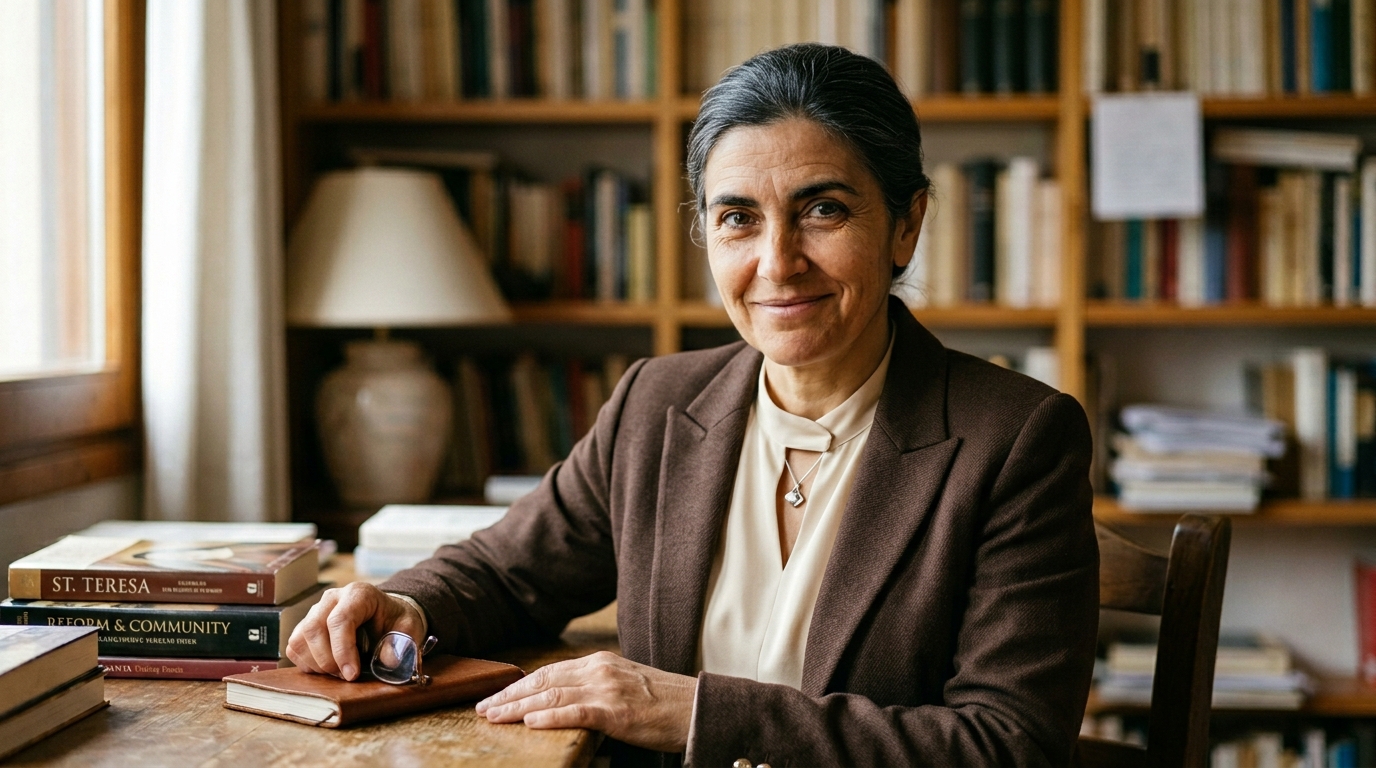
Session 14 — St. Teresa of Ávila
"The Interior Castle" — Teresa and the Architecture of the Soul
Opening Prayer
LEADER: Let us begin by asking the Holy Spirit to be with us tonight.
ALL: Come, Holy Spirit, fill the hearts of your faithful and kindle in us the fire of your love.
LEADER: Send forth your Spirit and we shall be created.
ALL: And you shall renew the face of the earth.
LEADER: O God, who by the light of the Holy Spirit did instruct the hearts of the faithful,
ALL: Grant that by the same Holy Spirit we may be truly wise and ever rejoice in His consolation, through Christ our Lord. Amen.
LEADER: Tonight we sit with a Spanish Carmelite who taught the Church that the human soul is not a flat field but a castle with many rooms, and that the King is already waiting in the innermost chamber. Ask St. Teresa for the courage to look honestly at where you are dwelling in your own soul tonight.
ALL: St. Teresa of Ávila, pray for us. Amen.
Scripture Assignments
Assign each passage to a woman in the group before beginning.
- Passage 1: 1 Corinthians 3:16-17
- Passage 2: John 14:23
- Passage 3: Psalm 27:4
- Passage 4: Ephesians 3:14-19
Who Was This Woman?
Teresa de Cepeda y Ahumada was born on March 28, 1515, in Ávila, Spain, into a large family of converso descent — her paternal grandfather had been a Jewish convert to Catholicism. She was one of twelve children. Her mother died when Teresa was thirteen, and the young girl, by her own later account, was vain, charming, and addicted to romance novels.
At twenty she entered the Carmelite convent of the Incarnation in Ávila, partly because she could not see another path for herself and partly because she suspected — accurately — that she would be lost without the structure of religious life. The Incarnation in those years was a relaxed house. Nuns kept private property, received frequent visitors, and the spiritual seriousness of the early Carmelite rule had grown faint. Teresa lived there for nearly thirty years, much of it sick, much of it spiritually mediocre by her own honest account.
The turning point came in 1554, when she was thirty-nine. Praying before a statue of the wounded Christ, she was undone. She wrote later that she had been trying to serve two masters and had been miserable at both. From that point her interior life deepened rapidly — mystical experiences, locutions, visions of Christ. She doubted them. She brought them to confessors, some of whom told her she was deceived by the devil. She submitted everything to the judgment of the Church, and the Church eventually confirmed her.
In 1562 she founded the convent of San José in Ávila, the first house of what would become the Discalced (barefoot) Carmelite reform — a return to the original strict rule, with poverty, silence, and contemplative prayer at the center. Over the next twenty years she founded sixteen more houses across Spain, traveling by mule cart through brutal Castilian summers and winters, often sick, always working. She partnered with a young Carmelite friar she met in 1567 — St. John of the Cross — who carried the reform into the men's branch of the order.
She wrote three major works under obedience to her confessors: her Life (autobiography), the Way of Perfection (a manual of prayer for her nuns), and The Interior Castle (her mature masterpiece, written in 1577 in a single sustained burst of about six months while she was in her sixties).
She died on October 4, 1582, in Alba de Tormes, after a long final journey on the road. Her last recorded words were a verse from a psalm: Cor contritum et humiliatum, Deus, non despicies — "A broken and humbled heart, O God, You will not despise." She was canonized in 1622. In 1970, Pope St. Paul VI declared her a Doctor of the Church — together with St. Catherine of Siena, one of the first two women so named in the Church's history.
That is the woman we are sitting with tonight.
Teaching Block 1 — The Castle Is Already Built
Teresa begins The Interior Castle with a vision the Lord gave her. She saw the soul as a castle made of a single diamond or very clear crystal, in which there are many rooms — muchas moradas, many mansions. Some rooms are above, some below, some to the sides. And in the center, at the very heart of the castle, is the room where the King dwells.
This is not a metaphor she invented. It is the literal teaching of Sacred Scripture about who you are.
Do you not know that you are the Temple of God, and that the Spirit of God lives within you? But if anyone violates the Temple of God, God will destroy him. For the Temple of God is holy, and you are that Temple.
1 Corinthians 3:16-17 — CPDV
Paul does not say the soul is like a temple. He says it is a temple. The Holy Spirit dwells in the baptized. Not at the door. Not in the courtyard. In the inner sanctuary. The King is already at the center of the castle of your soul. He moved in at your baptism and He has not left.
The Catholic tradition has always taught this. The indwelling of the Holy Trinity in the soul in a state of grace is not a poetic flourish — it is doctrine. Jesus Himself says it plainly:
Jesus responded and said to him: "If anyone loves me, he shall keep my word. And my Father will love him, and we will come to him, and we will make our dwelling place with him.
John 14:23 — CPDV
We — the Father and the Son, and by implication the Holy Spirit who proceeds from Them — will come to him and make Our home with him. The Greek word is monē — a dwelling place, a mansion. The same word He uses in the next chapter when He says in My Father's house are many mansions. Heaven has many mansions. The soul has many mansions. The architecture is the same, because the soul in grace is already participating in the life of heaven.
Teresa's astonishment in The Interior Castle is not that God is far away. It is the opposite. He is already there. The drama of the interior life is not the drama of getting to Him. It is the drama of waking up to the fact that He has been waiting for you in the innermost room while you have been living in the outer courtyard with the lizards and the vermin — her words, not a softening of them.
This is why Teresa says, with characteristic Spanish bluntness, that most souls do not even know they have an interior. They live entirely in the outer rooms of their castle — distracted, scattered, busy with the affairs of the world — and never once enter the door of prayer that leads inward. The tragedy is not that they cannot get in. The tragedy is that they will not.
Discussion Question 1: When you think about where you actually live in your own soul most of the time — which room, how far from the center — what's your honest answer? Not where you'd like to live. Where you live.
Teaching Block 2 — The Seven Mansions and the Door of Prayer
Teresa structures The Interior Castle around seven mansions — seven concentric rings of rooms, from the outer wall to the King's chamber at the center. They are not seven literal compartments. They are seven stages or modes of the soul's life with God, and the soul moves through them by prayer.
The first three mansions are about the soul's own labor, with the help of grace — beginning to pray, learning to be recollected, growing in virtue and self-knowledge. Teresa calls these the rooms where the soul does most of the work, though never alone. Honest examination of conscience, struggle with sin, the slow discipline of mental prayer — this is the territory of the first three mansions, and Teresa is clear that most souls who pray seriously will live in these rooms for years.
The fourth mansion is the hinge. Here something shifts. The soul's own efforts begin to give way to God's direct action. Teresa distinguishes between consolations (which the soul produces by its own activity, helped by grace) and spiritual delights (which God infuses directly, without any cooperation the soul could engineer). The fourth mansion is the threshold of what the Church calls infused or mystical prayer — prayer that is no longer something the soul does but something God gives.
The fifth, sixth, and seventh mansions are the territory of mystical union. Teresa describes them with care and with constant warnings — these are not states the soul can produce, manufacture, or hurry. They are gifts. The soul that tries to force entry into the inner mansions by technique will fail. The soul that remains in the outer rooms, faithful in prayer, faithful in the duties of state, faithful to the Church, leaves the door open for God to draw it deeper whenever and however He wills.
This is the doctrinal heart of what Teresa is teaching, and it must not be missed:
By reason of this grace, I bend my knees to the Father of our Lord Jesus Christ, from whom all paternity in heaven and on earth takes its name. And I ask him to grant to you to be strengthened in virtue by his Spirit, in accord with the wealth of his glory, in the inner man, so that Christ may live in your hearts through a faith rooted in, and founded on, charity. So may you be able to embrace, with all the saints, what is the width and length and height and depth of the charity of Christ, and even be able to know that which surpasses all knowledge, so that you may be filled with all the fullness of God.
Ephesians 3:14-19 — CPDV
Paul prays that the Ephesians may be strengthened — by the Spirit, in the inner being, so that Christ may dwell in their hearts through faith, rooted and grounded in love. The work is God's. The grammar of the passage is full of divine verbs done to the soul. The soul's role is to remain in love, to keep the door open, to be faithful in the outer rooms while waiting for the King to draw it further in.
The door of prayer is mental prayer — what Teresa calls oración mental, the silent, attentive turning of the soul toward God who is already present within. Not the recitation of formulas. Not the achievement of feelings. The simple act of remaining in His presence with intention. Teresa says, in her Way of Perfection, that anyone who can pray vocally with attention can pray mentally — the door is open to every soul. It is the daily choice to walk through it that most souls do not make.
Discussion Question 2: What does your prayer actually look like on a normal day — not your ideal prayer, not what you tell people you do, but what actually happens? And where in Teresa's mansions does that put you?
Teaching Block 3 — The King in the Center
At the very center of the castle, in the seventh and innermost mansion, the soul lives in conscious union with the Blessed Trinity. Teresa describes it with restraint — she had been there, and she knew the danger of describing what cannot be described. She uses the image of two candles whose flames have merged into one, while remaining two candles. The soul does not become God. It is not absorbed. But the wall between the soul and the indwelling Trinity becomes, in some sense, transparent. The King who has always been at the center is finally seen and known and loved as He is.
This is the goal. Not feelings. Not visions. Not extraordinary phenomena — Teresa is fierce that those things are not the point and are often dangerous. The goal is union with the One who has lived inside the soul since baptism.
And here is what must not be missed in this teaching: the soul does not climb to the seventh mansion by spiritual technique. The soul waits for the King to draw it. Teresa writes that no human effort can open the door from the third mansion to the fourth — that door opens only from the inside, and the King opens it when He wills. The soul's task is to be in the outer mansions faithfully, attentively, in love. To sit in the temple. To wait.
Give to them according to their works and according to the wickedness of their inventions. Assign to them according to the works of their hands. Repay them with their own retribution.
Psalm 27:4 — CPDV
One thing — unam petii a Domino, the Latin Vulgate has it — one thing have I asked of the Lord, that I may dwell in the house of the Lord all the days of my life, to behold the beauty of the Lord. David asks for dwelling. Not visiting. Not running through. Dwelling. To live in the inner chambers of the temple of God.
The Catholic tradition has always taught that this dwelling is the destiny of every baptized soul — not only the mystics, not only the cloistered. The Carmelite ascent is the human ascent. Teresa wrote The Interior Castle for her nuns, but she said clearly in the prologue that she was writing for the soul — for any soul. The architecture she describes is in every woman who is in a state of grace. The King is in the center of every soul listening tonight.
Which means the question of the interior life is not can I get there. The question is: will I go in. The door of prayer stands open. The Trinity waits. The outer rooms with their noise and their lizards are not your home. The innermost mansion is your home, and you are loved there by the One who lives there, and He is calling you in.
Discussion Question 3: If you knew — really knew, not just intellectually — that the Blessed Trinity was dwelling in the innermost room of your soul right now, tonight, while you sat in this room, what would change about how you prayed this week? About how you lived this week?
This Week
Set aside ten minutes — only ten — on five days this week to sit in silence with the Lord. Not to say anything. Not to read anything. Not to ask for anything. Sit in a chair, close your eyes, and remind yourself that the Blessed Trinity dwells in the innermost room of your soul. Then be there with Him.
If your mind wanders — and it will, constantly — return without scolding yourself. Teresa says the distractions are not the failure. The return is the prayer.
Pray once before you begin:
Lord, You dwell within me. Teach me to come in.
Closing Prayer
Gather prayer requests and close out.