Session 2
"And a Sword Will Pierce Your Own Soul" — Mary at the Cross and Redemptive Suffering
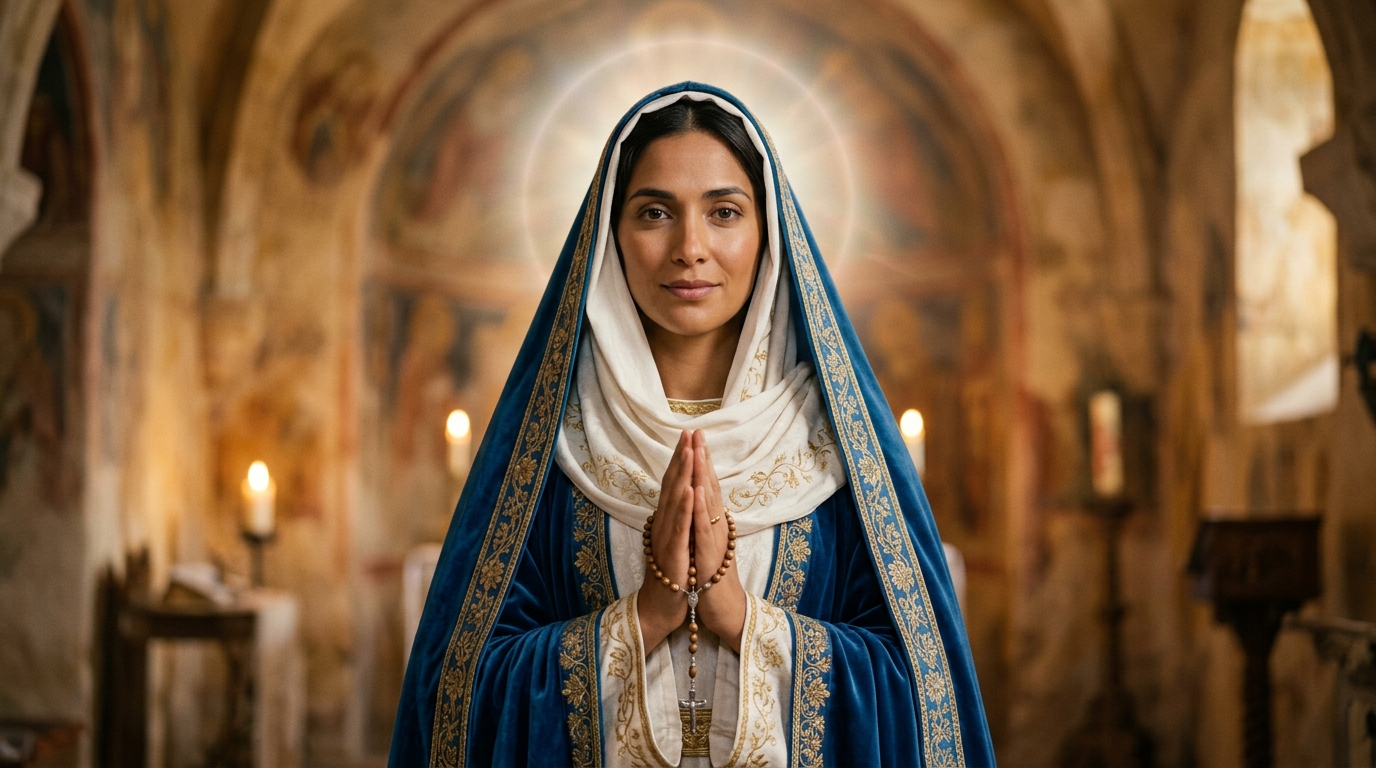
Session 2 — The Blessed Virgin Mary
"And a Sword Will Pierce Your Own Soul" — Mary at the Cross and Redemptive Suffering
Opening Prayer
LEADER: Let us begin by asking the Holy Spirit to be with us tonight.
ALL: Come, Holy Spirit, fill the hearts of your faithful and kindle in us the fire of your love.
LEADER: Send forth your Spirit and we shall be created.
ALL: And you shall renew the face of the earth.
LEADER: O God, who by the light of the Holy Spirit did instruct the hearts of the faithful,
ALL: Grant that by the same Holy Spirit we may be truly wise and ever rejoice in His consolation, through Christ our Lord. Amen.
LEADER: Tonight we stand with Our Lady at the foot of the Cross. We pray her own words, the ones the Church has prayed beside her for centuries:
LEADER: At the Cross her station keeping, stood the mournful Mother weeping,
ALL: close to Jesus to the last.
LEADER: Through her heart, His sorrow sharing, all His bitter anguish bearing,
ALL: now at length the sword had passed.
LEADER: Holy Mother, pierce me through; in my heart each wound renew of my Savior crucified.
ALL: Amen.
Scripture Assignments
Assign each passage to a woman in the group before beginning.
- Passage 1: Luke 2:33-35
- Passage 2: John 19:25-27
- Passage 3: Colossians 1:24
- Passage 4: Lamentations 1:12
Who Was This Woman?
Last week we met Mary as a young girl in Nazareth — fourteen, maybe sixteen, saying yes to an angel about a future she could not see. Tonight we meet her again, perhaps thirty-three years later, standing at the foot of a Roman execution stake while her Son is killed in front of her.
She is no longer a girl. She is a woman in her late forties or early fifties, by the math of the Gospels — old, by the standards of her time and place. Joseph has been gone for years; Scripture stops mentioning him after the finding in the Temple, and the early tradition is unanimous that he died before the public ministry. Mary has been a widow for a long time. Jesus is, in human terms, all she has.
And He is dying. Not quietly, not privately, but publicly, as a state criminal, in the most humiliating manner the Roman empire had devised. The crowd is jeering. The disciples have fled. Peter has denied Him three times. Only a handful of women and one young man — St. John — are still there.
Mary is there.
The Gospel of John tells us this with stunning economy. Standing by the cross of Jesus were His mother, and His mother's sister, and Mary the wife of Clopas, and Mary Magdalene. Four words in Greek do the work of the entire scene: εἱστήκει παρὰ τῷ σταυρῷ — she stood by the Cross. The Latin Mass keeps this verb forever in the title of the great medieval hymn we just prayed: Stabat Mater. The Mother was standing.
She did not collapse. She did not run. She did not faint. The Church has chosen this image — Mary standing — over the swooning Mary of some medieval art for a reason. Mary's suffering at the Cross is not the suffering of someone being destroyed by it. It is the suffering of someone choosing, again, to say what she said at the Annunciation: let it be done unto me according to Your word.
That is the woman we are sitting with tonight. The girl from Nazareth has become the woman at Calvary. And the fiat she spoke in the bedroom has become a fiat spoken in blood.
Teaching Block 1 — Simeon's Sword
Long before Calvary, Mary was warned. Eight days after the birth of Jesus, she and Joseph brought Him to the Temple for the rite of purification, and an old man named Simeon — a man who, Luke tells us, had been promised that he would not die before seeing the Messiah — took the infant Jesus into his arms, blessed God, and then turned to Mary with a prophecy that must have stopped her breath.
And his father and mother were wondering over these things, which were spoken about him. And Simeon blessed them, and he said to his mother Mary: "Behold, this one has been set for the ruin and for the resurrection of many in Israel, and as a sign which will be contradicted. And a sword will pass through your own soul, so that the thoughts of many hearts may be revealed."
Luke 2:33-35 — CPDV
Read it again. And a sword will pierce through your own soul also.
This is not a metaphor that Mary could have understood in the moment. She was a young mother, holding her firstborn child, in the most joyful liturgical setting of her people's life. Simeon's prophecy was, in that instant, a riddle. But the Church has read it ever since as the first announcement of the Passion — and the first announcement that Mary's destiny would be inseparable from her Son's.
The sword is not a metaphor for ordinary maternal grief. Every mother who loses a child grieves; every mother who watches her child suffer suffers with him. Mary's suffering at Calvary is human suffering — she is not a stone, she is a mother — but it is also more than that. The sword Simeon names is the sword of the Cross itself, the sword of redemption, passing through her Son's body and through her own soul because she alone in the entire world is bound to that body by the bond of being its mother. She gave that flesh from her own flesh. When the soldiers drive the nails, they are driving them into flesh she made.
This is why the Church has always said that Mary's role in the work of redemption is unique. Not because she co-saves alongside her Son — Christ alone redeems, and any teaching that obscures this is a teaching the Church rejects. Mary is not a second Christ. But she is the only human being whose body gave the Redeemer His body, and the only human being whose yes at the Annunciation made the Cross even possible. The sword Simeon promised is the cost of that yes, paid out across a lifetime and finished on Good Friday.
There is a lesson here for every woman who has ever loved someone deeply enough to suffer with them. Love and suffering are not opposites. The deepest loves are the ones that suffer most, because love binds. Mary's pierced soul is not the failure of her fiat. It is the proof of it.
Discussion Question 1: Simeon tells Mary the sword is coming thirty-three years before it arrives. What does it mean to receive a hard word from God in advance — to know that suffering is part of the path you have said yes to? Has there been a "Simeon moment" in your own life — a moment of warning you could not yet understand?
Teaching Block 2 — "Woman, Behold Your Son"
There is a moment at the Cross that is so quiet most readers miss it. Jesus is dying. He has spoken from the Cross only a handful of times. And among the very few sentences He speaks, He stops to do something for His mother.
And standing beside the cross of Jesus were his mother, and his mother's sister, and Mary of Cleophas, and Mary Magdalene. Therefore, when Jesus had seen his mother and the disciple whom he loved standing near, he said to his mother, "Woman, behold your son." Next, he said to the disciple, "Behold your mother." And from that hour, the disciple accepted her as his own.
John 19:25-27 — CPDV
Woman, behold your son. Behold your mother.
On the surface, this is a son making provision for His widowed mother. Jesus is the firstborn, and in His culture, He bears responsibility for her care; with Joseph dead and Jesus dying, He entrusts her to His beloved disciple. And from that hour the disciple took her to his own. The Greek phrase — eis ta idia — means into his own home, into his own life, into what was his. St. John received her completely.
That much is true. But the Church has read these words for two thousand years and has heard something more in them. When Jesus calls His mother Woman, He is using the same word He used at the wedding at Cana — Woman, what is this between you and Me? — and the same word God uses in Genesis 3:15 when He promises that there will be a woman whose offspring will crush the serpent's head. Woman is Mary's title in the work of redemption. And when Jesus, dying, gives her as Mother not just to the disciple John but to the disciple as such — to the one who believes — He is doing something that the disciple represents to the whole Church for all time.
He is giving us His mother.
This is what the Church means when it calls Mary the Mother of the Church — Mater Ecclesiae. Her motherhood does not stop at the Cross; it begins there, in a new way. The motherhood she said yes to at the Annunciation, which gave the world its Redeemer, becomes a motherhood that gives the redeemed their mother. We are, every one of us who has been baptized into Christ, given to her in the person of John. She is, every one of us, given to us in His final breath.
And here is what is so striking — Mary receives this. She does not protest, she does not argue that her motherhood belongs only to Jesus, she does not insist that her grief is private. She takes John home. She takes the Church home. Her fiat has stretched all the way out to us.
Discussion Question 2: Mary's motherhood does not end when her Son dies — it widens. She receives John, and through John, she receives the whole Church. What does it mean for you, personally, to receive Mary as your mother? Is she a real mother to you, or a figure you respect from a distance? What would change if you took her into your own home — eis ta idia — the way John did?
Teaching Block 3 — Filling Up What Is Lacking
There is one more thing to see, and it is the most theologically pointed teaching of the session. St. Paul writes a single sentence in his letter to the Colossians that, taken alone, sounds nearly impossible.
For now I rejoice in my passion on your behalf, and I complete in my flesh the things that are lacking in the Passion of Christ, for the sake of his body, which is the Church.
Colossians 1:24 — CPDV
I rejoice in my sufferings for your sake, and in my flesh I complete what is lacking in Christ's afflictions for the sake of His body, that is, the Church.
What is lacking in Christ's afflictions? Was Christ's suffering not enough? Did He leave something undone?
No. The Church is unambiguous: Christ's suffering on the Cross is sufficient, complete, and infinite. There is nothing lacking in the work itself. What is lacking — what is always lacking, in every generation — is the application of that work in the lives of His members. The Cross is finished. The acceptance of the Cross by each soul in each century is not. And so St. Paul, in his own flesh, joins his suffering to Christ's. He fills up — in himself, in his own body — what is lacking in the Church's reception of Christ's afflictions.
This is what the Catholic tradition calls redemptive suffering. It does not mean that human suffering saves anyone. Christ alone saves. But it does mean that, by the grace of God, a Christian's suffering, united to the suffering of Christ, becomes part of the redemption Christ is working through His body in the world. The Cross is not a single moment in the year 33 A.D. It is a single moment that contains all moments, and our small sufferings, united to it, are gathered into its infinity.
Mary is the first Christian to live this. Standing at the Cross, she is not a passive witness. She is participating. She is, in the deepest sense of the word, co-suffering with her Son — not because she adds to His suffering, but because she gives her fiat over again, this time at the foot of a cross, accepting in her own pierced soul the cost of the world's salvation. She is the first member of His Body to fill up what is lacking. Every Christian who has ever offered up a sleepless night, a long illness, a hidden grief — every woman who has ever suffered for a child who would not come home — is walking in her steps.
This is the great Catholic teaching that Protestant theology often cannot quite hold: suffering is not just to be endured. It is to be offered. And Mary is the woman who shows us what offering looks like. Not crushed. Not destroyed. Standing.
Discussion Question 3: Mary's suffering at the Cross is not a passive thing — she offers it, unites it to her Son's, and it becomes part of His redeeming work. Most of us have suffering in our lives right now that we would like to make go away. What would it mean to offer your suffering instead — to give it to Christ as Mary gave hers? Is there something specific in your life right now that you could begin to offer this week?
This Week
This week, learn the Stabat Mater — or one verse of it, if the whole hymn is too much. Pray that verse once a day, slowly, while standing. Notice what it does to you to stand while you pray it. Notice what it does to you to put yourself, in your imagination, next to Mary at the foot of the Cross — not as a watcher, but as one of the women who stood there with her.
If there is a particular suffering in your life right now, take it with you to that imagined place. Set it down beside her. And ask her, simply: Mother, teach me how to stand.
Closing Prayer
Gather prayer requests and close out.
LEADER: Holy Mother of God, who stood beneath the Cross and did not turn away — pray for us. Teach us to receive what we cannot change. Teach us to offer what we cannot carry. Teach us to stand.
ALL: Holy Mary, Mother of God, pray for us sinners, now and at the hour of our death. Amen.