Session 6
"She Wept More Tears for Me Than Most Mothers Weep at the Death of a Son" — Monica and the Spirituality of Intercession
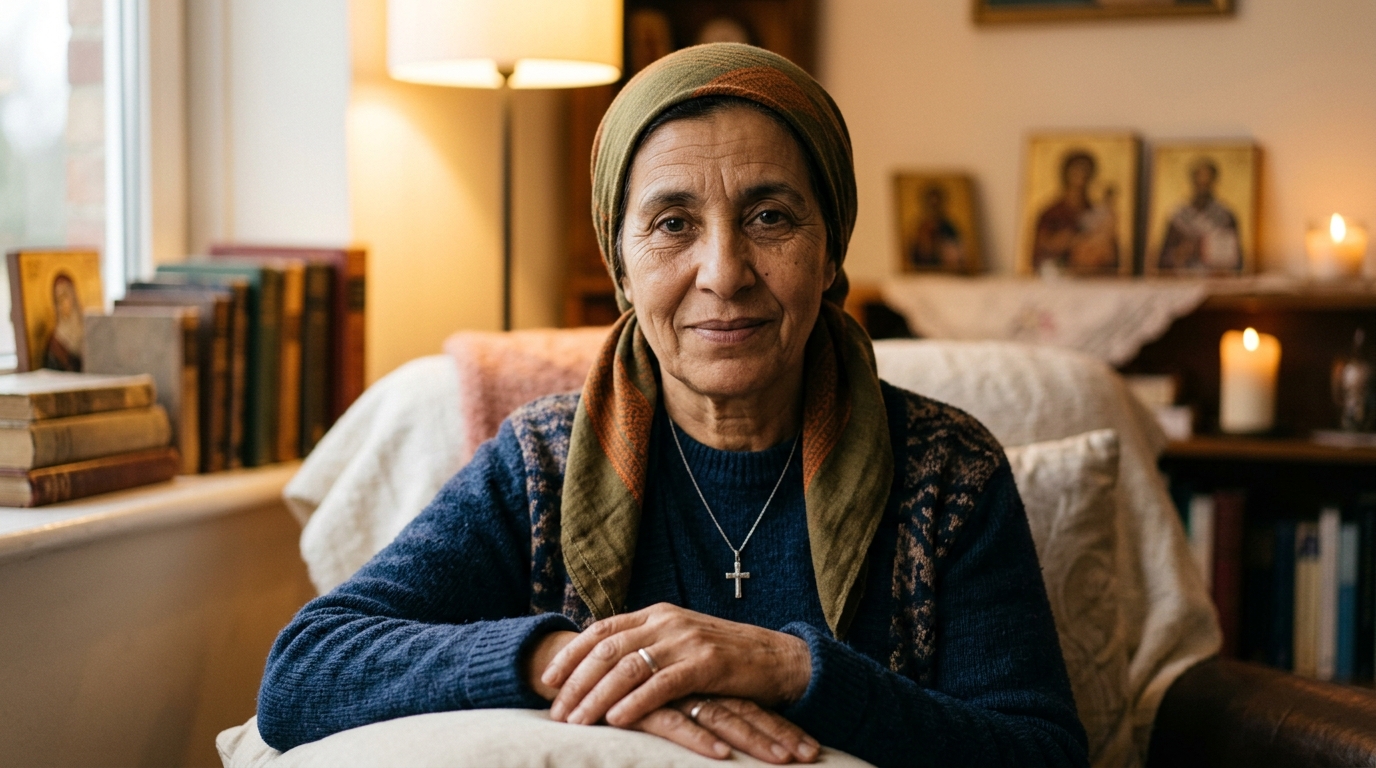
Session 6 — St. Monica
"She Wept More Tears for Me Than Most Mothers Weep at the Death of a Son" — Monica and the Spirituality of Intercession
Opening Prayer
LEADER: Let us begin by asking the Holy Spirit to be with us tonight.
ALL: Come, Holy Spirit, fill the hearts of your faithful and kindle in us the fire of your love.
LEADER: Send forth your Spirit and we shall be created.
ALL: And you shall renew the face of the earth.
LEADER: O God, who by the light of the Holy Spirit did instruct the hearts of the faithful,
ALL: Grant that by the same Holy Spirit we may be truly wise and ever rejoice in His consolation, through Christ our Lord. Amen.
LEADER: Tonight we sit with a woman who prayed her son into the Kingdom across thirty-three years and would not give up. Lord, give us her endurance. Give us her tears. Give us the long faith of a mother who refuses to be moved.
ALL: St. Monica, pray for us. Amen.
Scripture Assignments
Assign each passage to a woman in the group before beginning.
- Passage 1: 1 Samuel 1:10-18
- Passage 2: Luke 18:1-8
- Passage 3: James 5:16-18
- Passage 4: Romans 8:26-27
Who Was This Woman?
She was born in the year 331, in the Roman province of Numidia, in what is today Algeria. Her name was Monica — a North African name, possibly of Berber origin, common in the Christian communities of the region. Her family was Christian; she was raised in the faith, baptized as a child, and married young, in the custom of her time, to a pagan civic official named Patricius. He was older than she was, quick-tempered, and openly unfaithful. She bore him three children. The eldest was named Augustine.
That son would become, eventually, the greatest theologian of the Latin Church — St. Augustine of Hippo, whose writings have shaped Western Christianity more than any author except the writers of the New Testament. But before he was a saint, before he was a bishop, before he was a Doctor of the Church, he was a young man tearing his mother's heart out.
He left the faith. He took a concubine and fathered a child with her at seventeen. He fell into a Persian heresy called Manichaeism — a system that taught that material creation was evil, that the body was a prison, that the Old Testament was the work of a lesser god — and gave nine years of his life to it. He moved away from home without telling his mother, fleeing across the Mediterranean from North Africa to Rome to escape her tears. He was, by every measure, lost.
And St. Monica prayed.
She prayed for thirty-three years. She wept for him in chapels and on roadsides and at the doors of bishops who refused to receive her because she had come to ask them, again, to help with her son. She crossed the sea to find him. She followed him from one Roman city to another. When he sailed for Italy without her, she boarded the next ship and went after him. She fasted. She made pilgrimages. She buried her husband, who converted to the faith on his deathbed in part because she had not given up on him either. She buried one of her sons. And still she prayed for the one who was still lost.
The famous line we have used as the title of this session comes from St. Augustine himself. Looking back, after his conversion, he wrote in his Confessions that his mother had wept more tears for me than most mothers weep at the death of a son. He understood, by then, that her grief had not been ordinary maternal worry. It had been a sustained, lifelong, sacrificial intercession — the kind of prayer that ages a woman from the inside, that takes more out of her than the world will ever see, that costs her in ways nobody but God will record.
And it worked. In 386 — when Monica was fifty-five years old, and Augustine was thirty-two — he knelt under a fig tree in a garden in Milan, opened a copy of the letters of St. Paul, and was converted. He was baptized at Easter the following year. St. Monica died a few months after that, in the harbor town of Ostia, on her way home to North Africa with the son she had finally seen come back to the faith.
That is the woman we are sitting with tonight. The patroness of every mother who has ever prayed for a wayward child. The patroness of every wife who has ever loved a difficult husband. The patroness of every woman who has spent decades praying for someone and has not yet seen the answer. The Church gives us her name and her tears and her endurance, and tells us: do not stop.
Teaching Block 1 — The Prayer of Hannah and the Long Wait
To understand St. Monica, we have to begin at the door of a temple, almost a thousand years before her, with a woman named Hannah.
And since Hannah was bitter in soul, she prayed to the Lord, weeping greatly. And she made a vow, saying, "O Lord of hosts, if, in looking with favor, you will see the affliction of your servant and will remember me, and will not forget your handmaid, and if you will give to your servant a male child, then I will give him to the Lord all the days of his life, and no razor shall pass over his head." Then it happened that, while she multiplied prayers before the Lord, Eli observed her mouth. For Hannah was speaking in her heart, and only her lips moved, and her voice was barely heard. Therefore, Eli considered her to be drunk, and so he said to her: "How long will you be inebriated? You should take only a little wine, but instead you are drenched." Responding, Hannah said: "By no means, my lord. For I am an exceedingly unhappy woman, and I drank neither wine, nor anything that can inebriate. Instead, I have poured out my soul in the sight of the Lord. You should not repute your handmaid as one of the daughters of Belial. For I have been speaking from the abundance of my sorrow and grief, even until now." Then Eli said to her: "Go in peace. And may the God of Israel grant to you your petition, which you have begged of him." And she said, "I wish that your handmaid may find grace in your eyes." And the woman went on her way, and she ate, and her countenance was no longer changed for the worse.
1 Samuel 1:10-18 — CPDV
This is one of the great prayer scenes of the Old Testament, and the women in your group may not have read it in a long time. Hannah is barren. She is one of two wives of a man named Elkanah, and the other wife — who has children — torments her every year on their pilgrimage to the temple at Shiloh. Hannah is so distressed that she cannot eat. She goes up to the sanctuary and begins to pray, weeping bitterly, and her lips are moving but no sound is coming out.
The priest Eli, who is sitting nearby, watches her and assumes she is drunk. How long will you go on being drunk? Put your wine away from you. It is one of the most famous misunderstandings in Scripture. Hannah's answer is composed and dignified: No, my lord, I am a woman troubled in spirit. I have been pouring out my soul before the Lord. I have been speaking out of my great anxiety and vexation.
Notice the language. Pouring out my soul. Anxiety and vexation. This is not polite Catholic prayer. This is the prayer of a woman whose grief is so total that she cannot make sounds anymore, only mouth the words. Eli, when he understands, blesses her. Go in peace; and may the God of Israel grant your petition. And Hannah goes back, eats, and is no longer sad. She has not yet received what she asked for. But she has been heard. And she knows it.
She conceives Samuel within the year.
This is the prayer of the woman who waits. It is the prayer that Catholic spirituality has always recognized as a distinct kind of work — not the brief intercession of a passing moment, but the long, deep, often silent prayer of a soul carrying a burden it cannot put down. St. Monica prayed this kind of prayer for thirty-three years. The Church has prayed it on behalf of the world for two thousand years. Every Catholic woman who has prayed for a husband or a child or a friend for years without seeing the answer is in the long line of Hannah and St. Monica.
And here is what we must see: God does not always answer immediately, but He always hears. He heard Hannah. He heard St. Monica. He hears the woman in this room who has been praying for her grown daughter to come back to the Church since the daughter was nineteen and is now forty-two. The hearing is not the answer; the answer comes when it comes. But the hearing is real, and the hearing changes the one who is heard. Hannah went home and ate. Her sorrow was lifted before her circumstances changed. That is not the answer to her prayer; that is the fruit of it. The Lord can shift the weight off a woman's heart while the situation itself is still unresolved. He does this often. Catholic women have known it for centuries.
Discussion Question 1: Hannah's grief was so heavy she could not make sounds anymore, and Eli mistook her for drunk. Most of us have prayers we have been carrying for a long time — for a child, a spouse, a sibling, a friend — and most of us have, at some point, felt that no one but God could possibly understand the weight of them. What is the prayer you are carrying right now that nobody else really sees? Have you let yourself bring it to God honestly — with the weight on it — or have you been praying it politely?
Teaching Block 2 — The Widow and the Unjust Judge
There is a parable Jesus tells about a kind of prayer most modern Catholics have lost, and it is the parable that explains St. Monica.
Now he also told them a parable, that we should continually pray and not cease, saying: "There was a certain judge in a certain city, who did not fear God and did not respect man. But there was a certain widow in that city, and she went to him, saying, 'Vindicate me from my adversary.' And he refused to do so for a long time. But afterwards, he said within himself: 'Even though I do not fear God, nor respect man, yet because this widow is pestering me, I will vindicate her, lest by returning, she may, in the end, wear me out.' " Then the Lord said: "Listen to what the unjust judge said. So then, will not God grant the vindication of his elect, who cry out to him day and night? Or will he continue to endure them? I tell you that he will quickly bring vindication to them. Yet truly, when the Son of man returns, do you think that he will find faith on earth?"
Luke 18:1-8 — CPDV
Read it slowly. Jesus tells His disciples a parable about their need to pray always and not lose heart. That is the introduction Luke gives us — the parable is, explicitly, about prayer that does not give up. And then the story: a judge who fears neither God nor man, a widow who comes to him asking for justice against her adversary, and the judge who, for a long time, refuses. He does not care. He has nothing to gain. He puts her off.
But the widow does not stop coming. She comes back. She comes back again. She comes back so many times that the judge finally says — and Jesus puts the words in his mouth — Because this widow keeps bothering me, I will give her justice, so that she will not wear me out by her continual coming.
Then Jesus draws the lesson: Will not God give justice to His elect, who cry to Him day and night? Will He delay long over them? I tell you, He will give justice to them speedily.
This is the parable that the Catholic tradition has read for centuries as the warrant for what is sometimes called persevering prayer — the prayer that does not give up, that comes back day after day, that wears down what looks like resistance not because God is the unjust judge but because the Christian's heart needs the wearing. The parable is not teaching us that God is reluctant and we must badger Him into action. It is teaching us that prayer that perseveres is the prayer that gets answered, because the perseverance is itself the work God is doing in us.
St. Monica understood this. She did not pray once for St. Augustine and wait. She prayed every day for thirty-three years. When the bishop of one African city, exhausted by her tears, told her not to keep coming to him about her son, his famous reply has come down to us: Go your way, and God bless you. It is not possible that the son of these tears should perish. She did not stop coming. She did not believe him because his words were comforting. She believed him because she had been doing the work of the widow for years and she knew, by then, what kind of prayer it was.
There is something here that Catholic women especially need to hear. Many of us have been taught, somewhere along the way, that asking God for the same thing repeatedly is a kind of weak faith — that real faith asks once and trusts. That is not what Jesus teaches in this parable. The widow's faith is measured by her coming back. The widow's persistence is what Jesus is holding up as the example. And the Catholic tradition has gone further: persevering prayer, prayed over years, is one of the deepest forms of intercession the Church knows. It is the prayer of the rosary recited every day for a decade for the same intention. It is the novena prayed nine days, nine months, nine years. It is the same petition placed on the same altar at the same Mass, week after week, until something gives.
This is St. Monica's spirituality. And it is the spirituality of every Catholic mother who has stood in the back of a parish she once brought her children to, watching the grown children who no longer come, and praying anyway.
Discussion Question 2: Jesus tells His disciples a parable about praying always and not losing heart. Most of us have given up on some prayers — not consciously, but quietly, because they have gone unanswered for so long that we have stopped expecting anything. What is a prayer you have quietly stopped praying? What would it take for you to start again — the way the widow kept coming back?
Teaching Block 3 — The Spirit Prays in Us
There is one more thing we have to see, and it is the deepest thing the Catholic tradition teaches about intercessory prayer. When you carry someone in prayer for a long time, you are not doing it alone.
And similarly, the Spirit also helps our weakness. For we do not know how to pray as we ought, but the Spirit himself asks on our behalf with ineffable sighing. And he who examines hearts knows what the Spirit seeks, because he asks on behalf of the saints in accordance with God.
Romans 8:26-27 — CPDV
Likewise the Spirit helps us in our weakness; for we do not know how to pray as we ought, but the Spirit Himself intercedes for us with sighs too deep for words.
Read that again. Sighs too deep for words. St. Paul is teaching us something that every woman who has prayed long for someone she loves has experienced but maybe never had the language for: when you are praying for the same person for years, and you have run out of words, and you do not even know anymore what you are asking for — the Holy Spirit is praying in you. He is taking your wordless grief, your sighs, the prayer that has gone past speech into something deeper than speech, and He is making it intercession before the Father.
This is why long intercessory prayer is the most exhausting form of prayer in the Catholic tradition. It is not because you are doing all the work. It is because the Holy Spirit is doing the work through you, using your body, your tears, your sleepless nights, your years of carrying someone, as the human instrument of a divine intercession. Your prayer is not a list of words you are saying to God. Your prayer is the wordless ache of the Holy Spirit, expressed through the particular grief of a particular woman, in a particular life, for a particular person.
This is what St. Monica was doing, even when she did not know it. The thirty-three years of her tears were not just her tears. They were the Holy Spirit weeping for St. Augustine through her. The Catholic tradition has always understood this — that intercessory prayer is participation in the priesthood of Christ Himself, the one true Mediator, who ever lives to make intercession for them. When you intercede for someone you love, you are joining your prayer to His. You are letting Him pray through you. You are becoming, in a small and specific way, a priest of his salvation.
And there is one more piece, and it is what St. James writes in his epistle:
Therefore, confess your sins to one another, and pray for one another, so that you may be saved. For the unremitting prayer of a just person prevails over many things. Elijah was a mortal man like us, and in prayer he prayed that it would not rain upon the earth. And it did not rain for three years and six months. And he prayed again. And the heavens gave rain, and the earth brought forth her fruit.
James 5:16-18 — CPDV
The prayer of a righteous person has great power as it is working. Elijah was a man with a nature like ours, and he prayed fervently that it might not rain, and for three years and six months it did not rain on the earth.
A righteous person's prayer has great power as it is working. The Greek word James uses for power is energeia — the same root we get energy from. The prayer of a righteous person energizes — it does work, real work, in the unseen realms, on behalf of the person prayed for. It is not a wish dispatched into the void. It is a force operating in the world. The wayward son moving slowly back toward the Church across decades is not moving by accident. Something is drawing him. Something is wearing down his resistance. Something is opening doors he did not even know were closed. That something is, in part, the prayer of the woman who has not stopped.
If you have been praying for someone for years, hear this clearly. Your prayer is doing something. You cannot see what. You may not see it in your lifetime. St. Monica saw the answer to her thirty-three-year prayer for less than a year before she died — most of her life was spent praying without seeing. But the work is real. The Holy Spirit is praying in you. The wordless grief is intercession. And the One who hears it has not, ever, missed a single word.
Discussion Question 3: St. Paul says the Holy Spirit prays in us with sighs too deep for words — and St. James says the prayer of a righteous person has real power, doing real work. Most Catholic women have been taught that prayer is something they have to generate — words they have to find, faith they have to muster. What changes if you believe that, when you are praying for someone you love, the Holy Spirit is praying in you, and your prayer is actually accomplishing something you cannot see?
This Week
Identify one person you have been praying for, for a long time, and choose one specific time each day this week — morning, lunch, before bed — when you will pause and lift them up. It does not have to be long. A decade of the rosary, a Hail Mary, even a wordless turning of your heart in their direction.
Then, when you have done it, place the rest in the hands of the Holy Spirit. He has been praying with you in this person all along. He will keep praying. You are not carrying the whole weight.
If you have stopped praying for someone — quietly, because the years have gone on too long — this is the week to start again. The widow came back. So can you.
Closing Prayer
Gather prayer requests and close out.