Session 7
"Bury My Body Anywhere" — Monica and Holy Detachment
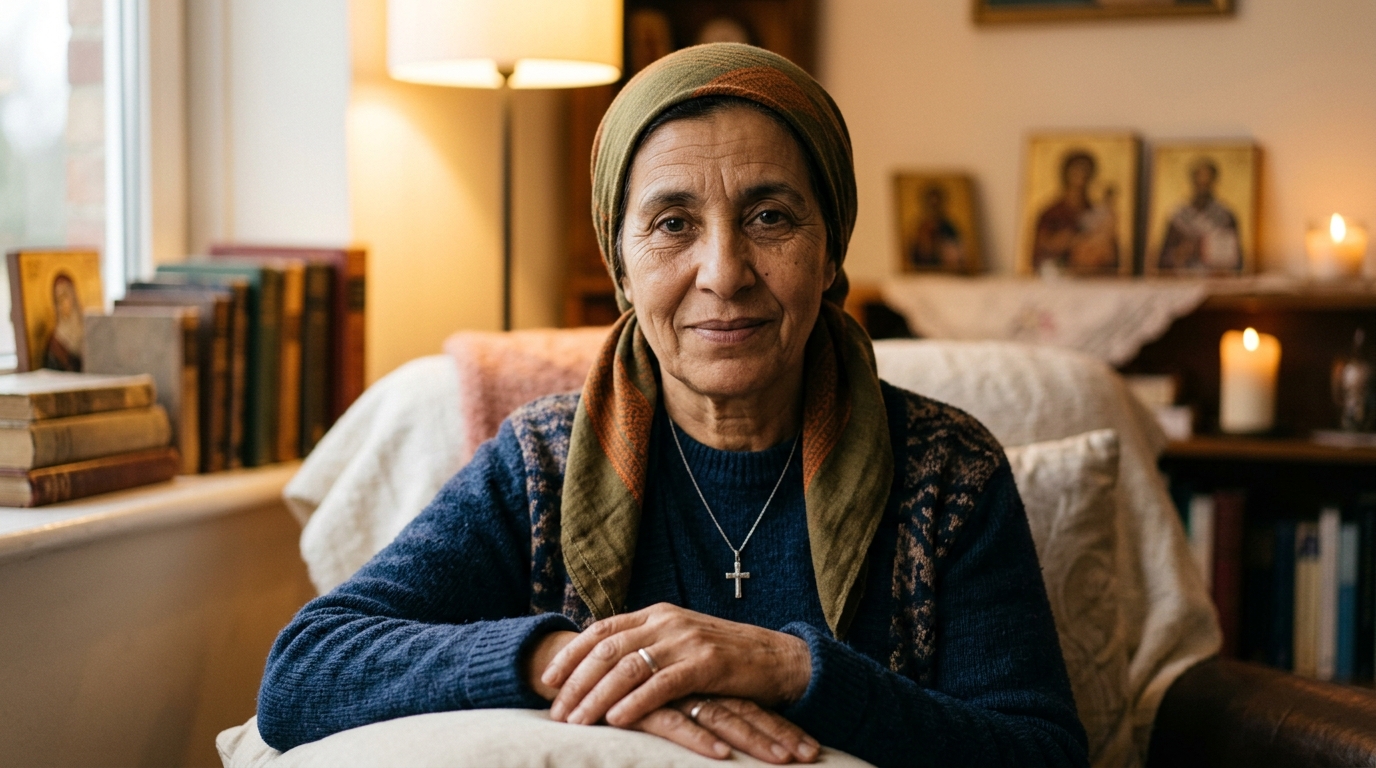
Session 7 — St. Monica
"Bury My Body Anywhere" — Monica and Holy Detachment
Opening Prayer
LEADER: Let us begin by asking the Holy Spirit to be with us tonight.
ALL: Come, Holy Spirit, fill the hearts of your faithful and kindle in us the fire of your love.
LEADER: Send forth your Spirit and we shall be created.
ALL: And you shall renew the face of the earth.
LEADER: O God, who by the light of the Holy Spirit did instruct the hearts of the faithful,
ALL: Grant that by the same Holy Spirit we may be truly wise and ever rejoice in His consolation, through Christ our Lord. Amen.
LEADER: Tonight we sit with a woman at the end of her life, looking out a window in a Roman harbor town, having finally received what she had prayed for, and ready to let everything else go. Lord, give us her detachment. Give us hands that can hold the things You give us with open palms.
ALL: St. Monica, pray for us. Amen.
Scripture Assignments
Assign each passage to a woman in the group before beginning.
- Passage 1: Philippians 3:7-14
- Passage 2: Matthew 6:19-21
- Passage 3: 2 Corinthians 4:16-18
- Passage 4: Philippians 1:21-24
Who Was This Woman?
Last week we met St. Monica as the mother who would not stop praying — thirty-three years of tears for a son who had walked away from the faith, and the woman who refused to give up on him. Tonight we meet her again, at the end of her life, six months after her son's baptism, in a town she had never planned to die in.
The story comes to us, again, from St. Augustine himself, in Book IX of his Confessions. After his baptism at Easter of 387, mother and son began the long journey home to North Africa. They got as far as Ostia — the port city of Rome, at the mouth of the Tiber, where ships sailed for the southern Mediterranean. They stopped there to rest before the sea voyage. And while they were there, in a quiet house with a garden, St. Monica fell ill.
The illness was sudden. A fever. The kind of thing that, in the fourth century, you might survive or you might not, and she did not. Within a few days it was clear she was dying. She was fifty-six years old.
What happens in that house in Ostia is one of the most beautiful death scenes in all of Christian literature. St. Augustine, who was thirty-three by then, sits with her. They speak together about heaven. He records the conversation — what came to be called the Vision at Ostia, a moment of contemplative ascent shared between mother and son when, for an instant, they touched together the eternity they had both been seeking. And then, a few days later, as she was preparing to die, the people around her — her sons, her grandson, her friends — began to worry about where she would be buried. She had spent her whole life in North Africa. Her husband Patricius was buried there. The family tomb was there. Surely she wanted to go home.
She did not.
St. Augustine records her exact words. Bury my body anywhere, she said. Do not let care for that disturb you. One thing only I ask you, that you remember me at the altar of the Lord, wherever you may be. And then she went a little further, and named the thing directly: Nothing is far from God; and I do not fear that He will not know, at the end of the world, where to raise me up.
A woman who had crossed the sea after her son, who had spent decades hoping to bring him home to the African Church she loved, who had every reason to want to be laid beside her husband in the soil of her birthplace — said bury me anywhere. She had given up the one thing every woman of her century would have insisted on. She had let it go.
That is the woman we are sitting with tonight. Not St. Monica the weeping mother. St. Monica the detached mother — the woman who, when her great prayer had finally been answered, sat down beside it and said, now I do not need anything else.
Teaching Block 1 — What Detachment Actually Is
The Catholic spiritual tradition has a word for what St. Monica had at the end of her life, and we have to be careful about it because it is one of the most misunderstood words in our vocabulary. The word is detachment.
It does not mean what most people think it means.
Detachment is not coldness. It is not the absence of love. It is not the soul's withdrawal from caring about anything in this world. The English word can sound like ice — detached in modern usage means distant, unfeeling, unmoved. That is not what Catholic spirituality has ever meant by the term. The Catholic tradition has used detachment to translate the Latin abnegatio and renuntiatio — self-denial, renunciation — and what these words actually describe is something much more specific: the spiritual freedom of a soul that loves the gifts of God as gifts, rather than clinging to them as if they were God Himself.
A detached woman is not a woman who does not love. She is a woman who loves correctly — who loves the people and things God has given her without trying to make those gifts ultimate, without staking her whole salvation on whether they stay or go.
St. Paul says it about as plainly as it can be said.
But the things which had been to my gain, the same have I considered a loss, for the sake of Christ. Yet truly, I consider everything to be a loss, because of the preeminent knowledge of Jesus Christ, my Lord, for whose sake I have suffered the loss of everything, considering it all to be like dung, so that I may gain Christ, and so that you may be found in him, not having my justice, which is of the law, but that which is of the faith of Christ Jesus, the justice within faith, which is of God. So shall I know him, and the power of his resurrection, and the fellowship of his Passion, having been fashioned according to his death, if, by some means, I might attain to the resurrection which is from the dead. It is not as though I have already received this, or were already perfect. But rather I pursue, so that by some means I might attain, that in which I have already been attained by Christ Jesus. Brothers, I do not consider that I have already attained this. Instead, I do one thing: forgetting those things that are behind, and extending myself toward those things that are ahead, I pursue the destination, the prize of the heavenly calling of God in Christ Jesus.
Philippians 3:7-14 — CPDV
Whatever gain I had, I counted as loss for the sake of Christ. Indeed, I count everything as loss because of the surpassing worth of knowing Christ Jesus my Lord. He uses a deliberately harsh word — rubbish, in some translations dung — for the things he had valued before. His pedigree, his learning, his standing in his community, the religion of his fathers. Rubbish, compared to knowing Christ.
That is the Pauline standard, and it sounds extreme to modern ears. But notice what St. Paul is not saying. He is not saying that the gifts he had received from God — his Jewish heritage, his education, his community — were worthless in themselves. They were real gifts. He is saying that, set beside the surpassing worth of Christ, they could be released. They were not ultimate. They were good things, but not the best thing. And in the day when he had to choose, he chose.
That is detachment. Not the absence of love for the gifts. The recognition that the Giver is greater than any gift He could give.
St. Monica's bury my body anywhere is exactly this. She did not stop loving North Africa. She did not stop loving Patricius's memory. She did not stop wanting to go home. She had simply learned, by the end of her life, that none of those things were ultimate — that the one thing she asked was the one thing that actually mattered: remember me at the altar of the Lord. Everything else could fall away.
Most Catholic women in this room are carrying attachments they have never named. To a particular outcome for a child. To a particular kind of marriage. To a particular house, a particular parish, a particular vision of how the next decade of life should go. None of those attachments are sinful in themselves. Most of them are good. But every one of them has the potential to harden into the kind of grip that confuses the gift with the Giver — and the spiritual life cannot grow under that kind of grip.
Discussion Question 1: Detachment is not coldness; it is loving the gifts of God as gifts, with open hands rather than clenched fists. What is one thing in your life right now that you are gripping too tightly — a person, an outcome, a vision of your future — and what would it look like to begin holding it the way St. Monica held her own funeral plans, with open palms?
Teaching Block 2 — Treasure in Heaven
Jesus is more direct about this than St. Paul is, and the women in this room may have read His words a hundred times without letting them land.
Do not choose to store up for yourselves treasures on earth: where rust and moth consume, and where thieves break in and steal. Instead, store up for yourselves treasures in heaven: where neither rust nor moth consumes, and where thieves do not break in and steal. For where your treasure is, there also is your heart.
Matthew 6:19-21 — CPDV
Do not lay up for yourselves treasures on earth, where moth and rust consume and where thieves break in and steal, but lay up for yourselves treasures in heaven... For where your treasure is, there your heart will be also.
Read the last sentence one more time. Where your treasure is, there your heart will be also.
Jesus is teaching us something about the geography of the soul. The heart goes where the treasure goes. You can find out, in any given moment, where your heart actually is by asking yourself a simple question: What am I afraid of losing? Whatever the answer is, that is where your heart is living. Not where it should be living. Not where you would like it to be living. Where it actually is.
For most Catholic women, the answer to that question is not God. The answer is something else — a child's life, a marriage, a financial security, a particular dream, a particular health, a particular relationship. Those things are not wrong to love. But Jesus is naming a danger: if your heart's geography is shaped around those things rather than around God, then the moth and rust and thieves of this world have power over your peace. Anything earthly can be lost. If your heart is laid up there, your heart can be lost with it.
The Catholic tradition has a name for what Jesus is calling us to: the primacy of God in the soul. Not the absence of other loves. The primacy. When Catholic spirituality talks about putting God first, it does not mean loving Him exclusively or treating other goods as nothing. It means letting Him be the anchor — the one love that, if every other love were taken from you, would still hold. The other loves are real loves; they radiate out from that anchor; they grow stronger and more peaceful precisely because they are anchored. But they are not the anchor.
This is what St. Monica had learned by the time she lay dying at Ostia. The thing she had spent her life praying for had been given to her. Her son was a Christian. Her great work was done. What remained for her? Where would her heart now go? It would not go back to anxiety about her burial. It would not go back to anxiety about her family's reputation. It would not even go back to the African soil she had loved her whole life. It would go where her treasure had always actually been: to Christ. To the altar of the Lord, where her son would remember her. To the eternity she had glimpsed through the window of that house, in the Vision at Ostia, when she and St. Augustine had touched, for an instant, the silence beyond all sound.
She could say bury my body anywhere because her treasure was not in the ground.
For this reason, we are not insufficient. But it is as though our outer man is corrupted, while our inner man is renewed from day to day. For though our tribulation is, at the present time, brief and light, it accomplishes in us the weight of a sublime eternal glory, beyond measure. And we are contemplating, not the things that are seen, but the things that are unseen. For the things that are seen are temporal, whereas the things that are not seen are eternal.
2 Corinthians 4:16-18 — CPDV
St. Paul says the same thing again, in different words. We look not to the things that are seen but to the things that are unseen; for the things that are seen are transient, but the things that are unseen are eternal. The visible world is not the field where the soul builds its house. The unseen world is. And the woman whose treasure is laid up there is free in a way that no woman whose treasure is here can ever be.
Discussion Question 2: Jesus says where your treasure is, there your heart will be also. The honest question is: where is your heart actually living right now? Not where you want it to live, but where it actually is. What are you afraid of losing? And what would change if you began to put that fear, week after week, into the hands of Christ?
Teaching Block 3 — To Die Is Gain
There is one more text we must read tonight, because it is the text that explains what St. Monica was doing in those last days at Ostia, and it is one of the most striking sentences St. Paul ever wrote.
For to me, to live is Christ, and to die is gain. And while I live in the flesh, for me, there is the fruit of works. But I do not know which I would choose. For I am constrained between the two: having a desire to be dissolved and to be with Christ, which is the far better thing, but then to remain in the flesh is necessary for your sake.
Philippians 1:21-24 — CPDV
For to me to live is Christ, and to die is gain... My desire is to depart and be with Christ, for that is far better.
Read it twice. To die is gain. This is not the language of a man who is exhausted by life or who has lost his will to live. This is the language of a man whose treasure is so completely in Christ that the only thing keeping him on earth is the work Christ has given him to do here. I am hard pressed between the two, St. Paul writes. My desire is to depart and be with Christ, for that is far better; but to remain in the flesh is more necessary on your account. He is staying because the Philippians still need him. He would, in himself, rather go.
This is what the Catholic spiritual tradition has always called holy desire for heaven — the orientation of a soul that has lived long enough with Christ in this world to begin to hunger for Him in the next. It is not death-wish. It is not despair. It is the deepest possible yes to the goodness of God — a soul saying, what I have tasted here is so good that I cannot help longing for the fullness of it.
Most modern Catholic women have never heard this preached. We have been formed, instead, in a culture that treats death as the worst possible outcome — something to be postponed, fought, hidden from. And there is a partial truth in that. Life is a gift; longevity is good; the Church does not endorse fatalism about death. But the Catholic tradition has also held, alongside the love of life, this strange and beautiful longing for the world to come. The saints have it in unmistakable forms — St. Paul wanting to depart, St. Thérèse of Lisieux saying I am not dying, I am entering into life, St. Teresa of Ávila exclaiming I die because I do not die. And St. Monica had it at Ostia. Now nothing remains for me in this life, she said to her son. What is keeping me here?
She had been given what she had asked for. The son she had wept over for thirty-three years was a Christian. The work of her life was complete. And so the next door — the one she had been longing for without knowing she had been longing for it — opened, and she walked through.
This is the great gift St. Monica offers every Catholic woman who reads her story carefully. She shows us what it looks like to die well — to die in detachment, in completion, in confidence, with hands open, with the body offered up. Bury my body anywhere. The body she had used to bear three children, to cross the sea, to follow her son across an empire, to kneel in countless chapels in countless cities, was hers no longer to worry about. It belonged to Christ. He could raise it from any soil. He knew where to find her.
Every Catholic woman in this room will, one day, lie in a room very much like the one in Ostia. Most of us, when that day comes, will be afraid. St. Monica is the saint we go to when we want to learn not to be — to die the way she died, with the one thing that mattered already accomplished, the rest already handed over, the eternal Mass already on the horizon.
Discussion Question 3: Most of us have been formed to fear death and to think very little about it. But the Catholic saints have always carried a holy desire for heaven — a longing for the world to come that does not diminish their love for this one. What is your relationship with the thought of your own death? Have you been able to think of it the way the saints did, as the door to the One you have been seeking, or have you treated it as an enemy?
This Week
Take one thing you are gripping tightly this week — one fear, one outcome, one person, one hope you have been carrying with closed hands — and bring it deliberately, every morning, to the Eucharist. If you cannot go to daily Mass, bring it to your prayer. Place it on the altar, in your imagination, and walk away from the altar without it.
You will pick it up again. That is fine. The next morning, place it on the altar again. Eventually, the hand that has been gripping it begins to open. That is the work of detachment, and it is the work of a lifetime. St. Monica did not have her open hands at thirty. She had them at fifty-six, after decades of having her grip pried open by God Himself.
If you are ready, tonight, pray with the dying St. Monica's words: Bury my body anywhere. One thing only I ask, that You remember me at the altar of the Lord. Nothing is far from God.
Closing Prayer
Gather prayer requests and close out.