Session 8
"The Teacher" — Macrina and the Domestic Church
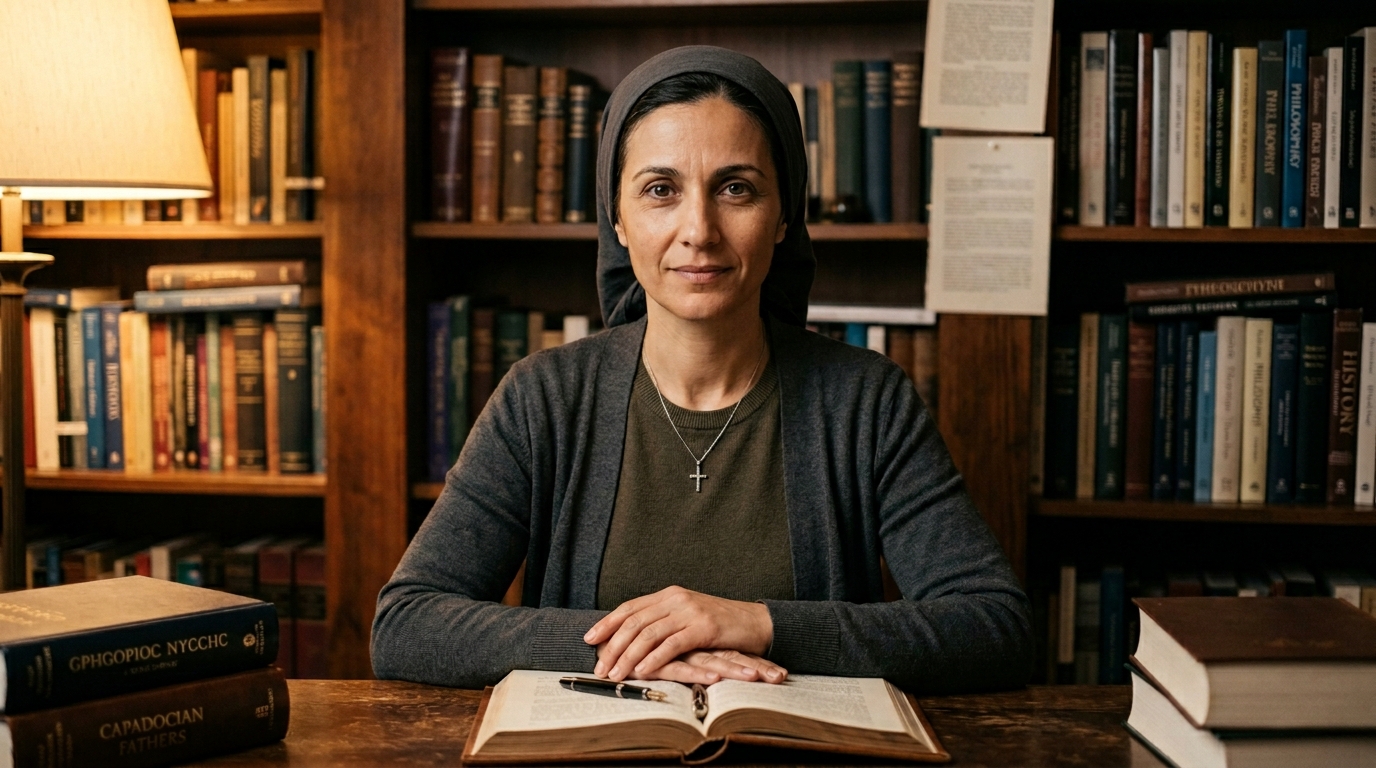
Session 8 — St. Macrina the Younger
"The Teacher" — Macrina and the Domestic Church
Opening Prayer
LEADER: Let us begin by asking the Holy Spirit to be with us tonight.
ALL: Come, Holy Spirit, fill the hearts of your faithful and kindle in us the fire of your love.
LEADER: Send forth your Spirit and we shall be created.
ALL: And you shall renew the face of the earth.
LEADER: O God, who by the light of the Holy Spirit did instruct the hearts of the faithful,
ALL: Grant that by the same Holy Spirit we may be truly wise and ever rejoice in His consolation, through Christ our Lord. Amen.
LEADER: Tonight we sit with a woman who turned a Roman estate in the mountains of Cappadocia into a school of holiness, who taught two future bishops to be saints, and whose name almost no Catholic woman alive today knows. Lord, give us her vision — let us see our own homes as You see them.
ALL: St. Macrina, pray for us. Amen.
Scripture Assignments
Assign each passage to a woman in the group before beginning.
- Passage 1: Deuteronomy 6:4-9
- Passage 2: 2 Timothy 1:1-7
- Passage 3: Titus 2:3-5
- Passage 4: Acts 18:24-26
Who Was This Woman?
Her name was Macrina, and she is called the Younger to distinguish her from her grandmother — St. Macrina the Elder, herself a saint, who had survived the persecution of the emperor Diocletian and taught the faith to her own children at a time when teaching it could cost you your life.
The Younger St. Macrina was born around the year 327 in the Roman province of Pontus, in what is today northern Turkey — on the southern shore of the Black Sea, in the highlands the Romans called Cappadocia. Her family was wealthy and Christian, of senatorial rank, with significant estates in the country. She was the oldest of ten children. Three of her brothers became bishops, and two of those three — St. Basil the Great and St. Gregory of Nyssa — are numbered today among the four great Cappadocian Fathers and among the most important theologians of the early Church. The third bishop-brother, St. Peter of Sebaste, became bishop of a small city in the same region.
You may have studied St. Basil already. In Wisdom of the Fathers Vol 1, he is the Father of the Basiliad, the great early Christian hospital and refuge for the poor outside Caesarea, and one of the founders of organized Christian monasticism in the East. St. Gregory of Nyssa is a theological giant whose Life of Moses and Commentary on the Song of Songs shaped Christian mystical theology for the next thousand years. These were not minor men.
What almost no Catholic woman in your group has ever been told is that the older sister who shaped both of them — who taught them, formed them, corrected them, called them to holiness, and was, in their own grown estimation, the most spiritually advanced member of their family — was St. Macrina.
She was betrothed as a teenager to a young man of good family. He died before the wedding. By Roman custom and her own family's expectation, she should have been remarried quickly. She refused. She declared that, because she had been betrothed to her late fiancé before God, she considered herself bound to him in something like widowhood, and would not marry another. This was, in the world of the fourth century, an audacious move for a young woman of her station. She used the refusal to consecrate her life to Christ.
She stayed in her family home, on the estate at a place called Annisa, on the Iris River. After her father's death, she organized the household into something the Christian East had never quite seen before: a community of consecrated women, living a common life of prayer, work, and study, in what had been an ordinary Roman aristocratic home. Her widowed mother joined the community. The household servants were freed and invited to live as equals with the women they had served. The estate became, in St. Gregory of Nyssa's later description, a school of philosophy — using philosophy in the ancient Christian sense, meaning the wisdom of the Gospel as a way of life.
From this household, St. Basil emerged. From this household, St. Gregory of Nyssa emerged. From this household, St. Peter of Sebaste emerged. Three bishops, two of them Doctors of the Church, and behind all three of them stood an older sister who, in St. Gregory's own words, was the teacher of our family in everything that pertains to holiness. He calls her, in his Greek, hē didaskalos — the Teacher. It is one of the only times in early Christian literature that a woman is named with that title, by a bishop, in writing, for the historical record.
She died in 379, in her early fifties. St. Gregory wrote a biography of her called The Life of Macrina, and a theological dialogue called On the Soul and the Resurrection — which we will read together next week — in which he places his sister in the role of Socrates, teaching him about the deepest mysteries of the Christian faith on her own deathbed.
That is the woman we are sitting with tonight. The one who proves, in case anyone doubted, that women have been teaching the faith inside the homes of the Church from the very beginning — and that the Church's greatest sons, more often than its written history admits, have been formed by them.
Teaching Block 1 — The Hidden Architecture of the Faith
There is a teaching the Catholic tradition has always carried, but that we have, in the last century, allowed to grow quiet. The teaching is this: the home is a Church.
Not a metaphor for a church. Not a thing that is like a church. The Catholic tradition calls the Christian home, in formal theological language, the ecclesia domestica — the domestic Church. The phrase is ancient, going back to St. John Chrysostom and others in the patristic era, and was renewed in the documents of the Second Vatican Council, which taught that the family, so to speak, is the domestic Church. It is not a recent invention. It is a recovery of what the early Church always knew.
What does it mean for a home to be a Church?
It means that, inside the four walls of a Christian household, the same Spirit that consecrates the parish sanctuary is also at work. The same baptism that makes a woman a member of the Body of Christ also makes her, in her home, a kind of priest of the daily prayer and a witness of the faith to those around her. The kitchen table is an altar. The bedside where children are tucked in is a place of blessing. The conversations at meals are a school of catechesis. The Christian home does not merely prepare people for the Church; the Christian home is the Church, in its smallest and most particular form.
This is the great teaching that runs through St. Macrina's life. She did not leave her home for a monastery. She did not flee to the desert. She did not retreat from family. She transformed her family — and the home where she lived, on the Iris River, became one of the most influential places in fourth-century Christianity precisely because she did the slow, ordinary work of making that household holy.
Hear what the Old Testament has always said about this:
Listen, O Israel: the Lord our God is one Lord. You shall love the Lord your God with all your heart, and with all your soul, and with all your strength. And these words, which I instruct to you this day, shall be in your heart. And you shall explain them to your sons. And you shall meditate upon them sitting in your house, and walking on a journey, when lying down and when rising up. And you shall bind them like a sign on your hand, and they shall be placed and shall move between your eyes. And you shall write them at the threshold and on the doors of your house.
Deuteronomy 6:4-9 — CPDV
Hear, O Israel: the Lord our God is one Lord; and you shall love the Lord your God with all your heart, and with all your soul, and with all your might. And these words which I command you this day shall be upon your heart; and you shall teach them diligently to your children, and shall talk of them when you sit in your house, and when you walk by the way, and when you lie down, and when you rise.
This is the Shema — the central prayer of Judaism, prayed every morning and evening by observant Jews for three thousand years. And notice what it commands. Not, go to the temple and teach your children there. The temple in Jerusalem was central, holy, and prescribed in the Law. But the commandment to teach the faith is not located in the temple. It is located in the home. When you sit in your house. When you walk by the way. When you lie down. When you rise.
The Old Testament economy is clear: the heart of Israel's transmission of the faith is the household. The temple is essential — it is where sacrifice is offered, where the priesthood operates, where the great feasts are kept. But the teaching of the faith, the daily formation of souls, the catechesis of the next generation — that work was always done in the home, and the woman of the home was, even before Christ, the central catechist of her children.
St. Macrina inherits this. She is a Christian, not a Jew, but the architecture is the same. The parish is essential — it is where the Eucharist is celebrated, where the priesthood operates, where the great feasts are kept. But the home is where the soul is formed, day after day, in the small and steady work of catechesis. And St. Macrina shows us, in vivid detail, what a Christian home can become when a woman accepts the dignity of that work.
There is something here that Catholic women need to hear, especially in a moment in history when so much of the broader culture treats the home as a place of lesser work — somewhere you escape from to do important things elsewhere. The Catholic tradition has never agreed. The Catholic tradition has always held that the woman who forms the souls of her children, who turns her kitchen into a school of the Gospel, who prays with her family at meals, who blesses her children at bedtime, is doing one of the most consequential works of the Church. She is building the foundation that bishops will later stand on.
Discussion Question 1: The Catholic tradition calls the Christian home the domestic Church — not a metaphor, but a real ecclesial reality. Most of us were not formed to see our homes this way. What would change in the way you order your day, your meals, your conversations, if you took seriously that the home you live in is a Church — and that you are not just a wife or a mother, but, in a real sense, its central teacher?
Teaching Block 2 — From Grandmother to Grandson — The Chain of Faith
There is a moment in St. Paul's letters where he names, with no fanfare, exactly how the faith comes down through families — and he names it as a woman's work.
Paul, an Apostle of Jesus Christ through the will of God, in accord with the promise of the life which is in Christ Jesus, to Timothy, most beloved son. Grace, mercy, peace, from God the Father and from Christ Jesus our Lord. I give thanks to God, whom I serve, as my forefathers did, with a pure conscience. For without ceasing I hold the remembrance of you in my prayers, night and day, desiring to see you, recalling your tears so as to be filled with joy, calling to mind the same faith, which is in you unfeigned, which also first dwelt in your grandmother, Lois, and in your mother, Eunice, and also, I am certain, in you. Because of this, I admonish you to revive the grace of God, which is in you by the imposition of my hands. For God has not given us a spirit of fear, but of virtue, and of love, and of self-restraint.
2 Timothy 1:1-7 — CPDV
Read it slowly. St. Paul is writing to his protégé Timothy, a young bishop he himself had trained and ordained. And in his opening, he says something striking: I am reminded of your sincere faith, a faith that dwelt first in your grandmother Lois and your mother Eunice and now, I am sure, dwells in you as well.
Stop and notice. The faith of Timothy — who would become one of the great bishops of the early Church, whose name is in the New Testament canon — came through his grandmother and his mother. Two women. Named. By St. Paul. In Scripture. Timothy's father was a Greek who, by all accounts, was not a believer. The transmission of faith to Timothy went grandmother to mother to son. St. Paul knows this and names it.
This is exactly what was happening in St. Macrina's family. The faith came down from Macrina the Elder — her grandmother, the persecution survivor — through her mother Emmelia, and then through the older daughter to her brothers. Three generations of women, holding the faith and transmitting it, until it produced three bishops and one Doctor of the Church. The chain was not accidental. It was the steady, deliberate work of women who believed that what they had received, they were responsible to pass on.
The Catholic tradition has a word for this that we should recover: Tradition, with a capital T, comes from the Latin traditio — the handing over. The faith is something handed over, person to person, generation to generation. And in the actual day-to-day mechanics of how that handing happens, women have always been central. They are the ones who teach a toddler to make the Sign of the Cross. They are the ones who say grace at the family table. They are the ones who sit at a child's bedside and answer the late-night questions about death and God and forever. They are the ones who keep the rhythms of the liturgical year inside a home — the candles of Advent, the ashes of Lent, the May altars to Our Lady, the Christmas crèche set up on the mantel.
This is not romantic. This is what was actually happening in Christian homes for two thousand years, and what kept the faith alive when persecution closed the public church or when bad bishops scandalized the faithful or when whole cultures fell into apostasy. The faith was kept in homes. By women.
There is one more text we have to read tonight, because it shows us that women teaching theology in the early Church was not a Macrina anomaly. It was apostolic practice.
Now a certain Jew named Apollo, born at Alexandria, an eloquent man who was powerful with the Scriptures, arrived at Ephesus. He was learned in the Way of the Lord. And being fervent in spirit, he was speaking and teaching the things that are of Jesus, but knowing only the baptism of John. And so, he began to act faithfully in the synagogue. And when Priscilla and Aquila had heard him, they took him aside and expounded the Way of the Lord to him more thoroughly.
Acts 18:24-26 — CPDV
Apollos was a Jewish convert to the faith, gifted, eloquent in speech and competent in the Scriptures, who had begun preaching about Jesus in the synagogue at Ephesus — but his understanding had a gap. Luke records what happens. When Priscilla and Aquila heard him, they took him aside and explained to him the way of God more accurately.
Priscilla is named first. In Greek and Latin grammar of the period, the named-first position when listing a married couple is a signal of relative significance, and St. Luke names her first not just here but in most of the references to this couple in the New Testament. Priscilla and her husband Aquila were tentmakers from Rome who had been close associates of St. Paul. And here Luke records, without apology or qualification, that Priscilla taught Apollos — corrected his theology, deepened his understanding, made him into the apostolic preacher he became.
A woman, instructing a man, in apostolic theology, in the apostolic Church. Recorded in Scripture. Without controversy.
This is the warrant — apostolic, scriptural, unimpeachable — for what St. Macrina did three centuries later in her family home on the Iris River. The Church has never said that women cannot teach the faith. The Church has said specific things about ordained sacramental priesthood that are not the same as the question of teaching. From the New Testament forward, women have taught the faith — formally, informally, in homes, in catechesis, in writing, in spiritual direction. Some of them have taught bishops. One of them taught Apollos. One of them taught St. Basil and St. Gregory of Nyssa. The witness is on the record, and it is time Catholic women learned to read it.
Discussion Question 2: St. Paul names Timothy's grandmother and mother as the women through whom the faith came down to him. Most of us can name a woman — a mother, a grandmother, a great-aunt, a teacher — whose faith shaped ours, often in small ways we did not notice at the time. Who is that woman for you? And who might you be that woman for, right now, in someone else's life?
Teaching Block 3 — The Older Woman as Spiritual Mother
There is one more text we have to sit with, because it teaches a specific Catholic vocation that we have, in our own day, almost lost.
Old women, similarly, should be in holy attire, not false accusers, not given to much wine, teaching well, so that they may teach prudence to the young women, so that they may love their husbands, love their children, be sensible, chaste, restrained, have concern for the household, be kind, be subordinate to their husbands: so that the Word of God may be not blasphemed.
Titus 2:3-5 — CPDV
St. Paul writes to St. Titus, a bishop on Crete, and gives him instructions about how to order the Christian community. And among those instructions, he addresses the role of the older women specifically: Bid the older women likewise to be reverent in behavior... they are to teach what is good, and so train the young women...
The older woman is to teach and train the younger woman. The Greek word St. Paul uses for train is sōphronizō — to bring to wisdom, to make wise, to form into soundness of mind. This is not casual mentoring. This is intentional spiritual formation, in which an older Christian woman takes responsibility for the soul of a younger Christian woman, and walks with her into maturity.
This is what St. Macrina did. The household at Annisa was, in St. Gregory's description, full of younger women who had come to live with her — some from her own family, some from the surrounding region, some former servants who had been freed and chosen to stay. St. Macrina trained them. She prayed with them. She taught them Scripture. She taught them to chant the Psalms. She taught them how to keep a Christian household. She formed them into women who, when they left her or when she died, took the formation with them and built Christian lives wherever they went.
And here is what the Catholic tradition wants you to see tonight: this vocation is not optional for the older Christian woman. It is not a hobby. It is not a thing the lucky few get to do if they happen to have the time. It is St. Paul's direct instruction to a bishop about how the Church is to be ordered. The older women are to teach and form the younger women. Without this work, the Church begins to break down generationally — the faith handed down slows, then stops, and the next generation grows up with no woman in her life who can show her how to be a Christian.
We are, frankly, in something close to that moment in the Church right now. Many young Catholic women have no older woman in their life who can teach them how to pray, how to handle the early years of marriage, how to suffer well, how to raise children in the faith, how to grieve, how to age. They have priests. They have books. They have podcasts. What they often do not have is what Apollos had — a Priscilla — and what the women of Annisa had, a Macrina. The Catholic Church has a Pauline mandate for that vocation, and the older women of our parishes have, in many cases, never been told it is theirs.
If you are an older woman in this room — and the threshold is not chronological so much as spiritual; you are older the moment there is someone in the Church who could learn from your faith — this is your charge. Find a younger woman. Walk with her. Teach her, by the things you say and the way you live, what it looks like to be Catholic across a lifetime. The faith you have been given is not yours to keep. It is yours to hand on.
If you are a younger woman in this room, this is your invitation. Find an older woman whose faith you respect, and ask her — directly, openly — will you walk with me? Will you teach me? It is not weakness to ask. It is the apostolic order of the Church. Priscilla was waiting for Apollos. St. Macrina was waiting for her sisters. Somewhere in your parish, an older woman is waiting for you to ask.
Discussion Question 3: St. Paul tells the bishop St. Titus that the older women of the Church are to teach and form the younger ones — not as an optional kindness, but as the ordinary apostolic structure of the Church. Are you on the giving end or the receiving end of this vocation right now? And if you are not connected to anyone in either direction, what one step could you take this week to begin?
This Week
Choose one specific practice that marks your home as a domestic Church. It can be very small. A blessing of your children at bedtime. A short grace before meals — not just bless us O Lord, but a few sentences spoken with attention. A candle lit at the dinner table on Sunday evening. A small icon or crucifix placed somewhere in your home where it will be seen. A holy water font by the door.
If you already have such practices, choose a new one to add — a marking of a liturgical season you have never marked before, a hymn sung at the close of one meal a week, a Scripture verse read aloud at breakfast.
And, separately: identify one woman in your life — older or younger than you — to whom the faith might be handed, in either direction. Pray for her by name this week. If the Holy Spirit gives you an opening to speak with her about the things of God, take it.
The Church does not just happen at Sunday Mass. The Church happens at your kitchen table. St. Macrina has been waiting two thousand years for the modern Catholic woman to remember it.
Closing Prayer
Gather prayer requests and close out.