Session 9
"On the Soul and the Resurrection" — Macrina the Theologian
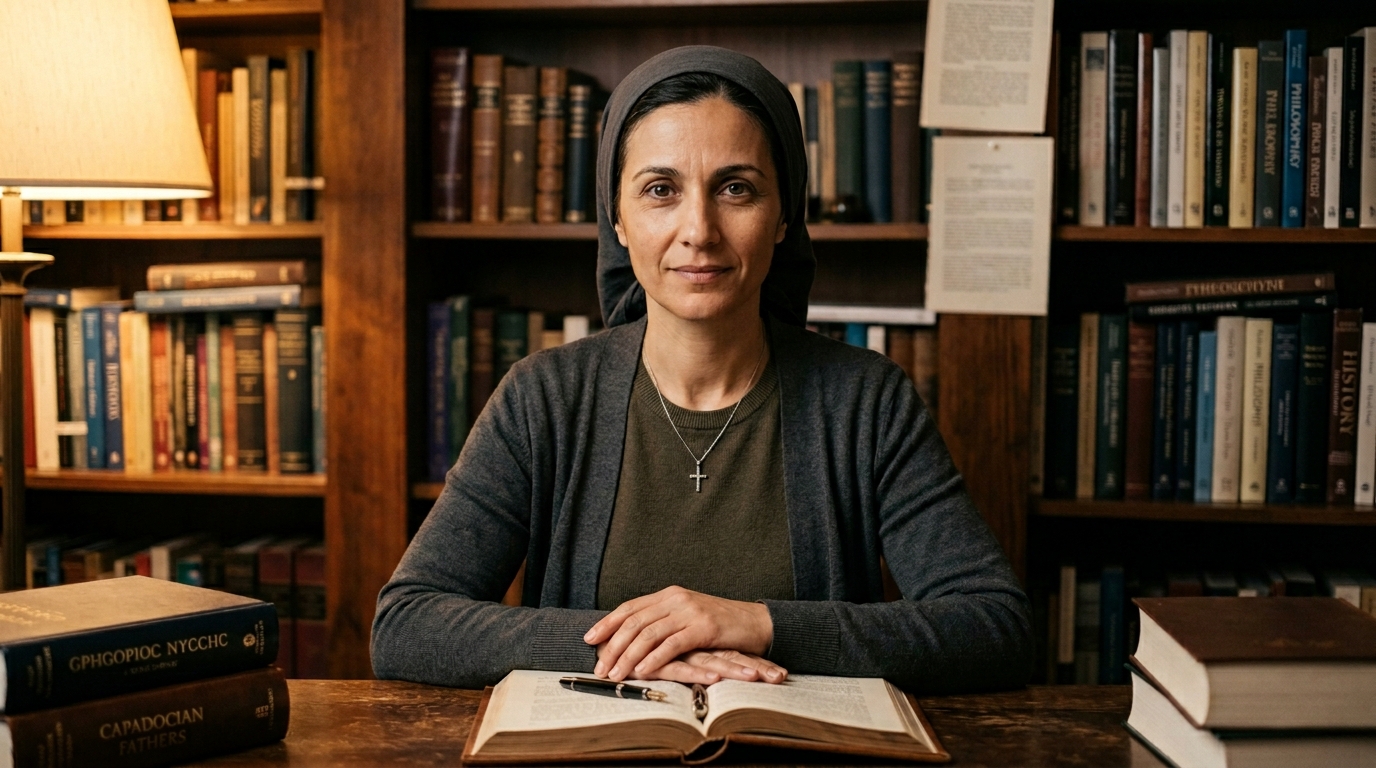
Session 9 — St. Macrina the Younger
"On the Soul and the Resurrection" — Macrina the Theologian
Opening Prayer
LEADER: Let us begin by asking the Holy Spirit to be with us tonight.
ALL: Come, Holy Spirit, fill the hearts of your faithful and kindle in us the fire of your love.
LEADER: Send forth your Spirit and we shall be created.
ALL: And you shall renew the face of the earth.
LEADER: O God, who by the light of the Holy Spirit did instruct the hearts of the faithful,
ALL: Grant that by the same Holy Spirit we may be truly wise and ever rejoice in His consolation, through Christ our Lord. Amen.
LEADER: Tonight we sit at the deathbed of a woman who, dying, spent her last hours teaching her bishop-brother about the resurrection of the body and the destiny of the human soul. Lord, give us her clarity. Give us her hope. Give us a faith that does not flinch when it stares into the unseen.
ALL: St. Macrina, pray for us. Amen.
Scripture Assignments
Assign each passage to a woman in the group before beginning.
- Passage 1: 1 Corinthians 15:35-44
- Passage 2: John 11:21-27
- Passage 3: 1 Thessalonians 4:13-18
- Passage 4: Revelation 21:1-5
Who Was This Woman?
Last week we met St. Macrina as the teacher of her family — the older sister who shaped two future Doctors of the Church inside the walls of a Roman estate. Tonight we meet her one more time, on the last day of her life, doing the deepest theological work of her career.
The setting comes to us from St. Gregory of Nyssa himself. In the year 379, St. Gregory — who was by then bishop of Nyssa, in his late forties — received word that his sister was dying. He had not seen her for some time. Their brother St. Basil had died a few months earlier, and St. Macrina herself, now in her early fifties, had fallen seriously ill at the family estate at Annisa. St. Gregory traveled across Cappadocia to be with her.
He arrived to find her in advanced sickness. A high fever. A failing body. But, as he writes in his account, her mind was untouched by the disease, and lifted up by it, as if to converse more clearly with the things above. For nearly a full day, brother and sister talked — and what they talked about, St. Gregory later wrote down, in the form of a Platonic-style dialogue called On the Soul and the Resurrection.
You should pause and feel the weight of that. The setting of this work is not academic. St. Gregory is not constructing a thought experiment. He is sitting at his sister's deathbed, and she is teaching him — in the role of the dying Socrates from Plato's Phaedo — about what is about to happen to her. What the soul is. Where it goes. What the body's separation from it means. What the resurrection of the body will be. What the renewed creation will look like. What it means, finally, that God will be all in all.
She does the teaching. He does the questioning. He is the bishop; she is the sister. He is the celebrated theologian whose name we still read fifteen hundred years later; she is the woman who never wrote a book. And yet, in St. Gregory's own account, written by his own hand, she is the master and he is the student. She has thought longer and more clearly about these questions than he has. She has prayed them into a kind of clarity he does not yet have. She is dying, and she is taking the chance to teach him one last thing before she goes.
This is the witness the Catholic tradition has carried forward of St. Macrina the Younger. Not the sister of St. Basil. Not the daughter of St. Macrina the Elder. The Teacher — and specifically, the theologian — whose dying conversation gave the Christian East one of its great works of eschatology. The Catholic Church has women theologians from the very beginning, doing real theological work, named by their brothers in writing, in the canonical historical record. Tonight we sit in on her last lecture.
Teaching Block 1 — What Happens When We Die
The Catholic tradition has always taught two things about death that have to be held together, because they explain each other.
The first is that the body dies. This sounds obvious, but the Catholic understanding of it is more specific than the common view. The Catholic teaching is not that the body is a prison the soul escapes from at death — that is a Platonic and Gnostic teaching the Church explicitly rejected, against the Manichaeans and others. The Catholic teaching is that the human person is, by God's design, body and soul together. The body is not the soul's container. The body is part of who you are. When the body dies, what happens is not the soul's liberation from an unfortunate shell. What happens is a separation — a tearing apart of two things that were meant to be one, a tearing that is itself a wound, the deepest wound the Fall introduced into creation.
The second is that the soul continues. The soul does not sleep. The soul does not dissolve. The soul does not wait in some neutral state of suspension. At the moment of death, the soul of the baptized passes immediately into the presence of God — either in the joy of the saved, the cleansing of purgatory, or, for the soul that has finally rejected God, the loss of hell. The Church calls this the particular judgment — the moment when each soul, in its individual existence, meets Christ and is shown the truth of its own life.
St. Macrina, on her deathbed, was clear about both of these truths. She was not afraid of the separation of body and soul. She had spent her life preparing for it. But she also did not collapse the Catholic hope into a Greek philosophical immortality, in which the soul was just naturally eternal and the body was unimportant. She held to the apostolic teaching that what comes next is not just the soul's continuation but, in due time, the resurrection of the body — the reuniting of the two, in a renewed form, in a new creation.
St. Paul taught this with great force.
But someone may say, "How do the dead rise again?" or, "What type of body do they return with?" How foolish! What you sow cannot be brought back to life, unless it first dies. And what you sow is not the body that will be in the future, but a bare grain, such as of wheat, or of some other grain. For God gives it a body according to his will, and according to each seed's proper body. Not all flesh is the same flesh. But one is indeed of men, another truly is of beasts, another is of birds, and another is of fish. Also, there are heavenly bodies and earthly bodies. But while the one, certainly, has the glory of heaven, the other has the glory of earth. One has the brightness of the sun, another the brightness of the moon, and another the brightness of the stars. For even star differs from star in brightness. So it is also with the resurrection of the dead. What is sown in corruption shall rise to incorruption. What is sown in dishonor shall rise to glory. What is sown in weakness shall rise to power. What is sown with an animal body shall rise with a spiritual body. If there is an animal body, there is also a spiritual one.
1 Corinthians 15:35-44 — CPDV
This passage is one of the most important in all of Christian eschatology, and the women in your group may have read it without seeing what it actually claims. St. Paul is responding to people who have asked him a real question — how are the dead raised? With what kind of body do they come? — and he answers them with an agricultural metaphor.
A seed, he says, is buried in the ground. What goes into the ground is not the same thing that comes out. What goes in is a bare grain — small, dry, apparently lifeless. What comes out is the green shoot, the stalk, the eventual flower or fruit — visibly continuous with the seed (you do not get a tomato plant from a wheat grain) but utterly transformed.
This, he says, is how it is with the resurrection of the body. What is sown is perishable, what is raised is imperishable. It is sown in dishonor, it is raised in glory. It is sown in weakness, it is raised in power. It is sown a physical body, it is raised a spiritual body. The body that goes into the grave is you — it is continuous with what comes out — but what comes out has been transformed by God into something stronger, brighter, more glorious than the body you have been carrying around your whole life. The body you are wearing right now is the seed. The body of the resurrection is the harvest.
St. Macrina taught St. Gregory this on her deathbed. She was not afraid of the seed going into the ground. She knew what came next.
Discussion Question 1: Most modern Catholics, when they think about death, picture the soul going to heaven and the body staying behind — and they treat the resurrection of the body as a distant, abstract doctrine they cannot quite make sense of. What changes in your faith if you take seriously that what awaits you is not just your soul's continuation, but the resurrection of your body — the same body you live in now, transformed and glorified? What does it mean that the body you have been given is the seed of the body of the world to come?
Teaching Block 2 — Martha at the Tomb
There is a moment in the Gospel of John where the same theology St. Macrina taught St. Gregory on her deathbed is taught by a woman to Jesus Himself — or, more precisely, where Jesus calls a woman into the deepest possible confession of resurrection faith. The woman is Martha. The setting is the death of her brother Lazarus.
And then Martha said to Jesus: "Lord, if you had been here, my brother would not have died. But even now, I know that whatever you will request from God, God will give to you." Jesus said to her, "Your brother shall rise again." Martha said to him, "I know that he shall rise again, at the resurrection on the last day." Jesus said to her: "I am the Resurrection and the Life. Whoever believes in me, even though he has died, he shall live. And everyone who lives and believes in me shall not die for eternity. Do you believe this?" She said to him: "Certainly, Lord. I have believed that you are the Christ, the Son of the living God, who has come into this world."
John 11:21-27 — CPDV
Read it slowly. Martha comes out of the house to meet Jesus on the road, four days after her brother's burial. She says the thing every grieving woman has wanted to say to God at some point in her life: Lord, if You had been here, my brother would not have died. She is honest with Him. She is hurt. She does not pretend.
And then Jesus does something striking. He does not immediately offer her comfort. He does not say I am sorry, I know this is hard. He moves her into theology. Your brother will rise again.
Martha gives the standard Jewish answer of her day. I know that he will rise again in the resurrection on the last day. She is not wrong. The Pharisees of Jesus's time believed in a general resurrection at the end of time, and Martha is reciting the orthodox teaching. But Jesus is not satisfied with the orthodox teaching. He pushes her into something deeper.
I am the resurrection and the life. He who believes in Me, though he die, yet shall he live, and whoever lives and believes in Me shall never die. Do you believe this?
This is one of the most important sentences in the New Testament, and Jesus says it to a woman in the middle of her grief. He is not just claiming that there will be a resurrection at the end of time. He is claiming that He is the resurrection. The thing Martha is waiting for is standing in front of her. The doctrine she has been holding at arm's length, waiting for the end of the world, has walked up to her house and is asking her to believe it now, in person, in her brother's case, four days into his death.
And Martha says yes. Yes, Lord; I believe that You are the Christ, the Son of God, He who is coming into the world. This is, in Catholic biblical tradition, one of the great Christological confessions of the New Testament, on a par with St. Peter's You are the Christ, the Son of the living God. And it is made by a woman, in grief, on a road, four days after a funeral.
Martha is the woman St. Macrina was sitting with, theologically, on her deathbed. Both women had been formed to know the doctrine. Both women had had the doctrine become personal — had met the resurrection as a Person, not as an idea, and been able to confess Him by name. And both women teach us, across the centuries, what Catholic eschatology actually is: not a comforting story we tell ourselves at funerals, but a confession of Christ Himself — He is the resurrection. What we await on the last day is not an event. It is a Person coming back for what is His.
Discussion Question 2: Jesus moves Martha from a polite acknowledgment of the resurrection at the end of time to the much harder confession that He Himself is the resurrection, present now, in person. Most of us have a similar instinct — we treat the resurrection as a comforting doctrine at the end of time, but we have not made the personal confession that Martha made. Where in your life is Christ asking you to make Martha's confession — to say yes, Lord, I believe — about something specific, not abstract?
Teaching Block 3 — A New Heaven and a New Earth
The resurrection of the body is not a private event. It is part of something much larger — the renewal of the whole of creation. The Catholic tradition has always held that what awaits us at the end of time is not the destruction of this world and the escape of souls to a disembodied heaven somewhere else. What awaits us is the renewal of all things — a new heaven and a new earth, in which the redeemed live, body and soul, in the presence of God forever.
St. Paul taught this. St. John saw it in his vision on Patmos.
And we do not want you to be ignorant, brothers, concerning those who are sleeping, so as not to be sorrowful, like these others who do not have hope. For if we believe that Jesus has died and risen again, so also will God bring back with Jesus those who sleep in him. For we say this to you, in the Word of the Lord: that we who are alive, who remain until the return of the Lord, will not precede those who have fallen asleep. For the Lord himself, with a command and with the voice of an Archangel and with a trumpet of God, shall descend from heaven. And the dead, who are in Christ, shall rise up first. Next, we who are alive, who are remaining, shall be taken up quickly together with them into the clouds to meet Christ in the air. And in this way, we shall be with the Lord always. Therefore, console one another with these words.
1 Thessalonians 4:13-18 — CPDV
St. Paul is comforting the Thessalonians, some of whose loved ones have died. We would not have you ignorant, brethren, concerning those who are asleep, that you may not grieve as others do who have no hope. Notice the precision. He does not say do not grieve. Christians grieve. Christians weep at funerals. Christians carry the wounds of loss across decades. But Christians do not grieve as others do who have no hope. The grief has a different shape because it is bounded by what is coming.
The Lord Himself will descend from heaven with a cry of command, with the archangel's call, and with the sound of the trumpet of God. And the dead in Christ will rise first; then we who are alive, who are left, shall be caught up together with them in the clouds to meet the Lord in the air; and so we shall always be with the Lord.
This is not poetic vagueness. This is a specific Christian claim about what will happen at the end of time. Christ will return — in person, visibly, as Lord — and at His coming, the dead in Christ will rise, the living who belong to Him will be transformed, and the entire community of the redeemed will be united with Him forever. The Catholic Church confesses this every Sunday in the Creed: He will come again in glory to judge the living and the dead, and His kingdom will have no end. It is not a metaphor. It is the central Christian claim about the future of the world.
And St. John, on the island of Patmos, saw the end of it.
I saw the new heaven and the new earth. For the first heaven and the first earth passed away, and the sea is no more. And I, John, saw the Holy City, the New Jerusalem, descending out of heaven from God, prepared like a bride adorned for her husband. And I heard a great voice from the throne, saying: "Behold the tabernacle of God with men. And he will dwell with them, and they will be his people. And God himself will be their God with them. And God will wipe away every tear from their eyes. And death shall be no more. And neither mourning, nor crying out, nor grief shall be anymore. For the first things have passed away." And the One who was sitting upon the throne, said, "Behold, I make all things new." And he said to me, "Write, for these words are entirely faithful and true."
Revelation 21:1-5 — CPDV
Read this passage slowly, because it may be the most beautiful sentence in the New Testament. Behold, the dwelling of God is with men. He will dwell with them, and they shall be His people, and God Himself will be with them; He will wipe away every tear from their eyes, and death shall be no more, neither shall there be mourning nor crying nor pain any more, for the former things have passed away.
This is what awaits. Not a disembodied paradise of harps and clouds. The dwelling of God with men. God Himself, present with His people, in a new creation — a renewed earth, a new heavens, in which the wounds of the old world are healed and the tears of every generation are personally wiped away by the hand of God. The body is not abandoned. The earth is not abandoned. Everything good in this world is taken up, transformed, and made new. Behold, I make all things new.
St. Macrina taught this to her brother on the day she died. She did not flinch when she described it. She knew, by then, that the body she was leaving behind was a seed — and that the harvest was coming. She knew that the world she had served in for fifty years was, in some real way, the early form of the world that was about to be revealed. She knew that the brother sitting beside her, taking notes, would also one day cross over and find her there.
There is something the Catholic tradition wants you to feel tonight, and it is hard to put in words, but St. Macrina felt it and St. Gregory felt it and St. John felt it on Patmos. What is coming is unspeakably good. Not just acceptable. Not just bearable. Good — in a way no Catholic woman in this room has yet experienced, because no one in this room has yet had every tear wiped from her eyes by the literal hand of God. That is what is coming. That is what we are walking toward, every day, every Mass, every act of love, every breath. And every Catholic woman in this room will, by the grace of God, see it.
Discussion Question 3: St. John tells us that in the new creation, God Himself will wipe away every tear from their eyes. Each woman in this room is carrying tears — some shed, some still held in. What would it mean to know, concretely, that there is a day coming when God Himself, with His own hand, will dry the specific tears you have wept in this life? Have you let that hope shape the way you carry your sorrows, or have you been carrying them as though there is no future for them but loss?
This Week
Read 1 Corinthians 15 in its entirety — slowly, prayerfully, in one sitting. It is the longest sustained teaching on the resurrection in all of Scripture, and St. Macrina knew it nearly by heart. Most Catholic women have never read the whole chapter at once.
Then, sometime this week, sit with one specific grief you have been carrying — a death, a loss, a hope that did not come true — and bring it to your prayer in the light of what you have read. Tell Christ: I am bringing You this tear, and I am asking You to hold it for me until the day You will wipe it away Yourself. And then trust Him to do it.
St. Macrina spent her last hours teaching her brother what awaits the soul that loves Christ. The doctrine she taught is the same doctrine the Church teaches you. The hope she had is the hope the Church offers you. Walk in it this week.
Closing Prayer
Gather prayer requests and close out.